



 Chat with AI
Exam 54: Biodiversity and Conservation Biology

Exam 1: Biology and the Tree of Life35 Questions
Exam 2: Water and Carbon: the Chemical Basis of Life53 Questions
Exam 3: Protein Structure and Function40 Questions
Exam 4: Nucleic Acids and the Rna World40 Questions
Exam 5: An Introduction to Carbohydrates42 Questions
Exam 6: Lipids, Membranes, and the First Cells53 Questions
Exam 7: Inside the Cell41 Questions
Exam 8: Energy and Enzymes59 Questions
Exam 9: Cellular Respiration and Fermentation43 Questions
Exam 10: Photosynthesis41 Questions
Exam 11: Cellcell Interactions38 Questions
Exam 12: The Cell Cycle39 Questions
Exam 13: Meiosis40 Questions
Exam 14: Mendel and the Gene47 Questions
Exam 15: Dna and the Gene: Synthesis and Repair39 Questions
Exam 16: How Genes Work39 Questions
Exam 17: Transcription, Rna Processing, and Translation37 Questions
Exam 18: Control of Gene Expression in Bacteria38 Questions
Exam 19: Control of Gene Expression in Eukaryotes40 Questions
Exam 20: The Molecular Revolution: Biotechnology and Beyond39 Questions
Exam 21: Gene Structure and Development39 Questions
Exam 22: Evolution by Natural Selection42 Questions
Exam 23: Evolutionary Processes48 Questions
Exam 24: Speciation40 Questions
Exam 25: Phylogenies and the History of Life37 Questions
Exam 26: Bacteria and Archaea38 Questions
Exam 27: Protists36 Questions
Exam 28: Green Algae and Land Plants54 Questions
Exam 29: Fungi40 Questions
Exam 30: An Introduction to Animals42 Questions
Exam 31: Protostome Animals38 Questions
Exam 32: Deuterostome Animals43 Questions
Exam 33: Viruses35 Questions
Exam 34: Plant Form and Function39 Questions
Exam 35: Water and Sugar Transport in Plants42 Questions
Exam 36: Plant Nutrition37 Questions
Exam 37: Plant Sensory Systems, Signals, and Responses64 Questions
Exam 38: Plant Reproduction and Development44 Questions
Exam 39: Animal Form and Function37 Questions
Exam 40: Water and Electrolyte Balance in Animals41 Questions
Exam 41: Animal Nutrition43 Questions
Exam 42: Gas Exchange and Circulation46 Questions
Exam 43: Animal Nervous Systems40 Questions
Exam 44: Animal Sensory Systems43 Questions
Exam 45: Animal Movement42 Questions
Exam 46: Chemical Signals in Animals38 Questions
Exam 47: Animal Reproduction and Development39 Questions
Exam 48: The Immune System in Animals38 Questions
Exam 49: An Introduction to Ecology40 Questions
Exam 50: Behavioural Ecology39 Questions
Exam 51: Population Ecology49 Questions
Exam 52: Community Ecology38 Questions
Exam 53: Ecosystems and Global Ecology41 Questions
Exam 54: Biodiversity and Conservation Biology38 Questions
Select questions type


Which of the following have an impact on decisions about humans mitigating the extinctions and damages to ec services?
I. moral issues
II. economic problems
III. biological problems

Free
(Multiple Choice)
5.0/5  (67)
(67) Correct Answer: Verified
C
During the inventory of bacterial genes present in the Sargasso Sea in the middle of the Atlantic Ocean, a research team concluded that at least 1800 bacterial species were discovered. Based on what you know about this area, what would you expect to see in coral reef waters?
Free
(Multiple Choice)
4.8/5 (70)
(70) Correct Answer:Verified
VerifiedC
In a debate about the destruction of tropical wet forests, the arguments keep focussing on biodiversity and how this affects the animals themselves, as well as the ecosystem. What is one direct benefit of biodiversity to humans that you can argue to help people understand why these forests need to be preserved?
Free
(Multiple Choice)
4.9/5 (81)
(81) Correct Answer:Verified
VerifiedD
Which of the following statements regarding species diversity is FALSE?
(Multiple Choice)
5.0/5 (82)
(82)  Figure 54.2
-Based on Figure 54.2, what snake antivenom would you administer to a person bitten by a king brown snake?
Figure 54.2
-Based on Figure 54.2, what snake antivenom would you administer to a person bitten by a king brown snake? (Multiple Choice)
5.0/5 (67)
(67) How can biodiversity affect the way we decontaminate industrial sites?
(Multiple Choice)
4.8/5 (95)
(95) 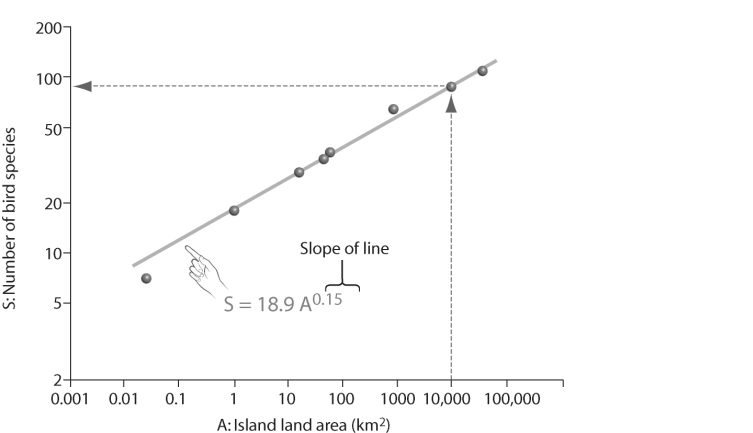 Figure 54.7
-Based on the species- area plot in the figure above, if habitable area on an island were reduced from 10,000 km2 to 1,000 km2, roughly what percentage of the species would disappear?
Figure 54.7
-Based on the species- area plot in the figure above, if habitable area on an island were reduced from 10,000 km2 to 1,000 km2, roughly what percentage of the species would disappear? (Multiple Choice)
5.0/5 (90)
(90) 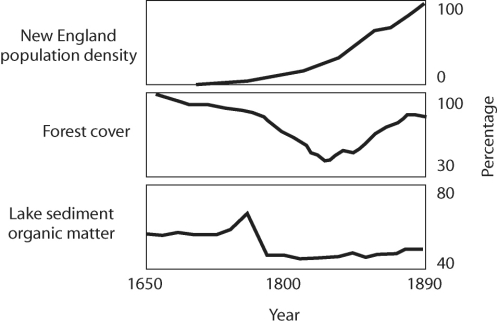 Figure 54.9
-Based on Figure 54.9, what can you conclude about land- use legacy in New England?
Figure 54.9
-Based on Figure 54.9, what can you conclude about land- use legacy in New England? (Multiple Choice)
4.9/5 (82)
(82) 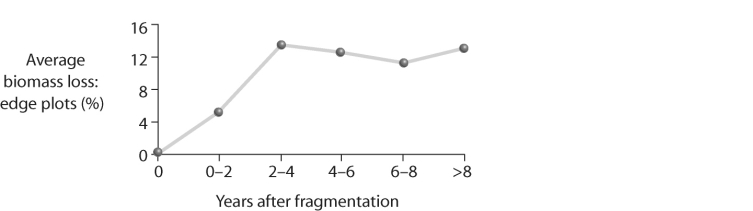 Figure 54.6
-In looking at the figure above, what can be said about edge effects?
Figure 54.6
-In looking at the figure above, what can be said about edge effects? (Multiple Choice)
4.8/5 (92)
(92) Researchers have been studying a rare population of 87 voles in an isolated area. Ten voles from a larger population were added to this isolated population. Besides having 10 additional animals, what benefits are there to importing individuals?
(Multiple Choice)
5.0/5 (70)
(70) According to the figure above, what is the least likely explanation for the data after 1985?
(Multiple Choice)
4.8/5 (78)
(78) If the last remaining population of a particular bird species were all highly related, which type of diversity would be of greatest concern when planning to keep the species from going extinct?
(Multiple Choice)
4.9/5 (81)
(81) Figure 54.7
-In looking at the species- area plot in the figure above, what can be concluded?
Figure 54.7
-In looking at the species- area plot in the figure above, what can be concluded? (Multiple Choice)
4.7/5 (91)
(91) Which one of the following is likely not a hotspot for birds?
(Multiple Choice)
4.9/5 (95)
(95) Use the following information when answering the corresponding questions).
Abstract:
Recognition of the importance of land- use legacies in most ecological systems has been a major factor driving the recent focus on human activity as a legitimate and essential subject of environmental science. Ecologists, conservationists, and natural resource policy makers now recognize that the legacies of land- use activities continue to influence ecosystem structure and function for decades or centuries-or even longer-after those activities have ceased. 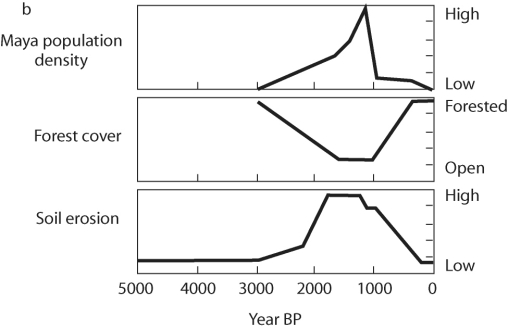 Figure 54.8
-Based on the figure above, what can you conclude about land- use legacy in the southern Yucatán?
Figure 54.8
-Based on the figure above, what can you conclude about land- use legacy in the southern Yucatán? (Multiple Choice)
4.8/5 (78)
(78) Ecosystems services include processes that increase the quality of the abiotic environment. Which of the following processes would not fall under this category?
(Multiple Choice)
4.8/5 (89)
(89) 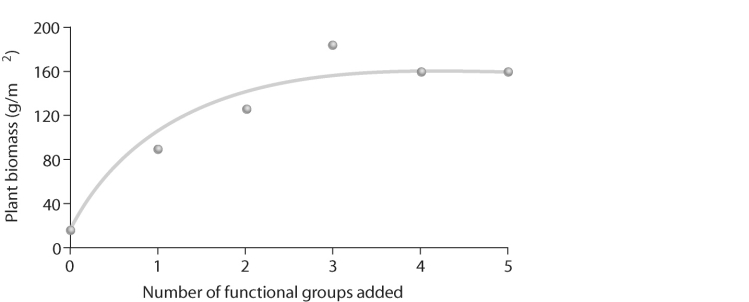 Figure 54.4
-Hypothesis: Productivity increases with species richness because certain species or functional groups facilitate the growth of other species by providing them with nutrients, partial shade, or other benefits. In looking at the data in Figure 54.4, how would you relate it to this hypothesis?
Figure 54.4
-Hypothesis: Productivity increases with species richness because certain species or functional groups facilitate the growth of other species by providing them with nutrients, partial shade, or other benefits. In looking at the data in Figure 54.4, how would you relate it to this hypothesis? (Multiple Choice)
4.9/5 (75)
(75) You discover, in your massive 2000- hectare forest, a species of bat that is not found anywhere else. The habitat of your bat population is designated as a protected area. What, if any, would be an advantage of removing a small number of bats and placing them in a zoo?
(Multiple Choice)
4.9/5 (74)
(74) 
Filters
- Essay(0)
- Multiple Choice(0)
- Short Answer(0)
- True False(0)
- Matching(0)