



 Chat with AI
Exam 54: Biodiversity and Conservation Biology

Exam 1: Biology and the Tree of Life35 Questions
Exam 2: Water and Carbon: the Chemical Basis of Life53 Questions
Exam 3: Protein Structure and Function40 Questions
Exam 4: Nucleic Acids and the Rna World40 Questions
Exam 5: An Introduction to Carbohydrates42 Questions
Exam 6: Lipids, Membranes, and the First Cells53 Questions
Exam 7: Inside the Cell41 Questions
Exam 8: Energy and Enzymes59 Questions
Exam 9: Cellular Respiration and Fermentation43 Questions
Exam 10: Photosynthesis41 Questions
Exam 11: Cellcell Interactions38 Questions
Exam 12: The Cell Cycle39 Questions
Exam 13: Meiosis40 Questions
Exam 14: Mendel and the Gene47 Questions
Exam 15: Dna and the Gene: Synthesis and Repair39 Questions
Exam 16: How Genes Work39 Questions
Exam 17: Transcription, Rna Processing, and Translation37 Questions
Exam 18: Control of Gene Expression in Bacteria38 Questions
Exam 19: Control of Gene Expression in Eukaryotes40 Questions
Exam 20: The Molecular Revolution: Biotechnology and Beyond39 Questions
Exam 21: Gene Structure and Development39 Questions
Exam 22: Evolution by Natural Selection42 Questions
Exam 23: Evolutionary Processes48 Questions
Exam 24: Speciation40 Questions
Exam 25: Phylogenies and the History of Life37 Questions
Exam 26: Bacteria and Archaea38 Questions
Exam 27: Protists36 Questions
Exam 28: Green Algae and Land Plants54 Questions
Exam 29: Fungi40 Questions
Exam 30: An Introduction to Animals42 Questions
Exam 31: Protostome Animals38 Questions
Exam 32: Deuterostome Animals43 Questions
Exam 33: Viruses35 Questions
Exam 34: Plant Form and Function39 Questions
Exam 35: Water and Sugar Transport in Plants42 Questions
Exam 36: Plant Nutrition37 Questions
Exam 37: Plant Sensory Systems, Signals, and Responses64 Questions
Exam 38: Plant Reproduction and Development44 Questions
Exam 39: Animal Form and Function37 Questions
Exam 40: Water and Electrolyte Balance in Animals41 Questions
Exam 41: Animal Nutrition43 Questions
Exam 42: Gas Exchange and Circulation46 Questions
Exam 43: Animal Nervous Systems40 Questions
Exam 44: Animal Sensory Systems43 Questions
Exam 45: Animal Movement42 Questions
Exam 46: Chemical Signals in Animals38 Questions
Exam 47: Animal Reproduction and Development39 Questions
Exam 48: The Immune System in Animals38 Questions
Exam 49: An Introduction to Ecology40 Questions
Exam 50: Behavioural Ecology39 Questions
Exam 51: Population Ecology49 Questions
Exam 52: Community Ecology38 Questions
Exam 53: Ecosystems and Global Ecology41 Questions
Exam 54: Biodiversity and Conservation Biology38 Questions
Select questions type


Approximately how many species have we described out of the species alive today?
(Multiple Choice)
4.9/5  (85)
(85) 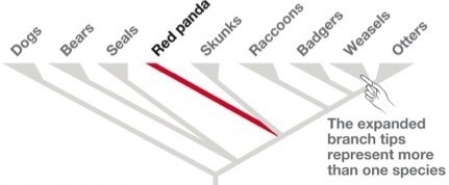 Figure 54.1
Dogs ~43 Bears ~19 Seals ~36
Red Panda ~1 Skunks ~13 Raccoons ~15 Badgers ~10 Weasels ~38 Otters ~8
-According to the figure above, which of the following groups is particularly important to preserve?
Figure 54.1
Dogs ~43 Bears ~19 Seals ~36
Red Panda ~1 Skunks ~13 Raccoons ~15 Badgers ~10 Weasels ~38 Otters ~8
-According to the figure above, which of the following groups is particularly important to preserve? (Multiple Choice)
4.9/5 (80)
(80) Which of the following is the true statement regarding species diversity and taxonomic diversity?
(Multiple Choice)
4.8/5 (77)
(77)  Figure 54.2
-Based on how you would go about measuring biodiversity, which of the following is true?
Figure 54.2
-Based on how you would go about measuring biodiversity, which of the following is true? (Multiple Choice)
4.7/5 (93)
(93) Environmental sequencing has brought to light what crucial finding?
(Multiple Choice)
4.9/5 (78)
(78) Figure 54.1
Dogs ~43 Bears ~19 Seals ~36
Red Panda ~1 Skunks ~13 Raccoons ~15 Badgers ~10 Weasels ~38 Otters ~8
-Why is it important to preserve the tuataras see Figure 54.1)?
Figure 54.1
Dogs ~43 Bears ~19 Seals ~36
Red Panda ~1 Skunks ~13 Raccoons ~15 Badgers ~10 Weasels ~38 Otters ~8
-Why is it important to preserve the tuataras see Figure 54.1)? (Multiple Choice)
4.9/5 (79)
(79) 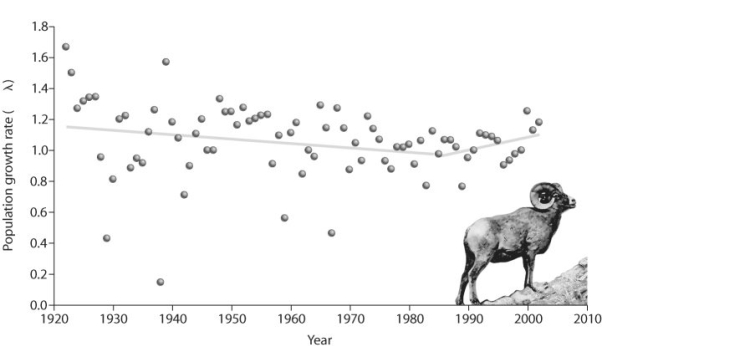 Figure 54.5
-According to the figure above, what is occurring after 1985?
Figure 54.5
-According to the figure above, what is occurring after 1985? (Multiple Choice)
4.9/5 (94)
(94) Figure 54.2
-By knowing the interrelatedness of various snake species, the type of antivenom can be chosen depending on the species involved in the bite. Based on Figure 54.2, which snake antivenom would you administer to a person bitten by an Australian copperhead?
Figure 54.2
-By knowing the interrelatedness of various snake species, the type of antivenom can be chosen depending on the species involved in the bite. Based on Figure 54.2, which snake antivenom would you administer to a person bitten by an Australian copperhead? (Multiple Choice)
4.8/5 (83)
(83) Which of the following is a cultural service of ecosystems?
(Multiple Choice)
4.9/5 (72)
(72) 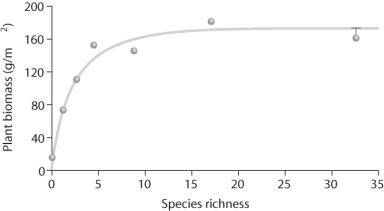 Figure 54.3
-Upon looking at Figure 54.3 regarding Tilman's experiments, what can you conclude about the data?
Figure 54.3
-Upon looking at Figure 54.3 regarding Tilman's experiments, what can you conclude about the data? (Multiple Choice)
4.9/5 (87)
(87) A land developer is arguing with a group of ecologists. Of course the land developer wants the most land possible for building houses, but has to compromise by saving some land for animal habitat. The land developer offers 20 hectares in evenly distributed but isolated 1- hectare portions. The ecologists keep arguing for one 20 hectare area to remain intact. Why are the ecologists making this proposal?
(Multiple Choice)
4.7/5 (82)
(82) While travelling in the Alps, you come across a butterfly that you cannot identify. You quickly find out that it is a new species. Which of the following is NOT a step in understanding the biodiversity of this new species?
(Multiple Choice)
4.7/5 (70)
(70) With regard to the destruction of tropical forests, the focus is often on biodiversity and the impact on these ecosystems. What is a direct compelling benefit to humans that helps explain why these forests need to be preserved?
(Multiple Choice)
4.7/5 (83)
(83) Erwin and Scott used an insecticidal fog to knock down insects from the top of a L. seemannii tree. The researchers identified over 900 species of beetles among the individuals that fell. Erwin also projected that this entire tree is host to about 600 specialist arthropods. There are approximately 50,000 species of tropical trees. Although it could not be entirely accurate, what would be the best way to estimate the total number of arthropod species?
(Multiple Choice)
4.9/5 (82)
(82) During the inventory of bacterial genes present in the Sargasso Sea, a research team concluded that at least 1800 bacterial species were discovered. Based on what you know about this area, what would expect to see in coral reef waters?
(Multiple Choice)
4.7/5 (81)
(81) Which of the following statements regarding extinction is FALSE?
(Multiple Choice)
4.8/5 (77)
(77) What is true concerning the high consumption of fossil fuels?
(Multiple Choice)
4.8/5 (67)
(67) Philippe Bouchet and colleagues conducted a massive survey of marine molluscs on the west coast of New Caledonia. Twenty percent of the species found were represented by a single specimen. What does that suggest about the diversity of molluscs in this area?
(Multiple Choice)
4.8/5 (77)
(77) 
Filters
- Essay(0)
- Multiple Choice(0)
- Short Answer(0)
- True False(0)
- Matching(0)