



 Chat with AI
Exam 41: Animal Nutrition

Exam 1: Biology and the Tree of Life35 Questions
Exam 2: Water and Carbon: the Chemical Basis of Life53 Questions
Exam 3: Protein Structure and Function40 Questions
Exam 4: Nucleic Acids and the Rna World40 Questions
Exam 5: An Introduction to Carbohydrates42 Questions
Exam 6: Lipids, Membranes, and the First Cells53 Questions
Exam 7: Inside the Cell41 Questions
Exam 8: Energy and Enzymes59 Questions
Exam 9: Cellular Respiration and Fermentation43 Questions
Exam 10: Photosynthesis41 Questions
Exam 11: Cellcell Interactions38 Questions
Exam 12: The Cell Cycle39 Questions
Exam 13: Meiosis40 Questions
Exam 14: Mendel and the Gene47 Questions
Exam 15: Dna and the Gene: Synthesis and Repair39 Questions
Exam 16: How Genes Work39 Questions
Exam 17: Transcription, Rna Processing, and Translation37 Questions
Exam 18: Control of Gene Expression in Bacteria38 Questions
Exam 19: Control of Gene Expression in Eukaryotes40 Questions
Exam 20: The Molecular Revolution: Biotechnology and Beyond39 Questions
Exam 21: Gene Structure and Development39 Questions
Exam 22: Evolution by Natural Selection42 Questions
Exam 23: Evolutionary Processes48 Questions
Exam 24: Speciation40 Questions
Exam 25: Phylogenies and the History of Life37 Questions
Exam 26: Bacteria and Archaea38 Questions
Exam 27: Protists36 Questions
Exam 28: Green Algae and Land Plants54 Questions
Exam 29: Fungi40 Questions
Exam 30: An Introduction to Animals42 Questions
Exam 31: Protostome Animals38 Questions
Exam 32: Deuterostome Animals43 Questions
Exam 33: Viruses35 Questions
Exam 34: Plant Form and Function39 Questions
Exam 35: Water and Sugar Transport in Plants42 Questions
Exam 36: Plant Nutrition37 Questions
Exam 37: Plant Sensory Systems, Signals, and Responses64 Questions
Exam 38: Plant Reproduction and Development44 Questions
Exam 39: Animal Form and Function37 Questions
Exam 40: Water and Electrolyte Balance in Animals41 Questions
Exam 41: Animal Nutrition43 Questions
Exam 42: Gas Exchange and Circulation46 Questions
Exam 43: Animal Nervous Systems40 Questions
Exam 44: Animal Sensory Systems43 Questions
Exam 45: Animal Movement42 Questions
Exam 46: Chemical Signals in Animals38 Questions
Exam 47: Animal Reproduction and Development39 Questions
Exam 48: The Immune System in Animals38 Questions
Exam 49: An Introduction to Ecology40 Questions
Exam 50: Behavioural Ecology39 Questions
Exam 51: Population Ecology49 Questions
Exam 52: Community Ecology38 Questions
Exam 53: Ecosystems and Global Ecology41 Questions
Exam 54: Biodiversity and Conservation Biology38 Questions
Select questions type


Fangs, like those found in wolves, are designed to

Free
(Multiple Choice)
4.8/5  (78)
(78) Correct Answer: Verified
D
If you found a vertebrate skull in the woods and the teeth were sharp and scissor- like, what type of food would you expect this animal to eat?
Free
(Multiple Choice)
4.9/5 (80)
(80) Correct Answer:Verified
VerifiedD
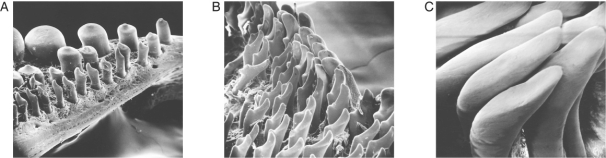 Figure 41.2
-Refer to Figure 41.2. Which of the mouthparts shown in the figure above are specialized for crushing and grinding?
Figure 41.2
-Refer to Figure 41.2. Which of the mouthparts shown in the figure above are specialized for crushing and grinding? (Short Answer)
4.8/5 (90)
(90) Which of the following molecules are absorbed from the lumen of the small intestine into epithelial cells through simple diffusion?
(Multiple Choice)
4.8/5 (76)
(76) Refer to the following nutrition label for the corresponding questions). Apple juice has the following nutrition label: Contains 100% Juice
\begin{array}{|llcc|} \hline \text { Nutrition Facts Serving Size 8 } \\\hline \text { oz (240 ml) Servings Per } \\\hline \text {Container 8 }\\\hline \\\\\hline\text { Amount Per Serving} \\\hline\text { Calories 120} \\\hline\text { RDA} \\\hline\text { Total Fat 0 \mathrm{~g} 0 \% } \\\hline \text { Sodium \( 10 \mathrm{mg} 0 \% \)} \\\hline \text { Potassium \( 240 \mathrm{mg} 6 \% \) }\\\hline\text { Total Carbohydrate \( 29 \mathrm{~g} 10 \% \)} \\\hline \text { Sugars \( 28 \mathrm{~g} \)} \\\hline\text { Protein \( 0 \mathrm{~g} \) }\\\hline\text { Vitamin A \( 0 \% \)} \\\hline\text { Vitamin C \( 20 \% \) }\\\hline \text { Calcium \( 2 \% \) }\\\hline \text { Iron \( 6 \% \) }\\ \hline \text {Not a significant source of } \\ \text {other nutrients }\\\hline \end{array}
\begin{array}{|llcc|} \hline \text { Nutrition Facts Serving Size 8 } \\\hline \text { oz (240 ml) Servings Per } \\\hline \text {Container 8 }\\\hline \\\\\hline\text { Amount Per Serving} \\\hline\text { Calories 120} \\\hline\text { RDA} \\\hline\text { Total Fat 0 \mathrm{~g} 0 \% } \\\hline \text { Sodium \( 10 \mathrm{mg} 0 \% \)} \\\hline \text { Potassium \( 240 \mathrm{mg} 6 \% \) }\\\hline\text { Total Carbohydrate \( 29 \mathrm{~g} 10 \% \)} \\\hline \text { Sugars \( 28 \mathrm{~g} \)} \\\hline\text { Protein \( 0 \mathrm{~g} \) }\\\hline\text { Vitamin A \( 0 \% \)} \\\hline\text { Vitamin C \( 20 \% \) }\\\hline \text { Calcium \( 2 \% \) }\\\hline \text { Iron \( 6 \% \) }\\ \hline \text {Not a significant source of } \\ \text {other nutrients }\\\hline \text {RDA is based on a 2000 }\\ \text {calorie diet}\\\hline \end{array}
-From the information contained on the label above, you can infer that apple juice is a good source of which of the following?
(Multiple Choice)
4.9/5 (81)
(81) 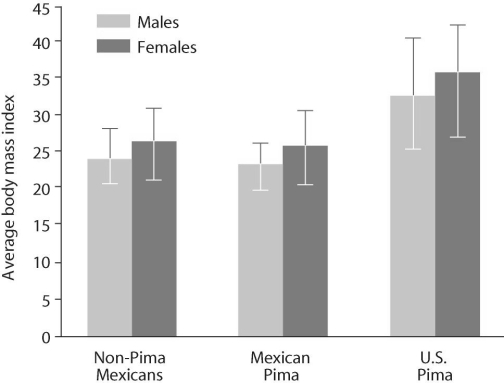 Figure 41.3
-Based on the graph in the Figure 41.3, what can you infer about the incidence of type II diabetes mellitus?
Figure 41.3
-Based on the graph in the Figure 41.3, what can you infer about the incidence of type II diabetes mellitus? (Multiple Choice)
4.8/5 (87)
(87) Glucose is transported from the intestinal lumen into epithelial cells through and from the intestinal epithelium into circulation by .
(Multiple Choice)
4.7/5 (63)
(63) What can the mouthparts of an animal tell you about its diet?
(Multiple Choice)
4.9/5 (79)
(79) The stomach is highly acidic, creating a hostile environment for invading bacteria. Another function of the acidic environment is to activate the enzyme that initiates protein digestion in the stomach. What proteolytic enzyme is activated by the acidic environment?
(Multiple Choice)
4.9/5 (76)
(76) If you chew a salted cracker long enough, it begins to taste sweet. Why?
(Multiple Choice)
4.7/5 (87)
(87) What is the importance of the mucins that are released by salivary glands?
(Multiple Choice)
4.8/5 (90)
(90) If there is a strong genetic link for type II diabetes mellitus in your family, how might you minimize your risk of developing the disorder?
(Multiple Choice)
4.8/5 (91)
(91) Following a meal high in starch, digestive processes break the starch into , which when absorbed into circulation cause a release of the hormone _ .
(Multiple Choice)
4.8/5 (81)
(81) What are the molar teeth of herbivorous mammals especially effective at?
(Multiple Choice)
4.8/5 (71)
(71) Cholecystokinin CCK) stimulates the release of numerous digestive enzymes. Which of the following digestive enzymes is NOT released by CCK?
(Multiple Choice)
4.9/5 (82)
(82) How many food calories does the jug of apple juice contain?
(Multiple Choice)
4.7/5 (87)
(87) What should individuals who have their gallbladders removed reduce their consumption of?
(Multiple Choice)
4.9/5 (71)
(71) 
Filters
- Essay(0)
- Multiple Choice(0)
- Short Answer(0)
- True False(0)
- Matching(0)