



 Chat with AI
Exam 14: Mendel and the Gene

Exam 1: Biology and the Tree of Life35 Questions
Exam 2: Water and Carbon: the Chemical Basis of Life53 Questions
Exam 3: Protein Structure and Function40 Questions
Exam 4: Nucleic Acids and the Rna World40 Questions
Exam 5: An Introduction to Carbohydrates42 Questions
Exam 6: Lipids, Membranes, and the First Cells53 Questions
Exam 7: Inside the Cell41 Questions
Exam 8: Energy and Enzymes59 Questions
Exam 9: Cellular Respiration and Fermentation43 Questions
Exam 10: Photosynthesis41 Questions
Exam 11: Cellcell Interactions38 Questions
Exam 12: The Cell Cycle39 Questions
Exam 13: Meiosis40 Questions
Exam 14: Mendel and the Gene47 Questions
Exam 15: Dna and the Gene: Synthesis and Repair39 Questions
Exam 16: How Genes Work39 Questions
Exam 17: Transcription, Rna Processing, and Translation37 Questions
Exam 18: Control of Gene Expression in Bacteria38 Questions
Exam 19: Control of Gene Expression in Eukaryotes40 Questions
Exam 20: The Molecular Revolution: Biotechnology and Beyond39 Questions
Exam 21: Gene Structure and Development39 Questions
Exam 22: Evolution by Natural Selection42 Questions
Exam 23: Evolutionary Processes48 Questions
Exam 24: Speciation40 Questions
Exam 25: Phylogenies and the History of Life37 Questions
Exam 26: Bacteria and Archaea38 Questions
Exam 27: Protists36 Questions
Exam 28: Green Algae and Land Plants54 Questions
Exam 29: Fungi40 Questions
Exam 30: An Introduction to Animals42 Questions
Exam 31: Protostome Animals38 Questions
Exam 32: Deuterostome Animals43 Questions
Exam 33: Viruses35 Questions
Exam 34: Plant Form and Function39 Questions
Exam 35: Water and Sugar Transport in Plants42 Questions
Exam 36: Plant Nutrition37 Questions
Exam 37: Plant Sensory Systems, Signals, and Responses64 Questions
Exam 38: Plant Reproduction and Development44 Questions
Exam 39: Animal Form and Function37 Questions
Exam 40: Water and Electrolyte Balance in Animals41 Questions
Exam 41: Animal Nutrition43 Questions
Exam 42: Gas Exchange and Circulation46 Questions
Exam 43: Animal Nervous Systems40 Questions
Exam 44: Animal Sensory Systems43 Questions
Exam 45: Animal Movement42 Questions
Exam 46: Chemical Signals in Animals38 Questions
Exam 47: Animal Reproduction and Development39 Questions
Exam 48: The Immune System in Animals38 Questions
Exam 49: An Introduction to Ecology40 Questions
Exam 50: Behavioural Ecology39 Questions
Exam 51: Population Ecology49 Questions
Exam 52: Community Ecology38 Questions
Exam 53: Ecosystems and Global Ecology41 Questions
Exam 54: Biodiversity and Conservation Biology38 Questions
Select questions type


A black guinea pig crossed with an albino guinea pig produced 12 black offspring. When the albino was crossed with a second black animal, 6 blacks and 6 albinos were obtained. What is the best explanation for this genetic situation?

Free
(Multiple Choice)
4.9/5  (80)
(80) Correct Answer: Verified
C
Phenylketonuria is an inherited disease caused by a recessive autosomal allele. If a woman and her husband are both carriers, what is the probability that their first child will be a phenotypically normal girl?
Free
(Multiple Choice)
4.8/5 (76)
(76) Correct Answer:Verified
VerifiedB
The following questions) refer to the pedigree chart in the figure provided for a family, some of whose members exhibit the dominant trait, W. Affected individuals are indicated by a dark square or circle.
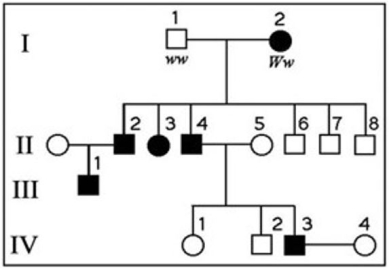 -What is the genotype of individual II- 5?
Free
(Multiple Choice)
4.9/5 (83)
(83) Correct Answer:Verified
VerifiedA
Sex Phenotype Number male wild 123 male yellow 116 female wild 240 Figure 14.1
-In a Drosophila experiment, a cross was made between homozygous wild- type females and yellow- bodied males. All of the resulting F1s were phenotypically wild type. However, adult flies of the F2 generation resulting from matings of the F1s) had the characteristics shown in the figure above:
A. Is the mutant allele for yellow body recessive or dominant?
B. Is the yellow locus autosomal not X- linked) or X- linked?
(Multiple Choice)
4.8/5 (84)
(84) Gene S controls the sharpness of spines in a type of cactus. Cactuses with the dominant allele, S, have sharp spines, whereas homozygous recessive ss cactuses have dull spines. At the same time, a second gene, N, determines whether or not cactuses have spines. Homozygous recessive nn cactuses have no spines at all. If doubly heterozygous SsNn cactuses were allowed to self- pollinate, the F2 would segregate in which of the following ratios?
(Multiple Choice)
4.8/5 (75)
(75) A homozygous tomato plant with red fruit and yellow flowers was crossed with a homozygous tomato plant with golden fruit and white flowers. The F1 all had red fruit and yellow flowers. The following phenotypes were obtained in the F2: Red fruit and yellow flowers-41 Red fruit and white flowers-7 Golden fruit and yellow flowers-8 Golden fruit and white flowers-44
How many map units separate these genes?
(Multiple Choice)
4.9/5 (71)
(71) A man has extra digits six fingers on each hand and six toes on each foot). His wife and their daughter have a normal number of digits. Having extra digits is a dominant trait. The couple's second child has extra digits. What is the probability that their next third) child will have extra digits?
(Multiple Choice)
4.9/5 (76)
(76) A man and woman are both of normal pigmentation and have a child who is albino without melanin pigmentation). Albinism is an autosomal not sex- linked) recessive trait. What are the genotypes of the albino's parents?
(Multiple Choice)
4.7/5 (62)
(62) Pseudohypertrophic muscular dystrophy is a human disorder that causes gradual deterioration of the muscles. Only boys are affected, and they are always born to phenotypically normal parents. Due to the severity of the disease, the boys die in their teens. Is this disorder likely to be caused by a dominant or recessive allele? Is its inheritance sex- linked or autosomal?
(Multiple Choice)
4.8/5 (78)
(78) Glucose- 6- phosphate dehydrogenase deficiency G6PD) is inherited as a recessive allele of an X- linked gene in humans. A woman whose father suffered from G6PD marries a normal man. a) What proportion of their sons is expected to be G6PD? b) If the husband was not normal but was G6PD deficient, would you change your answer in part a)?
(Multiple Choice)
4.8/5 (85)
(85) The B- globin gene has many alleles. What is the maximum number of different alleles of the B- globin gene that could be carried by 6 children with the same mom and dad given that the parents are heterozygous?
(Multiple Choice)
5.0/5 (78)
(78) When Mendel crossed yellow- seeded and green- seeded pea plants, all the offspring were yellow seeded. When he took these F1 yellow- seeded plants and crossed them to green- seeded plants, what genotypic ratio is expected?
(Multiple Choice)
4.8/5 (70)
(70) Gray seed colour in peas is dominant to white. Assume that Mendel conducted a series of experiments where plants with gray seeds were crossed among themselves, and the following progeny were produced: 302 gray and 98 white. a) What is the most probable genotype of each parent? b) Based on your answer in a) above, what genotypic and phenotypic ratios are expected in these progeny? Assume the following symbols: G = gray and g = white.)
(Multiple Choice)
4.8/5 (67)
(67) Whenever the dominant allele of either or both) gene A or gene B is present, red colour is produced. A cross of
AaBb × AaBb can be expected to yield how many red offspring out of 16? Assume the genes are not linked.
(Multiple Choice)
4.8/5 (81)
(81) In Drosophila melanogaster, vestigial short) wings vg) are caused by a recessive allele of a gene that independently assorts with a gene pair that influences body hair. Hairy h) results in a hairy body. A cross is made between a fly with normal wings and a hairy body and a fly with vestigial wings and a normal body. The phenotypically normal F1 flies were crossed among each other, and 1024 F2 flies were reared. What phenotypes would you expect in the F2, and in what actual numbers not ratios) would you expect to find them?
(Multiple Choice)
4.8/5 (74)
(74) There are 40 different alleles for a gene involved in immune function. What is the maximum number of alleles that a human can have?
(Multiple Choice)
4.8/5 (69)
(69) A man and woman are both of normal pigmentation, but both have one parent who is albino without melanin pigmentation). Albinism is an autosomal not sex- linked) recessive trait. What is the probability that their first child will be an albino?
(Multiple Choice)
4.7/5 (69)
(69) A man who carries an allele of an X- linked gene will pass it on to
(Multiple Choice)
4.8/5 (83)
(83) Hemophilia is caused by several genetic factors; one, a recessive allele of an X- linked gene, is the subject of this problem. Assume that a man with hemophilia marries a normal woman whose father had hemophilia. What is the probability that they will have a daughter with hemophilia?
(Multiple Choice)
4.9/5 (72)
(72) In rabbits, the homozygous CC is normal, Cc results in deformed legs, and cc results in very short legs. The genotype BB produces black fur, Bb brown fur, and bb white fur. If a cross is made between brown rabbits with deformed legs and white rabbits with deformed legs, what percentage of the offspring would be expected to have deformed legs and white fur?
(Multiple Choice)
4.9/5 (76)
(76) 
Filters
- Essay(0)
- Multiple Choice(0)
- Short Answer(0)
- True False(0)
- Matching(0)