



 Chat with AI
Exam 14: Mendel and the Gene

Exam 1: Biology and the Tree of Life35 Questions
Exam 2: Water and Carbon: the Chemical Basis of Life53 Questions
Exam 3: Protein Structure and Function40 Questions
Exam 4: Nucleic Acids and the Rna World40 Questions
Exam 5: An Introduction to Carbohydrates42 Questions
Exam 6: Lipids, Membranes, and the First Cells53 Questions
Exam 7: Inside the Cell41 Questions
Exam 8: Energy and Enzymes59 Questions
Exam 9: Cellular Respiration and Fermentation43 Questions
Exam 10: Photosynthesis41 Questions
Exam 11: Cellcell Interactions38 Questions
Exam 12: The Cell Cycle39 Questions
Exam 13: Meiosis40 Questions
Exam 14: Mendel and the Gene47 Questions
Exam 15: Dna and the Gene: Synthesis and Repair39 Questions
Exam 16: How Genes Work39 Questions
Exam 17: Transcription, Rna Processing, and Translation37 Questions
Exam 18: Control of Gene Expression in Bacteria38 Questions
Exam 19: Control of Gene Expression in Eukaryotes40 Questions
Exam 20: The Molecular Revolution: Biotechnology and Beyond39 Questions
Exam 21: Gene Structure and Development39 Questions
Exam 22: Evolution by Natural Selection42 Questions
Exam 23: Evolutionary Processes48 Questions
Exam 24: Speciation40 Questions
Exam 25: Phylogenies and the History of Life37 Questions
Exam 26: Bacteria and Archaea38 Questions
Exam 27: Protists36 Questions
Exam 28: Green Algae and Land Plants54 Questions
Exam 29: Fungi40 Questions
Exam 30: An Introduction to Animals42 Questions
Exam 31: Protostome Animals38 Questions
Exam 32: Deuterostome Animals43 Questions
Exam 33: Viruses35 Questions
Exam 34: Plant Form and Function39 Questions
Exam 35: Water and Sugar Transport in Plants42 Questions
Exam 36: Plant Nutrition37 Questions
Exam 37: Plant Sensory Systems, Signals, and Responses64 Questions
Exam 38: Plant Reproduction and Development44 Questions
Exam 39: Animal Form and Function37 Questions
Exam 40: Water and Electrolyte Balance in Animals41 Questions
Exam 41: Animal Nutrition43 Questions
Exam 42: Gas Exchange and Circulation46 Questions
Exam 43: Animal Nervous Systems40 Questions
Exam 44: Animal Sensory Systems43 Questions
Exam 45: Animal Movement42 Questions
Exam 46: Chemical Signals in Animals38 Questions
Exam 47: Animal Reproduction and Development39 Questions
Exam 48: The Immune System in Animals38 Questions
Exam 49: An Introduction to Ecology40 Questions
Exam 50: Behavioural Ecology39 Questions
Exam 51: Population Ecology49 Questions
Exam 52: Community Ecology38 Questions
Exam 53: Ecosystems and Global Ecology41 Questions
Exam 54: Biodiversity and Conservation Biology38 Questions
Select questions type


Gene S controls the sharpness of spines in a type of cactus. Cactuses with the dominant allele, S, have sharp spines, whereas homozygous recessive ss cactuses have dull spines. At the same time, a second gene, N, determines whether or not cactuses have spines. Homozygous recessive nn cactuses have no spines at all. A cross between a true- breeding sharp- spined cactus and a spineless cactus would produce
(Multiple Choice)
4.9/5  (65)
(65) Regarding an allelic pair for flower colour in snapdragons, heterozygotes have pink flowers, whereas the two homozygotes have red flowers or white flowers. When plants with red flowers are crossed with plants with white flowers, what proportion of the offspring is expected to have pink flowers?
(Multiple Choice)
4.8/5 (71)
(71) Snapdragons are flowers that come in a variety of colours, including red, pink, and white. A series of crosses wit snapdragons having flowers of different colours produced the following results:
Pink × pink: 27 pink, 13 red, 14 white red × red: all red
White × white: all white
Pink × white: 29 pink, 26 white pink × red: 28 pink, 27 red white × red: all pink
Based on the results, what is the most reasonable explanation for the inheritance of these flower colours?
(Multiple Choice)
5.0/5 (87)
(87) What is the probability that a gamete from an individual with the genotype E1E2X1X1A1A2M2M2 will contain all paternally derived homologues?
(Multiple Choice)
4.8/5 (85)
(85) A heterozygous, but phenotypically wild- type fruit fly gray body colour and normal wings) was mated to a black fly with vestigial wings. The offspring had the following phenotypic distribution: wild type, 720;
Black- vestigial, 780; black- normal, 280; gray- vestigial, 220. What conclusion is likely from these results?
(Multiple Choice)
4.7/5 (69)
(69) Hemophilia is caused by several genetic factors; one, a recessive allele of an X- linked gene, is the subject of this problem. Assume that a man with hemophilia marries a normal woman whose father had hemophilia. What is the probability that their first son will have hemophilia?
(Multiple Choice)
4.8/5 (69)
(69) A couple has a child with Harman's ataxia a recessive disorder). If this couple has second child, what is the probability that child will have ataxia?
(Multiple Choice)
4.8/5 (86)
(86)  Figure 14.3
-The distance between two genes is a determinant of their recombination frequency. Based on the image below, which of the following sets of genes will show the greatest recombination frequency?
Figure 14.3
-The distance between two genes is a determinant of their recombination frequency. Based on the image below, which of the following sets of genes will show the greatest recombination frequency? (Multiple Choice)
4.9/5 (88)
(88) Radish flowers may be red, purple, or white. A cross between a red- flowered plant and a white- flowered plant yields all- purple offspring. The part of the radish we eat may be oval or long, with long being the dominant trait. If true- breeding red long radishes are crossed with true- breeding white oval radishes, the F1 will be expected to be which of the following?
(Multiple Choice)
4.8/5 (90)
(90) In humans, blue eyes are inherited as a recessive autosomal trait and colour blindness is an X- linked recessive trait. A woman with blue eyes and normal colour vision whose father was colour blind marries a man who also has normal colour vision. He has brown eyes, but his mother had blue eyes. Which of the following do you expect to be true for their sons?
(Multiple Choice)
4.8/5 (69)
(69) The figure provided shows the pedigree for a family. Dark- shaded symbols represent individuals with one of the two major types of colon cancer. Numbers under the symbols are the individual's age at the time of diagnosis. Males are represented by squares, females by circles.
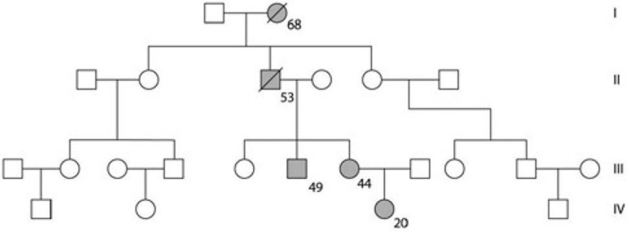 From this pedigree, this trait seems to be inherited
 (Multiple Choice)
4.9/5 (88)
(88) A man and woman are both of normal pigmentation, but both have one parent who is albino without melanin pigmentation). Albinism is an autosomal not sex- linked) recessive trait. What is the probability that their first female child will have albinism?
(Multiple Choice)
4.7/5 (87)
(87) Suppose two AaBbCc individuals are mated. Assuming that the genes are not linked, what fraction of the offspring are expected to be homozygous recessive for the three traits?
(Multiple Choice)
4.9/5 (78)
(78) 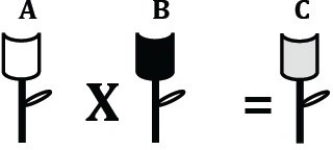 Figure 14.2
-In the figure above, flower A was crossed with flower B to produce flower C. The phenotype of flower C is the result of
Figure 14.2
-In the figure above, flower A was crossed with flower B to produce flower C. The phenotype of flower C is the result of (Multiple Choice)
4.9/5 (81)
(81) Assuming independent assortment for all gene pairs, what is the probability that the following parents, AABbCc
× AaBbCc, will produce an AaBbCc offspring?
(Multiple Choice)
4.8/5 (89)
(89) A sexually reproducing animal has two unlinked genes, one for head shape H) and one for tail length T). Its genotype is HhTt. Which of the following genotypes is possible in a gamete from this organism?
(Multiple Choice)
5.0/5 (77)
(77) Different ratios occur in crosses with single gene pairs or two gene pairs. What types of ratios are likely to occur in crosses dealing with a single gene pair?
(Multiple Choice)
4.9/5 (64)
(64) In tigers, a recessive allele causes a white tiger absence of fur pigmentation). If two phenotypically normal tigers that are heterozygous at this locus are mated, what percentage of their offspring is expected to be white?
(Multiple Choice)
4.8/5 (74)
(74) In humans, ABO blood types refer to glyocproteins in the membranes of red blood cells. There are three alleles for this autosomal gene: IA, IB, and i. The IA allele codes for the A glycoprotein, the IB allele codes for the B glycoprotein, and the i allele doesn't code for any membrane glycoprotein. IA and IB are codominant, and i is recessive to both IA and IB. People with A type blood have the genotypes IAIA or IAi, people with type B blood are IBIB or IBi, people with type AB blood are IAIB, and people with O type blood are ii. If a woman with type AB blood marries a man with type O blood, which of the following blood types could their children possibly have?
(Multiple Choice)
4.9/5 (65)
(65) Two individuals of genotype AABBCCDD and aabbccdd are mated. The F1 generation is interbred self- fertilized) to yield 5000 progeny. What proportion of the F2 is expected to be AabbCcDD?
(Multiple Choice)
4.9/5 (63)
(63) 
Filters
- Essay(0)
- Multiple Choice(0)
- Short Answer(0)
- True False(0)
- Matching(0)