



 Chat with AI
Exam 37: Plant Sensory Systems, Signals, and Responses

Exam 1: Biology and the Tree of Life35 Questions
Exam 2: Water and Carbon: the Chemical Basis of Life53 Questions
Exam 3: Protein Structure and Function40 Questions
Exam 4: Nucleic Acids and the Rna World40 Questions
Exam 5: An Introduction to Carbohydrates42 Questions
Exam 6: Lipids, Membranes, and the First Cells53 Questions
Exam 7: Inside the Cell41 Questions
Exam 8: Energy and Enzymes59 Questions
Exam 9: Cellular Respiration and Fermentation43 Questions
Exam 10: Photosynthesis41 Questions
Exam 11: Cellcell Interactions38 Questions
Exam 12: The Cell Cycle39 Questions
Exam 13: Meiosis40 Questions
Exam 14: Mendel and the Gene47 Questions
Exam 15: Dna and the Gene: Synthesis and Repair39 Questions
Exam 16: How Genes Work39 Questions
Exam 17: Transcription, Rna Processing, and Translation37 Questions
Exam 18: Control of Gene Expression in Bacteria38 Questions
Exam 19: Control of Gene Expression in Eukaryotes40 Questions
Exam 20: The Molecular Revolution: Biotechnology and Beyond39 Questions
Exam 21: Gene Structure and Development39 Questions
Exam 22: Evolution by Natural Selection42 Questions
Exam 23: Evolutionary Processes48 Questions
Exam 24: Speciation40 Questions
Exam 25: Phylogenies and the History of Life37 Questions
Exam 26: Bacteria and Archaea38 Questions
Exam 27: Protists36 Questions
Exam 28: Green Algae and Land Plants54 Questions
Exam 29: Fungi40 Questions
Exam 30: An Introduction to Animals42 Questions
Exam 31: Protostome Animals38 Questions
Exam 32: Deuterostome Animals43 Questions
Exam 33: Viruses35 Questions
Exam 34: Plant Form and Function39 Questions
Exam 35: Water and Sugar Transport in Plants42 Questions
Exam 36: Plant Nutrition37 Questions
Exam 37: Plant Sensory Systems, Signals, and Responses64 Questions
Exam 38: Plant Reproduction and Development44 Questions
Exam 39: Animal Form and Function37 Questions
Exam 40: Water and Electrolyte Balance in Animals41 Questions
Exam 41: Animal Nutrition43 Questions
Exam 42: Gas Exchange and Circulation46 Questions
Exam 43: Animal Nervous Systems40 Questions
Exam 44: Animal Sensory Systems43 Questions
Exam 45: Animal Movement42 Questions
Exam 46: Chemical Signals in Animals38 Questions
Exam 47: Animal Reproduction and Development39 Questions
Exam 48: The Immune System in Animals38 Questions
Exam 49: An Introduction to Ecology40 Questions
Exam 50: Behavioural Ecology39 Questions
Exam 51: Population Ecology49 Questions
Exam 52: Community Ecology38 Questions
Exam 53: Ecosystems and Global Ecology41 Questions
Exam 54: Biodiversity and Conservation Biology38 Questions
Select questions type


The addition of a phosphate group to a protein is called _ _, and it usually results in .

Free
(Multiple Choice)
4.8/5  (87)
(87) Correct Answer: Verified
A
What do phototropin and ABA have in common?
Free
(Multiple Choice)
4.8/5 (76)
(76) Correct Answer:Verified
VerifiedC
Which of the following is the strongest evidence that cytokinins regulate cell divisions?
Free
(Multiple Choice)
4.9/5 (75)
(75) Correct Answer:Verified
VerifiedE
You have discovered a previously unidentified plant, and you cultivate it in your lab. You notice that its flowers close when people are talking, yet are open when the lab is relatively quiet. You suspect that this plant may have the ability to hear! Based on what you know about plant sensation, which of the following hypotheses is the most reasonable to explain this phenomenon?
(Multiple Choice)
4.9/5 (71)
(71) Upon exposure to blue light, plants not only begin to grow toward the light, but move their chloroplasts to the sunny side of each cell. Why would it be advantageous to move chloroplasts within cells?
(Multiple Choice)
4.9/5 (92)
(92) Why does auxin move through the plant slower than sucrose does?
(Multiple Choice)
4.9/5 (84)
(84)  Plant A B C Growth Conditions 14 hours of darkness 14 hours of darkness, interrupted by 10 minutes of light during the fifth hour 14 hours of light, interrupted by 10 minutes of darkness during the fifth hour Result Flowers or no flowers) No flowers No flowers Flowers
Table 37.1
-Refer to the table above. Why did plant B fail to flower?
Plant A B C Growth Conditions 14 hours of darkness 14 hours of darkness, interrupted by 10 minutes of light during the fifth hour 14 hours of light, interrupted by 10 minutes of darkness during the fifth hour Result Flowers or no flowers) No flowers No flowers Flowers
Table 37.1
-Refer to the table above. Why did plant B fail to flower? (Multiple Choice)
4.8/5 (84)
(84) Use the following information when answering the corresponding questions).
Some plants continually produce secondary defense compounds. Other plants are induced to form secondary defense compou when they are injured. Corn seedling leaves that are chewed on by the caterpillars of a type of cutworm moth emit immediate chemicals LOX products), and, after six hours, large amounts of terpenoid compounds are released into the air. The terpenoid are released not only from the leaf being chewed, but from all leaves of the plant. The terpenoid compounds attract a parasitoid wasp female that lays her eggs on the caterpillar. When the wasp larvae hatch, they eat and kill the moth caterpillar. T.C.J. Turlings, J. H. Loughrin, P. J. McCall, U. S. R. Rose, W. J. Lewis, and J. H. Tumlinson. 1995. How
caterpillar- damaged plants protect themselves by attracting parasitic wasps. Proceedings of the National Academy of Science
92:4169- 74.)
-How could you test the hypothesis that compounds from the caterpillar alone do not attract parasitoid wasps?
(Multiple Choice)
4.8/5 (73)
(73) A caterpillar eats a leaf of a plant. The next day it crawls to a nearby leaf to eat. But after eating the second leaf, the caterpillar gets very sick and falls off the plant. Which of the following molecules were involved in the plant's ability to defend itself against the second attack?
(Multiple Choice)
4.9/5 (85)
(85) Which of the following events would be initially triggered by a signal transduction cascade?
(Multiple Choice)
4.8/5 (82)
(82) You discover a chemical that inhibits the conversion of starch to sugar and inhibits the breakdown of chlorophyll and cellulose in fruit. Who might be interested in buying this chemical?
(Multiple Choice)
5.0/5 (67)
(67) Use the following information when answering the corresponding questions).
The shade avoidance response is a plant's way of changing its growth pattern when it is being shaded by another plant. Upon to shade, many plants will grow taller, flatten their leaf angle, and extend their leaves further from their stems in order to reac sunlight. Research performed by Pierik et al. Interactions between ethylene and gibberellins in phytochrome- mediated shade avoidance responses in tobacco. 2004. Plant Physiology 136:2928- 36; online at "http://www.plantphysiol.org/cgi/content/full/136/2/2928)" http://www.plantphysiol.org/cgi/content/full/136/2/2928) examined the role of ethylene and gibberellins on the shade avoidance response in tobacco plants. The shade avoidance response is known to involve phytochromes.
-Ethylene's role in the shade avoidance response in tobacco plants is related to its role in fruit ripening, leaf abscission, and senescence.
(True/False)
4.8/5 (80)
(80) You have a bush in your yard that is the height that you want it, but not as bushy as you want it to be. How can you prune it to trigger it to get bushier?
(Multiple Choice)
4.8/5 (102)
(102) If you wanted to genetically engineer a plant to be more resistant to attack by pathogenic bacteria and viruses, which of the following hormones would you manipulate?
(Multiple Choice)
4.9/5 (73)
(73) You buy some fresh fruit at the grocery store. When you get home, you are in a hurry, and you put the fresh fruit in the crisper with some overripe fruit. At the end of the week you are disappointed to find that your new fruit has already become overripe. What happened?
(Multiple Choice)
4.8/5 (62)
(62) Based on the findings presented above, combined with what you have learned about the hypersensitive respons sequence of events occurs when a pathogen infects a plant cell? Only some of the events will be used)
1) The R protein binds to the avr protein.
2) The pathogen releases avr proteins.
3) The plant cell produces nitric oxide.
4) The pathogen produces reactive oxygen intermediates.
5) A signal transduction cascade occurs.
6) The plant cell and the pathogen die.
7) The pathogen dies, the plant cell lives.
8) The plant cell produces both nitric oxide and reactive oxygen intermediates.
(Multiple Choice)
4.9/5 (84)
(84) Suppose a plant had a photosynthetic pigment that absorbed far- red wavelengths of light. In which of the following environments could that plant thrive?
(Multiple Choice)
4.9/5 (71)
(71) Antisense gene sequences can be used to block the transcription of specific genes in a cell or group of cells. Suppose you took a cutting from a plant and treated it with an antisense gene that would block the transcription of an enzyme involved in auxin production. What would happen to your cutting?
(Multiple Choice)
5.0/5 (59)
(59) Species from sunny habitat (Chenopodium)
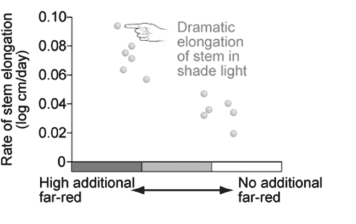 Species from shady habitat (Teucrium)
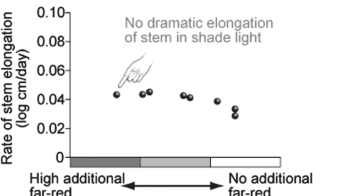 Figure 37.1
-The data in the figure above were taken from a study on the effects of far- red light on stem elongation. The data indicate that plants from shady habitats do not respond to far- red light by growing taller. Which of the following would be a logical hypothesis for why these plants do not respond to far- red light?
Species from shady habitat (Teucrium)
Figure 37.1
-The data in the figure above were taken from a study on the effects of far- red light on stem elongation. The data indicate that plants from shady habitats do not respond to far- red light by growing taller. Which of the following would be a logical hypothesis for why these plants do not respond to far- red light? (Multiple Choice)
4.8/5 (73)
(73) 
Filters
- Essay(0)
- Multiple Choice(0)
- Short Answer(0)
- True False(0)
- Matching(0)