



 Chat with AI
Exam 37: Plant Sensory Systems, Signals, and Responses

Exam 1: Biology and the Tree of Life35 Questions
Exam 2: Water and Carbon: the Chemical Basis of Life53 Questions
Exam 3: Protein Structure and Function40 Questions
Exam 4: Nucleic Acids and the Rna World40 Questions
Exam 5: An Introduction to Carbohydrates42 Questions
Exam 6: Lipids, Membranes, and the First Cells53 Questions
Exam 7: Inside the Cell41 Questions
Exam 8: Energy and Enzymes59 Questions
Exam 9: Cellular Respiration and Fermentation43 Questions
Exam 10: Photosynthesis41 Questions
Exam 11: Cellcell Interactions38 Questions
Exam 12: The Cell Cycle39 Questions
Exam 13: Meiosis40 Questions
Exam 14: Mendel and the Gene47 Questions
Exam 15: Dna and the Gene: Synthesis and Repair39 Questions
Exam 16: How Genes Work39 Questions
Exam 17: Transcription, Rna Processing, and Translation37 Questions
Exam 18: Control of Gene Expression in Bacteria38 Questions
Exam 19: Control of Gene Expression in Eukaryotes40 Questions
Exam 20: The Molecular Revolution: Biotechnology and Beyond39 Questions
Exam 21: Gene Structure and Development39 Questions
Exam 22: Evolution by Natural Selection42 Questions
Exam 23: Evolutionary Processes48 Questions
Exam 24: Speciation40 Questions
Exam 25: Phylogenies and the History of Life37 Questions
Exam 26: Bacteria and Archaea38 Questions
Exam 27: Protists36 Questions
Exam 28: Green Algae and Land Plants54 Questions
Exam 29: Fungi40 Questions
Exam 30: An Introduction to Animals42 Questions
Exam 31: Protostome Animals38 Questions
Exam 32: Deuterostome Animals43 Questions
Exam 33: Viruses35 Questions
Exam 34: Plant Form and Function39 Questions
Exam 35: Water and Sugar Transport in Plants42 Questions
Exam 36: Plant Nutrition37 Questions
Exam 37: Plant Sensory Systems, Signals, and Responses64 Questions
Exam 38: Plant Reproduction and Development44 Questions
Exam 39: Animal Form and Function37 Questions
Exam 40: Water and Electrolyte Balance in Animals41 Questions
Exam 41: Animal Nutrition43 Questions
Exam 42: Gas Exchange and Circulation46 Questions
Exam 43: Animal Nervous Systems40 Questions
Exam 44: Animal Sensory Systems43 Questions
Exam 45: Animal Movement42 Questions
Exam 46: Chemical Signals in Animals38 Questions
Exam 47: Animal Reproduction and Development39 Questions
Exam 48: The Immune System in Animals38 Questions
Exam 49: An Introduction to Ecology40 Questions
Exam 50: Behavioural Ecology39 Questions
Exam 51: Population Ecology49 Questions
Exam 52: Community Ecology38 Questions
Exam 53: Ecosystems and Global Ecology41 Questions
Exam 54: Biodiversity and Conservation Biology38 Questions
Select questions type


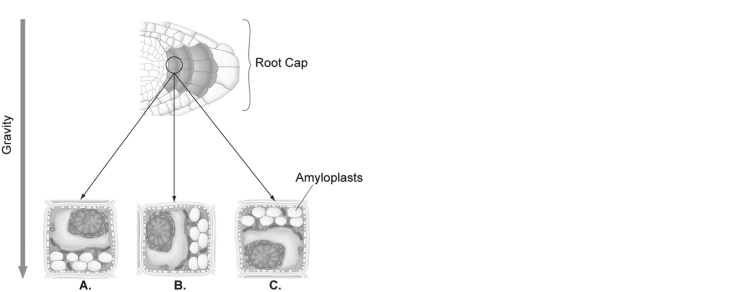 Figure 37.2
-Suppose you laid a seedling on its side so that the root was parallel to the ground. Several hours after the change in position, where in the root cells position A, B, or C in Figure 37.2 above) would you find the amyloplasts?
Figure 37.2
-Suppose you laid a seedling on its side so that the root was parallel to the ground. Several hours after the change in position, where in the root cells position A, B, or C in Figure 37.2 above) would you find the amyloplasts? (Multiple Choice)
5.0/5  (85)
(85) How does auxin binding to the auxin receptor trigger cell elongation?
(Multiple Choice)
4.8/5 (78)
(78)  Plant A B C Growth Conditions 14 hours of darkness 14 hours of darkness, interrupted by 10 minutes of light during the fifth hour 14 hours of light, interrupted by 10 minutes of darkness during the fifth hour Result Flowers or no flowers) No flowers No flowers Flowers
Table 37.1
-Refer to the table above. How would Plant A be classified?
Plant A B C Growth Conditions 14 hours of darkness 14 hours of darkness, interrupted by 10 minutes of light during the fifth hour 14 hours of light, interrupted by 10 minutes of darkness during the fifth hour Result Flowers or no flowers) No flowers No flowers Flowers
Table 37.1
-Refer to the table above. How would Plant A be classified? (Multiple Choice)
4.9/5 (84)
(84) If cells in the _ are removed, roots will no longer respond to gravity.
(Multiple Choice)
4.7/5 (66)
(66) Use the following information when answering the corresponding questions).
The shade avoidance response is a plant's way of changing its growth pattern when it is being shaded by another plant. Upon to shade, many plants will grow taller, flatten their leaf angle, and extend their leaves further from their stems in order to reac sunlight. Research performed by Pierik et al. Interactions between ethylene and gibberellins in phytochrome- mediated shade avoidance responses in tobacco. 2004. Plant Physiology 136:2928- 36; online at "http://www.plantphysiol.org/cgi/content/full/136/2/2928)" http://www.plantphysiol.org/cgi/content/full/136/2/2928) examined the role of ethylene and gibberellins on the shade avoidance response in tobacco plants. The shade avoidance response is known to involve phytochromes.
-When the researchers inhibited the synthesis of gibberellins in the tobacco plants, neither ethylene nor far- red light could trigger a shade avoidance response. Taken together with the data presented above, these data suggest that gibberellins
(Multiple Choice)
4.9/5 (89)
(89) Use the following information when answering the corresponding questions).
Researchers found that high doses of nitric oxide were not lethal to soybean cells. Likewise, high doses of reactive oxygen intermediates were not lethal to soybean cells. However, when combined, nitric oxide and reactive oxygen intermediates wer lethal to soybean cells. M. Delledonne et al. 2001. Signal interactions between nitric oxide and reactive oxygen intermediates i the plant hypersensitive response. Proceedings of the National Academy of Science, USA 9823):13454- 59.)
-Why would the researchers study the association between cell death, nitric oxide, and reactive oxygen intermediates?
(Multiple Choice)
4.8/5 (80)
(80) To understand how plant phototropic responses are regulated, a researcher performed the following experiment. He exposed oat seedlings to light and then cut off tips of coleoptiles and placed them on agar blocks. Later, the agar blocks were placed on decapitated coleoptiles of other individuals. Some seedlings were kept in darkness, while others were exposed to light. Based on your knowledge of auxin synthesis and mode of action, predict in what cases the decapitated coleoptiles would bend to the right.
(Multiple Choice)
4.8/5 (67)
(67) A particular parasitoid is heterozygous for a gene that binds plant pheromones. Which of the following is true of that parasitoid?
(Multiple Choice)
4.9/5 (85)
(85) Which of the following is not a characteristic of plant hormones?
(Multiple Choice)
4.9/5 (75)
(75) In lettuce seeds, blue light initiates germination. If you measured hormone levels within the seed, which hormone would be produced upon exposure to blue light?
(Multiple Choice)
4.9/5 (85)
(85) An increase in girth and decrease in height of a shoot is in response to which of the following environmental stimuli?
(Multiple Choice)
4.9/5 (83)
(83) The transduction pathway that activates systemic acquired resistance in plants is initially signalled by which of the following?
(Multiple Choice)
4.8/5 (86)
(86) Suppose a plant had a nonsense mutation in a gene that encodes for an enzyme required for the synthesis of gibberellic acid. If the plant is homozygous at this locus, what will its phenotype be?
(Multiple Choice)
4.7/5 (69)
(69) Which of the following is the most likely plant response to an attack by herbivores?
(Multiple Choice)
4.7/5 (79)
(79) Use the following information when answering the corresponding questions).
The shade avoidance response is a plant's way of changing its growth pattern when it is being shaded by another plant. Upon to shade, many plants will grow taller, flatten their leaf angle, and extend their leaves further from their stems in order to reac sunlight. Research performed by Pierik et al. Interactions between ethylene and gibberellins in phytochrome- mediated shade avoidance responses in tobacco. 2004. Plant Physiology 136:2928- 36; online at "http://www.plantphysiol.org/cgi/content/full/136/2/2928)" http://www.plantphysiol.org/cgi/content/full/136/2/2928) examined the role of ethylene and gibberellins on the shade avoidance response in tobacco plants. The shade avoidance response is known to involve phytochromes.
-When tobacco plants were exposed to far- red light, they exhibited increased stem length, petiole length, and petiole angle. These three responses are part of the shade avoidance response. When the same plants were exposed to small concentrations of ethylene while being exposed to far- red light, they exhibited even greater increases in stem length, petiole length, and petiole angle. In a subsequent experiment, tobacco plants showed an increase in ethylene production in response to far- red light. Moreover, mutant plants that are insensitive to ethylene did not show a shade avoidance response when exposed to far- red light. Taken together, these data suggest that ethylene
(Multiple Choice)
4.7/5 (78)
(78) The cells that have phosphorylated phototropin receptors elongate in response to blue light.
(True/False)
4.9/5 (82)
(82) Which of the following will occur when sensory hairs in a Venus flytrap are stimulated?
(Multiple Choice)
4.8/5 (77)
(77) For a plant to initiate chemical responses to herbivory before it is directly attacked by herbivores, which of the following must have occurred?
(Multiple Choice)
4.8/5 (83)
(83) in concentration of auxin in shoot cells and in concentration of auxin in root cells lead to cell elongation.
(Multiple Choice)
4.9/5 (87)
(87) A certain bacterium infects a plant's upper leaves. A few days later, bacteria of the same species attempt to infect the same plant's roots but are unsuccessful. What process is responsible for the plant's ability to prevent this infection?
(Multiple Choice)
5.0/5 (94)
(94) 
Filters
- Essay(0)
- Multiple Choice(0)
- Short Answer(0)
- True False(0)
- Matching(0)