



 Chat with AI
Exam 37: Plant Sensory Systems, Signals, and Responses

Exam 1: Biology and the Tree of Life35 Questions
Exam 2: Water and Carbon: the Chemical Basis of Life53 Questions
Exam 3: Protein Structure and Function40 Questions
Exam 4: Nucleic Acids and the Rna World40 Questions
Exam 5: An Introduction to Carbohydrates42 Questions
Exam 6: Lipids, Membranes, and the First Cells53 Questions
Exam 7: Inside the Cell41 Questions
Exam 8: Energy and Enzymes59 Questions
Exam 9: Cellular Respiration and Fermentation43 Questions
Exam 10: Photosynthesis41 Questions
Exam 11: Cellcell Interactions38 Questions
Exam 12: The Cell Cycle39 Questions
Exam 13: Meiosis40 Questions
Exam 14: Mendel and the Gene47 Questions
Exam 15: Dna and the Gene: Synthesis and Repair39 Questions
Exam 16: How Genes Work39 Questions
Exam 17: Transcription, Rna Processing, and Translation37 Questions
Exam 18: Control of Gene Expression in Bacteria38 Questions
Exam 19: Control of Gene Expression in Eukaryotes40 Questions
Exam 20: The Molecular Revolution: Biotechnology and Beyond39 Questions
Exam 21: Gene Structure and Development39 Questions
Exam 22: Evolution by Natural Selection42 Questions
Exam 23: Evolutionary Processes48 Questions
Exam 24: Speciation40 Questions
Exam 25: Phylogenies and the History of Life37 Questions
Exam 26: Bacteria and Archaea38 Questions
Exam 27: Protists36 Questions
Exam 28: Green Algae and Land Plants54 Questions
Exam 29: Fungi40 Questions
Exam 30: An Introduction to Animals42 Questions
Exam 31: Protostome Animals38 Questions
Exam 32: Deuterostome Animals43 Questions
Exam 33: Viruses35 Questions
Exam 34: Plant Form and Function39 Questions
Exam 35: Water and Sugar Transport in Plants42 Questions
Exam 36: Plant Nutrition37 Questions
Exam 37: Plant Sensory Systems, Signals, and Responses64 Questions
Exam 38: Plant Reproduction and Development44 Questions
Exam 39: Animal Form and Function37 Questions
Exam 40: Water and Electrolyte Balance in Animals41 Questions
Exam 41: Animal Nutrition43 Questions
Exam 42: Gas Exchange and Circulation46 Questions
Exam 43: Animal Nervous Systems40 Questions
Exam 44: Animal Sensory Systems43 Questions
Exam 45: Animal Movement42 Questions
Exam 46: Chemical Signals in Animals38 Questions
Exam 47: Animal Reproduction and Development39 Questions
Exam 48: The Immune System in Animals38 Questions
Exam 49: An Introduction to Ecology40 Questions
Exam 50: Behavioural Ecology39 Questions
Exam 51: Population Ecology49 Questions
Exam 52: Community Ecology38 Questions
Exam 53: Ecosystems and Global Ecology41 Questions
Exam 54: Biodiversity and Conservation Biology38 Questions
Select questions type


An eccentric millionaire botanist has offered a $25,000 scholarship to anyone who can successfully get a plant to grow through a vertical maze in complete darkness. The maze is not in a box; the maze is simply drawn on the wall, and the contestants must get their plant to grow in a pattern that matches the path through the maze. You need the money and feel confident that you can accomplish this task. Which of the following techniques will help you succeed?
(Multiple Choice)
4.7/5  (76)
(76) Why does Arabidopsis have 5 genes that code for phytochrome?
(Multiple Choice)
4.9/5 (79)
(79) 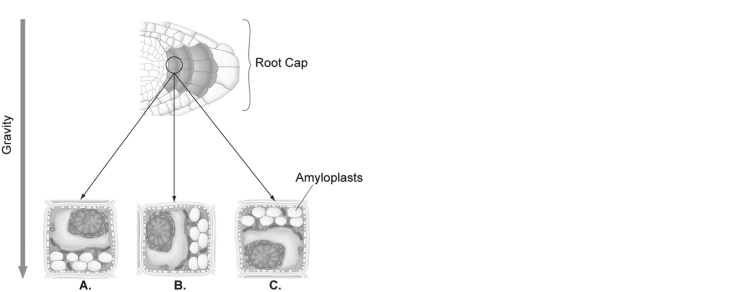 Figure 37.2
-Suppose you laid a seedling on its side so that the root was parallel to the ground. Immediately after the change in position, where in the root cells position A, B, or C in the figure above) would you find the amyloplasts? The answer should be one of the positions show in Figure 37.2.
Figure 37.2
-Suppose you laid a seedling on its side so that the root was parallel to the ground. Immediately after the change in position, where in the root cells position A, B, or C in the figure above) would you find the amyloplasts? The answer should be one of the positions show in Figure 37.2. (Multiple Choice)
4.7/5 (81)
(81) Mammalian eyes sense light because they have cells containing molecules called opsins, which change structure when exposed to light. Which of the following plant molecules) would be analogous to mammalian opsins in their light- sensing ability?
(Multiple Choice)
4.9/5 (75)
(75) Lettuce seeds need full sunlight to germinate; therefore, germination is inhibited when their phytochrome molecules are in the Pfr conformation.
(True/False)
4.9/5 (73)
(73) Put the following events of the acid growth hypothesis in order.
1) Cell wall softens and expands.
2) Sugar enters the cell via proton cotransporters.
3) Protons are pumped out of the cell by H+- ATPases.
4) Positively charged ions enter the cell.
5) New cellulose microfibrils are produced to extend cell length.
6) Water enters the cell via osmosis, and the cell swells.
(Multiple Choice)
4.9/5 (82)
(82) In the fall, the leaves of some trees change colour. This happens because chlorophyll breaks down and the accessory pigments become visible. What hormone is responsible for this?
(Multiple Choice)
5.0/5 (89)
(89) When Charles and Francis Darwin first documented phototropism, why was it important that they germinated the grass seeds in the dark before beginning the experiment?
(Multiple Choice)
4.9/5 (71)
(71) Use the following information when answering the corresponding questions).
Some plants continually produce secondary defense compounds. Other plants are induced to form secondary defense compou when they are injured. Corn seedling leaves that are chewed on by the caterpillars of a type of cutworm moth emit immediate chemicals LOX products), and, after six hours, large amounts of terpenoid compounds are released into the air. The terpenoid are released not only from the leaf being chewed, but from all leaves of the plant. The terpenoid compounds attract a parasitoid wasp female that lays her eggs on the caterpillar. When the wasp larvae hatch, they eat and kill the moth caterpillar. T.C.J. Turlings, J. H. Loughrin, P. J. McCall, U. S. R. Rose, W. J. Lewis, and J. H. Tumlinson. 1995. How
caterpillar- damaged plants protect themselves by attracting parasitic wasps. Proceedings of the National Academy of Science
92:4169- 74.)
-How could you test the hypothesis that caterpillar saliva and a wound are both necessary to attract the parasitoid wasps?
(Multiple Choice)
5.0/5 (71)
(71)  Figure 37.3
-Figure 37.3 is a Northern blot showing the expression of Myb mRNA in cultured aleurone layer cells that were treated with gibberellin versus control cells that were not treated with gibberellin. Only the gibberellin- treated cells expressed the Myb mRNA, but the Myb mRNA was not detectable until 6- 12 hours after gibberellin application. Why did it take so long?
Figure 37.3
-Figure 37.3 is a Northern blot showing the expression of Myb mRNA in cultured aleurone layer cells that were treated with gibberellin versus control cells that were not treated with gibberellin. Only the gibberellin- treated cells expressed the Myb mRNA, but the Myb mRNA was not detectable until 6- 12 hours after gibberellin application. Why did it take so long? (Multiple Choice)
4.8/5 (80)
(80) Which of the following is the correct sequence of events after a receptor perceives a signal?
(Multiple Choice)
4.8/5 (69)
(69) Antisense gene sequences can be used to block the transcription of specific genes in a cell or group of cells. Suppose you treated a seed with an antisense sequence that blocked the transcription of GAMyb transcription factor. What would happen to the seed?
(Multiple Choice)
4.9/5 (86)
(86)  Plant A B C Growth Conditions 14 hours of darkness 14 hours of darkness, interrupted by 10 minutes of light during the fifth hour 14 hours of light, interrupted by 10 minutes of darkness during the fifth hour Result Flowers or no flowers) No flowers No flowers Flowers
Table 37.1
-Plant C is a long- day plant.
Plant A B C Growth Conditions 14 hours of darkness 14 hours of darkness, interrupted by 10 minutes of light during the fifth hour 14 hours of light, interrupted by 10 minutes of darkness during the fifth hour Result Flowers or no flowers) No flowers No flowers Flowers
Table 37.1
-Plant C is a long- day plant. (True/False)
4.9/5 (67)
(67) If a Venus flytrap were treated with a drug that inhibited the H+- ATPase, which of the following would likely happen?
(Multiple Choice)
4.9/5 (66)
(66) You grew reed canary grass seedlings in the dark and cut off their tips. You then placed the tips on agar blocks, one in dark and one in light. Based on your knowledge of auxin movement and stability in light, predict the concentration of auxin in the agar blocks.
(Multiple Choice)
4.9/5 (71)
(71) A population of plants experiences several years of severe drought. Much of the population dies due to lack of water, but a few individuals survive. You set out to discover the physiological basis for their adaptation to such an extreme environmental change. You hypothesize that the survivors have the ability to synthesize higher levels of than their siblings do.
(Multiple Choice)
4.8/5 (68)
(68) prevents seeds from germinating until conditions are favourable for the growth of the plant.
(Multiple Choice)
5.0/5 (72)
(72) Use the following information when answering the corresponding questions).
Some plants continually produce secondary defense compounds. Other plants are induced to form secondary defense compou when they are injured. Corn seedling leaves that are chewed on by the caterpillars of a type of cutworm moth emit immediate chemicals LOX products), and, after six hours, large amounts of terpenoid compounds are released into the air. The terpenoid are released not only from the leaf being chewed, but from all leaves of the plant. The terpenoid compounds attract a parasitoid wasp female that lays her eggs on the caterpillar. When the wasp larvae hatch, they eat and kill the moth caterpillar. T.C.J. Turlings, J. H. Loughrin, P. J. McCall, U. S. R. Rose, W. J. Lewis, and J. H. Tumlinson. 1995. How
caterpillar- damaged plants protect themselves by attracting parasitic wasps. Proceedings of the National Academy of Science
92:4169- 74.)
-What can you conclude based only on the information in the preceding paragraph?
(Multiple Choice)
4.7/5 (75)
(75) You are out working in your garden, and you notice that one of your favorite flowering plants has black, dead spots on the leaves. You immediately suspect that the plant has been invaded by a pathogen and has initiated a
(Multiple Choice)
4.9/5 (78)
(78) 
Filters
- Essay(0)
- Multiple Choice(0)
- Short Answer(0)
- True False(0)
- Matching(0)