



 Chat with AI
Exam 29: Fungi

Exam 1: Biology and the Tree of Life35 Questions
Exam 2: Water and Carbon: the Chemical Basis of Life53 Questions
Exam 3: Protein Structure and Function40 Questions
Exam 4: Nucleic Acids and the Rna World40 Questions
Exam 5: An Introduction to Carbohydrates42 Questions
Exam 6: Lipids, Membranes, and the First Cells53 Questions
Exam 7: Inside the Cell41 Questions
Exam 8: Energy and Enzymes59 Questions
Exam 9: Cellular Respiration and Fermentation43 Questions
Exam 10: Photosynthesis41 Questions
Exam 11: Cellcell Interactions38 Questions
Exam 12: The Cell Cycle39 Questions
Exam 13: Meiosis40 Questions
Exam 14: Mendel and the Gene47 Questions
Exam 15: Dna and the Gene: Synthesis and Repair39 Questions
Exam 16: How Genes Work39 Questions
Exam 17: Transcription, Rna Processing, and Translation37 Questions
Exam 18: Control of Gene Expression in Bacteria38 Questions
Exam 19: Control of Gene Expression in Eukaryotes40 Questions
Exam 20: The Molecular Revolution: Biotechnology and Beyond39 Questions
Exam 21: Gene Structure and Development39 Questions
Exam 22: Evolution by Natural Selection42 Questions
Exam 23: Evolutionary Processes48 Questions
Exam 24: Speciation40 Questions
Exam 25: Phylogenies and the History of Life37 Questions
Exam 26: Bacteria and Archaea38 Questions
Exam 27: Protists36 Questions
Exam 28: Green Algae and Land Plants54 Questions
Exam 29: Fungi40 Questions
Exam 30: An Introduction to Animals42 Questions
Exam 31: Protostome Animals38 Questions
Exam 32: Deuterostome Animals43 Questions
Exam 33: Viruses35 Questions
Exam 34: Plant Form and Function39 Questions
Exam 35: Water and Sugar Transport in Plants42 Questions
Exam 36: Plant Nutrition37 Questions
Exam 37: Plant Sensory Systems, Signals, and Responses64 Questions
Exam 38: Plant Reproduction and Development44 Questions
Exam 39: Animal Form and Function37 Questions
Exam 40: Water and Electrolyte Balance in Animals41 Questions
Exam 41: Animal Nutrition43 Questions
Exam 42: Gas Exchange and Circulation46 Questions
Exam 43: Animal Nervous Systems40 Questions
Exam 44: Animal Sensory Systems43 Questions
Exam 45: Animal Movement42 Questions
Exam 46: Chemical Signals in Animals38 Questions
Exam 47: Animal Reproduction and Development39 Questions
Exam 48: The Immune System in Animals38 Questions
Exam 49: An Introduction to Ecology40 Questions
Exam 50: Behavioural Ecology39 Questions
Exam 51: Population Ecology49 Questions
Exam 52: Community Ecology38 Questions
Exam 53: Ecosystems and Global Ecology41 Questions
Exam 54: Biodiversity and Conservation Biology38 Questions
Select questions type


Use the following information when answering the corresponding questions).
There is much discussion in the media about protecting biodiversity, but does it really matter? Canadian and Swiss researcher to know if the diversity of arbuscular mycorrhizal fungi AMF) was important to the productivity of grasslands M.G.A. van d Heijden, J. N. Klironomos, M. Ursic, P. Moutoglis, R. Streitwolf- Engel, T. Boler, A. Wiemken, and I. R. Sanders. 1998. Mycorrh fungal diversity determines plant biodiversity, ecosystem variability and productivity. Nature 396:69- 72). Specifically, they wanted to know if it mattered which specific AMF species were present, or just that some type of AMF was present. They grew various plants in combination with one of four AMF species, no AMF, or all four AMF species together; and they measured plant growth under each set of conditions. All plant species were grown in each plot, so they always competed
with each other with the only difference being which AMF species were present. Use the graphs in Figure 31.4 to answer the questions that follow. Note that the x- axis labels indicate the number and identity of AMF species bar 0 = no fungi; bars
A- D = individual AMF species; bar A+B+C+D = all AMF species together). The y- axis indicates the amount grams) of plant biomass for the species shown in italics above each graph.
 Figure 29.4
-Based on the graphs shown above, which of the following plant species is most likely not to form mycorrhizal associations?
Figure 29.4
-Based on the graphs shown above, which of the following plant species is most likely not to form mycorrhizal associations?
Free
(Multiple Choice)
4.9/5  (88)
(88) Correct Answer: Verified
A
Why are mycorrhizal fungi superior to plants at acquiring mineral nutrition from the soil?
Free
(Multiple Choice)
4.8/5 (64)
(64) Correct Answer:Verified
VerifiedD
Use the following information when answering the corresponding questions).
The researchers then wanted to know if plant biodiversity and productivity would increase in a natural system as a result of i AMF diversity beyond just four species. Consider Figure 29.6 below Figure 2 from van der Heijden et al. 1998):
 Figure 29.6
-Plant biomass growth) in Figure 29.6 increases as fungal diversity increases. True or false?
Figure 29.6
-Plant biomass growth) in Figure 29.6 increases as fungal diversity increases. True or false?Free
(True/False)
4.9/5 (88)
(88) Correct Answer:Verified
VerifiedTrue
It has been hypothesized that fungi and plants have a mutualistic relationship because fungi provide critical nitrogen for the plants' use. How do we know this happens?
(Multiple Choice)
4.9/5 (78)
(78) Why is it reasonable to hypothesize that lichens might predict air quality?
(Multiple Choice)
4.9/5 (76)
(76) Use the graphs in Figures 29.4 and 29.5 and the following information when answering the corresponding questions.
Canadian and Swiss researchers van der Heijden et al., 1998) interested in factors affecting biodiversity, grew a variety of gra plants in combination with one of four arbuscular mycorrhizal AMF) species, no AMF, or all four AMF species together; and measured plant growth under each set of conditions. All plant species were grown in each plot, so they always competed with each other with the only difference being which AMF were present. Use the graphs in Figure 31.5 to answer the questions
that follow. Note that the x- axis labels indicate the number and identity of AMF species bar 0 = no fungi; bars A- D = individual AMF species; bar A+B+C+D = all AMF species together). The y- axis indicates the amount grams) of plant biomass for the species shown in italics above each graph. Graph e) is the total biomass grams) of all 11 plant species combined; graph f) is the biomass of Bromus erectus plants only, separated from the total.
 Figure 29.4
 Figure 29.5
-What is the major difference between Bromus erectus graph f) and the other plant species graphs a- d) included in the study?
Figure 29.4
Figure 29.5
-What is the major difference between Bromus erectus graph f) and the other plant species graphs a- d) included in the study? (Multiple Choice)
4.9/5 (88)
(88) Figure 29.5
-Based on graphs e) and f) in Figure 29.5, which is the most well- supported prediction for the effect on total plant biomass if AMF diversity were increased to eight species?
Figure 29.5
-Based on graphs e) and f) in Figure 29.5, which is the most well- supported prediction for the effect on total plant biomass if AMF diversity were increased to eight species? (Multiple Choice)
4.8/5 (83)
(83) It has been hypothesized that fungi and plants have a mutualistic relationship because plants make sugars available for the fungi's use. What is the best evidence in support of this hypothesis?
(Multiple Choice)
4.8/5 (77)
(77) You are a forester charged with increasing productivity in a South American forest newly planted with pines from Oregon. You believe that the southern forest lacks the fungal diversity needed by the North American pines, and that this lack of fungi is affecting the pines' productivity, but you have no evidence to support your ideas. To count how many fungal species were present in the Oregon forest, which methodology would you choose, and why?
(Multiple Choice)
4.8/5 (88)
(88) Fungi have an extremely high surface- area- to- volume ratio. What is the advantage of this to an organism that gets most of its nutrition through absorption?
(Multiple Choice)
4.9/5 (79)
(79) The vegetative nutritionally active) bodies of most fungi are
I. composed of hyphae.
II. referred to as a mycelium.
III. usually underground.
(Multiple Choice)
4.9/5 (65)
(65) Microsporidians are considered parasitic because of the ability to penetrate their host cells using this structure.
(Multiple Choice)
4.9/5 (80)
(80) The fungi that we commonly know as mushrooms produce which of the following reproductive structures?
(Multiple Choice)
4.9/5 (83)
(83) Figure 29.5
-Why does total biomass graph e, Figure 29.5) not vary with AMF diversity?
Figure 29.5
-Why does total biomass graph e, Figure 29.5) not vary with AMF diversity? (Multiple Choice)
4.9/5 (77)
(77) Use the following information when answering the corresponding questions).
Suzanne Simard and colleagues knew that the same mycorrhizal fungal species could colonize multiple types of trees. They w if the same fungal individual would colonize different trees, forming an underground network that potentially could transpor and nutrients from one tree to another S. Simard et al. 1997. Net transfer of carbon between mycorrhizal tree species in the fi Nature 388:579- 82). Figure 29.2 illustrates the team's experimental setup. Pots containing seedlings of three different tree species were set up and grown under natural conditions for three years; two of the three species formed ectomycorrhizae Douglas fir, birch) and the other cedar) formed arbuscular mycorrhizae. For the experiment, the researchers placed airtight bags over the Douglas fir and birch seedlings; into each bag, they injected either carbon dioxide made from carbon- 13 or carbon- 14 13CO2 and 14CO2, isotopes of carbon). As the seedlings photosynthesized, the radioactive carbon dioxide was converted into radioactively labelled sugars that could be tracked and measured by the researchers.
 Figure 29.2
-Referring to Simard et al. 1997), what is the result that would most strongly refute their hypothesis?
Figure 29.2
-Referring to Simard et al. 1997), what is the result that would most strongly refute their hypothesis? (Multiple Choice)
4.9/5 (83)
(83) Simard et al. 1997) further hypothesized that if reciprocal transfer did occur, it would be a source- sink relationship driven by photosynthetic rates. That is, if one seedling is in full sun and the other in deep shade, there will be a net movement of carbon from the seedling in full sun to the one in deep shade. If a shade was placed over the birch seedlings and the cedar, and the Douglas fir was left in full sun, what result could Simard and colleagues expect?
(Multiple Choice)
4.9/5 (65)
(65) Figure 29.1
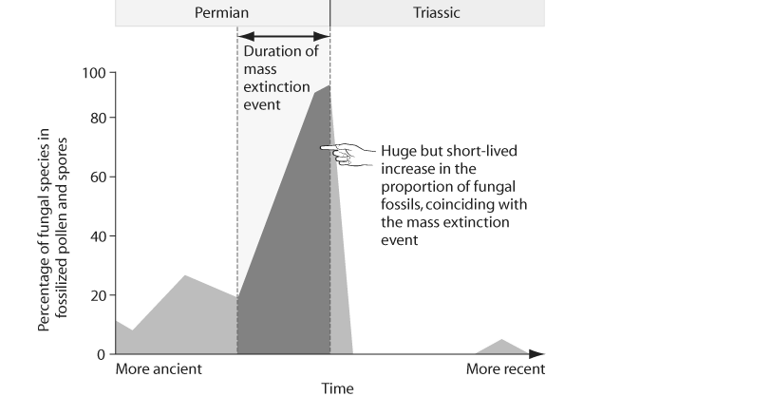 -Looking at Figure 29.1, draw a new graph that plots the percentage of plant species in the fossil pollen and spore record, and write a figure legend comparing it to the original figure.
 (Short Answer)
4.9/5 (81)
(81) Based on the idea that fungi have pores between their cell walls, allowing cytoplasm to move from one end of the mycelium to the other, which of the following hypotheses is the most plausible?
(Multiple Choice)
4.8/5 (75)
(75) Which of the following is an important role for fungi in the carbon cycle?
(Multiple Choice)
4.8/5 (74)
(74) Use the following information when answering the corresponding questions).
There is much discussion in the media about protecting biodiversity, but does it really matter? Canadian and Swiss researcher to know if the diversity of arbuscular mycorrhizal fungi AMF) was important to the productivity of grasslands M.G.A. van d Heijden, J. N. Klironomos, M. Ursic, P. Moutoglis, R. Streitwolf- Engel, T. Boler, A. Wiemken, and I. R. Sanders. 1998. Mycorrh fungal diversity determines plant biodiversity, ecosystem variability and productivity. Nature 396:69- 72). Specifically, they wanted to know if it mattered which specific AMF species were present, or just that some type of AMF was present. They grew various plants in combination with one of four AMF species, no AMF, or all four AMF species together; and they measured plant growth under each set of conditions. All plant species were grown in each plot, so they always competed
with each other with the only difference being which AMF species were present. Use the graphs in Figure 31.4 to answer the questions that follow. Note that the x- axis labels indicate the number and identity of AMF species bar 0 = no fungi; bars
A- D = individual AMF species; bar A+B+C+D = all AMF species together). The y- axis indicates the amount grams) of plant biomass for the species shown in italics above each graph.
Figure 29.4
-Which of the following best explains the data given in graph b) of Figure 29.4 about Lotus corniculatus?
Figure 29.4
-Which of the following best explains the data given in graph b) of Figure 29.4 about Lotus corniculatus? (Multiple Choice)
4.9/5 (65)
(65) 
Filters
- Essay(0)
- Multiple Choice(0)
- Short Answer(0)
- True False(0)
- Matching(0)