



 Chat with AI
Exam 29: Fungi

Exam 1: Biology and the Tree of Life35 Questions
Exam 2: Water and Carbon: the Chemical Basis of Life53 Questions
Exam 3: Protein Structure and Function40 Questions
Exam 4: Nucleic Acids and the Rna World40 Questions
Exam 5: An Introduction to Carbohydrates42 Questions
Exam 6: Lipids, Membranes, and the First Cells53 Questions
Exam 7: Inside the Cell41 Questions
Exam 8: Energy and Enzymes59 Questions
Exam 9: Cellular Respiration and Fermentation43 Questions
Exam 10: Photosynthesis41 Questions
Exam 11: Cellcell Interactions38 Questions
Exam 12: The Cell Cycle39 Questions
Exam 13: Meiosis40 Questions
Exam 14: Mendel and the Gene47 Questions
Exam 15: Dna and the Gene: Synthesis and Repair39 Questions
Exam 16: How Genes Work39 Questions
Exam 17: Transcription, Rna Processing, and Translation37 Questions
Exam 18: Control of Gene Expression in Bacteria38 Questions
Exam 19: Control of Gene Expression in Eukaryotes40 Questions
Exam 20: The Molecular Revolution: Biotechnology and Beyond39 Questions
Exam 21: Gene Structure and Development39 Questions
Exam 22: Evolution by Natural Selection42 Questions
Exam 23: Evolutionary Processes48 Questions
Exam 24: Speciation40 Questions
Exam 25: Phylogenies and the History of Life37 Questions
Exam 26: Bacteria and Archaea38 Questions
Exam 27: Protists36 Questions
Exam 28: Green Algae and Land Plants54 Questions
Exam 29: Fungi40 Questions
Exam 30: An Introduction to Animals42 Questions
Exam 31: Protostome Animals38 Questions
Exam 32: Deuterostome Animals43 Questions
Exam 33: Viruses35 Questions
Exam 34: Plant Form and Function39 Questions
Exam 35: Water and Sugar Transport in Plants42 Questions
Exam 36: Plant Nutrition37 Questions
Exam 37: Plant Sensory Systems, Signals, and Responses64 Questions
Exam 38: Plant Reproduction and Development44 Questions
Exam 39: Animal Form and Function37 Questions
Exam 40: Water and Electrolyte Balance in Animals41 Questions
Exam 41: Animal Nutrition43 Questions
Exam 42: Gas Exchange and Circulation46 Questions
Exam 43: Animal Nervous Systems40 Questions
Exam 44: Animal Sensory Systems43 Questions
Exam 45: Animal Movement42 Questions
Exam 46: Chemical Signals in Animals38 Questions
Exam 47: Animal Reproduction and Development39 Questions
Exam 48: The Immune System in Animals38 Questions
Exam 49: An Introduction to Ecology40 Questions
Exam 50: Behavioural Ecology39 Questions
Exam 51: Population Ecology49 Questions
Exam 52: Community Ecology38 Questions
Exam 53: Ecosystems and Global Ecology41 Questions
Exam 54: Biodiversity and Conservation Biology38 Questions
Select questions type


Which of these fungal features supports the phylogenetic conclusion that fungi are more closely related to animals than plants?
(Multiple Choice)
4.9/5  (91)
(91) Why is it more difficult to treat fungal infections than bacterial infections in humans?
(Multiple Choice)
4.7/5 (79)
(79) Why is it important that ectomycorrhizal fungi EMF) have peptidase enzymes?
(Multiple Choice)
4.7/5 (71)
(71) Which of the trees provided depicts the microsporidians as a sister group of the fungi, rather than as a fungus?

(Multiple Choice)
4.8/5 (81)
(81) When pathogenic fungi are found growing on the roots of grapevines, grape farmers sometimes respond by covering the ground around their vines with plastic sheeting and pumping a gaseous fungicide into the soil. The most important concern of grape farmers who engage in this practice should be that the
(Multiple Choice)
4.8/5 (84)
(84) Use the following information when answering the corresponding questions).
Suzanne Simard and colleagues knew that the same mycorrhizal fungal species could colonize multiple types of trees. They w if the same fungal individual would colonize different trees, forming an underground network that potentially could transpor and nutrients from one tree to another S. Simard et al. 1997. Net transfer of carbon between mycorrhizal tree species in the fi Nature 388:579- 82). Figure 29.2 illustrates the team's experimental setup. Pots containing seedlings of three different tree species were set up and grown under natural conditions for three years; two of the three species formed ectomycorrhizae Douglas fir, birch) and the other cedar) formed arbuscular mycorrhizae. For the experiment, the researchers placed airtight bags over the Douglas fir and birch seedlings; into each bag, they injected either carbon dioxide made from carbon- 13 or carbon- 14 13CO2 and 14CO2, isotopes of carbon). As the seedlings photosynthesized, the radioactive carbon dioxide was converted into radioactively labelled sugars that could be tracked and measured by the researchers.
 Figure 29.2
-Refer to Figure 29.2. Which of the following results would support Simard et al.'s 1997) hypothesis that fungi can move carbon from one plant to another? Hypothesis: Sugars made by one plant during photosynthesis can travel through a mycorrhizal fungus and be incorporated into the tissues of another plant.
Figure 29.2
-Refer to Figure 29.2. Which of the following results would support Simard et al.'s 1997) hypothesis that fungi can move carbon from one plant to another? Hypothesis: Sugars made by one plant during photosynthesis can travel through a mycorrhizal fungus and be incorporated into the tissues of another plant. (Multiple Choice)
4.9/5 (67)
(67) Use the graphs in Figures 29.4 and 29.5 and the following information when answering the corresponding questions.
Canadian and Swiss researchers van der Heijden et al., 1998) interested in factors affecting biodiversity, grew a variety of gra plants in combination with one of four arbuscular mycorrhizal AMF) species, no AMF, or all four AMF species together; and measured plant growth under each set of conditions. All plant species were grown in each plot, so they always competed with each other with the only difference being which AMF were present. Use the graphs in Figure 31.5 to answer the questions
that follow. Note that the x- axis labels indicate the number and identity of AMF species bar 0 = no fungi; bars A- D = individual AMF species; bar A+B+C+D = all AMF species together). The y- axis indicates the amount grams) of plant biomass for the species shown in italics above each graph. Graph e) is the total biomass grams) of all 11 plant species combined; graph f) is the biomass of Bromus erectus plants only, separated from the total.
 Figure 29.4
 Figure 29.5
-Using grams of biomass as an indicator of abundance, which species is most likely the dominant species in this ecosystem see Figure 29.5)?
Figure 29.4
Figure 29.5
-Using grams of biomass as an indicator of abundance, which species is most likely the dominant species in this ecosystem see Figure 29.5)? (Multiple Choice)
4.8/5 (86)
(86) Predict what you would see if you were looking at a new species of zygomycetes.
(Multiple Choice)
4.8/5 (67)
(67) Use the following information when answering the corresponding questions).
Suzanne Simard and colleagues knew that the same mycorrhizal fungal species could colonize multiple types of trees. They w if the same fungal individual would colonize different trees, forming an underground network that potentially could transpor and nutrients from one tree to another S. Simard et al. 1997. Net transfer of carbon between mycorrhizal tree species in the fi Nature 388:579- 82). Figure 29.2 illustrates the team's experimental setup. Pots containing seedlings of three different tree species were set up and grown under natural conditions for three years; two of the three species formed ectomycorrhizae Douglas fir, birch) and the other cedar) formed arbuscular mycorrhizae. For the experiment, the researchers placed airtight bags over the Douglas fir and birch seedlings; into each bag, they injected either carbon dioxide made from carbon- 13 or carbon- 14 13CO2 and 14CO2, isotopes of carbon). As the seedlings photosynthesized, the radioactive carbon dioxide was converted into radioactively labelled sugars that could be tracked and measured by the researchers.
Figure 29.2
-Referring to Simard et al. 1997), which design element is the control in this experiment and why?
Figure 29.2
-Referring to Simard et al. 1997), which design element is the control in this experiment and why? (Multiple Choice)
4.8/5 (84)
(84)  Figure 29.3
-Referring to Figure 29.3 Simard et al., 1997- third- year seedlings only), shown above, was there a net transfer of carbon from plants in sunlight to plants in shade?
Figure 29.3
-Referring to Figure 29.3 Simard et al., 1997- third- year seedlings only), shown above, was there a net transfer of carbon from plants in sunlight to plants in shade? (Multiple Choice)
5.0/5 (85)
(85) If seedlings in the shade commonly do receive sugars from plants in the sunlight, which of the following areas should be investigated by future research? Explain why you think each area should or should not) be investigated? Issues to consider: 1)Plausibility-can the research be performed with current technologies? 2) Is i interesting question that will lead to valuable future knowledge? If so, describe why the information will be help
A. The above- described exchanges were all among seedlings of the same age. Is the rate or degree of carbon tran from one plant to another more affected by the degree of shading, or by the relative photosynthetic ability size/a the tree)?
B. Does the identity of the partners matter for rate or degree of carbon transfer? Is there a greater exchange amon trees of the same species compared to trees of different species? Or do different fungal species have different cap for transfer?
C. How far linear distance in meters) can carbon be transferred in nature? Do exchanges occur only between adj plants, or can sugars be taken up by plants outside the immediate neighbors? Does distance affect the rate/degre exchange in and of itself? Can a heavily shaded tree that is farther away receive more carbon than a nearby tree sun?)
D. All of these areas should be investigated.
(Essay)
5.0/5 (67)
(67) Use the following information when answering the corresponding questions).
The researchers then wanted to know if plant biodiversity and productivity would increase in a natural system as a result of i AMF diversity beyond just four species. Consider Figure 29.6 below Figure 2 from van der Heijden et al. 1998):
 Figure 29.6
-If the number of mycorrhizal fungal species increases to 20, the amount of P in the soil will likely decline to zero Figure 29.6). True or false?
Figure 29.6
-If the number of mycorrhizal fungal species increases to 20, the amount of P in the soil will likely decline to zero Figure 29.6). True or false? (True/False)
4.9/5 (77)
(77) Use the following information when answering the corresponding questions).
The researchers then wanted to know if plant biodiversity and productivity would increase in a natural system as a result of i AMF diversity beyond just four species. Consider Figure 29.6 below Figure 2 from van der Heijden et al. 1998):
Figure 29.6
-The plants in graphs b), c), e), and f) have mycorrhizal associations. True or false?
Figure 29.6
-The plants in graphs b), c), e), and f) have mycorrhizal associations. True or false? (True/False)
4.9/5 (85)
(85) This symbiotic association grows on rocks, where it begins the process of soil formation, and it is a major food source for caribou.
(Multiple Choice)
4.9/5 (87)
(87) Most coal was formed during the Carboniferous period. What is a reasonable hypothesis that explains this observation?
(Multiple Choice)
4.7/5 (83)
(83) Basidiomycetes are the only fungal group capable of synthesizing lignin peroxidase. What advantage does this group of fungi have over other fungi because of this capability?
(Multiple Choice)
4.8/5 (85)
(85) Figure 29.1
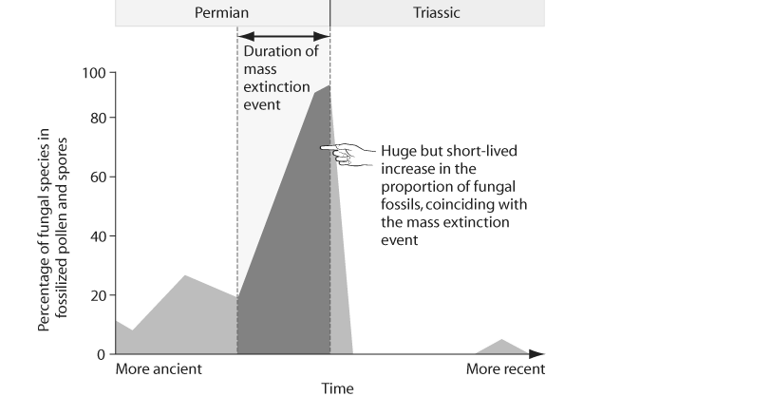 -After looking at Figure 29.1 above, why do you think the spike in fungal abundance ended so "abruptly"? Why didn't fungal abundance remain high?
 (Multiple Choice)
4.9/5 (76)
(76) Use the following information when answering the corresponding questions).
There is much discussion in the media about protecting biodiversity, but does it really matter? Canadian and Swiss researcher to know if the diversity of arbuscular mycorrhizal fungi AMF) was important to the productivity of grasslands M.G.A. van d Heijden, J. N. Klironomos, M. Ursic, P. Moutoglis, R. Streitwolf- Engel, T. Boler, A. Wiemken, and I. R. Sanders. 1998. Mycorrh fungal diversity determines plant biodiversity, ecosystem variability and productivity. Nature 396:69- 72). Specifically, they wanted to know if it mattered which specific AMF species were present, or just that some type of AMF was present. They grew various plants in combination with one of four AMF species, no AMF, or all four AMF species together; and they measured plant growth under each set of conditions. All plant species were grown in each plot, so they always competed
with each other with the only difference being which AMF species were present. Use the graphs in Figure 31.4 to answer the questions that follow. Note that the x- axis labels indicate the number and identity of AMF species bar 0 = no fungi; bars
A- D = individual AMF species; bar A+B+C+D = all AMF species together). The y- axis indicates the amount grams) of plant biomass for the species shown in italics above each graph.
 Figure 29.4
-Based on the van der Heijden et al. 1998) graphs in Figure 29.4, which of the following is the best description of the data supporting the idea that a plant species did not form mycorrhizae with a fungus?
Figure 29.4
-Based on the van der Heijden et al. 1998) graphs in Figure 29.4, which of the following is the best description of the data supporting the idea that a plant species did not form mycorrhizae with a fungus? (Multiple Choice)
4.9/5 (77)
(77) Some fungal species can kill herbivores while feeding off of sugars from its plant host. What type of relationship does this fungus have with its host?
(Multiple Choice)
4.9/5 (80)
(80) 
Filters
- Essay(0)
- Multiple Choice(0)
- Short Answer(0)
- True False(0)
- Matching(0)