



 Chat with AI
Exam 36: Plant Nutrition

Exam 1: Biology and the Tree of Life35 Questions
Exam 2: Water and Carbon: the Chemical Basis of Life53 Questions
Exam 3: Protein Structure and Function40 Questions
Exam 4: Nucleic Acids and the Rna World40 Questions
Exam 5: An Introduction to Carbohydrates42 Questions
Exam 6: Lipids, Membranes, and the First Cells53 Questions
Exam 7: Inside the Cell41 Questions
Exam 8: Energy and Enzymes59 Questions
Exam 9: Cellular Respiration and Fermentation43 Questions
Exam 10: Photosynthesis41 Questions
Exam 11: Cellcell Interactions38 Questions
Exam 12: The Cell Cycle39 Questions
Exam 13: Meiosis40 Questions
Exam 14: Mendel and the Gene47 Questions
Exam 15: Dna and the Gene: Synthesis and Repair39 Questions
Exam 16: How Genes Work39 Questions
Exam 17: Transcription, Rna Processing, and Translation37 Questions
Exam 18: Control of Gene Expression in Bacteria38 Questions
Exam 19: Control of Gene Expression in Eukaryotes40 Questions
Exam 20: The Molecular Revolution: Biotechnology and Beyond39 Questions
Exam 21: Gene Structure and Development39 Questions
Exam 22: Evolution by Natural Selection42 Questions
Exam 23: Evolutionary Processes48 Questions
Exam 24: Speciation40 Questions
Exam 25: Phylogenies and the History of Life37 Questions
Exam 26: Bacteria and Archaea38 Questions
Exam 27: Protists36 Questions
Exam 28: Green Algae and Land Plants54 Questions
Exam 29: Fungi40 Questions
Exam 30: An Introduction to Animals42 Questions
Exam 31: Protostome Animals38 Questions
Exam 32: Deuterostome Animals43 Questions
Exam 33: Viruses35 Questions
Exam 34: Plant Form and Function39 Questions
Exam 35: Water and Sugar Transport in Plants42 Questions
Exam 36: Plant Nutrition37 Questions
Exam 37: Plant Sensory Systems, Signals, and Responses64 Questions
Exam 38: Plant Reproduction and Development44 Questions
Exam 39: Animal Form and Function37 Questions
Exam 40: Water and Electrolyte Balance in Animals41 Questions
Exam 41: Animal Nutrition43 Questions
Exam 42: Gas Exchange and Circulation46 Questions
Exam 43: Animal Nervous Systems40 Questions
Exam 44: Animal Sensory Systems43 Questions
Exam 45: Animal Movement42 Questions
Exam 46: Chemical Signals in Animals38 Questions
Exam 47: Animal Reproduction and Development39 Questions
Exam 48: The Immune System in Animals38 Questions
Exam 49: An Introduction to Ecology40 Questions
Exam 50: Behavioural Ecology39 Questions
Exam 51: Population Ecology49 Questions
Exam 52: Community Ecology38 Questions
Exam 53: Ecosystems and Global Ecology41 Questions
Exam 54: Biodiversity and Conservation Biology38 Questions
Select questions type


The ability for a plant's roots to obtain nutrients and oxygen from the soil is partly determined by a soil's texture. Texture describes which of the following soil components?

Free
(Multiple Choice)
4.9/5  (83)
(83) Correct Answer: Verified
B
To understand the role of zinc in plant growth and development, you are growing a tomato plant using hydroponics. Which plant organs do you expect to have defects if you provide the plant with a solution devoid of zinc?
Free
(Multiple Choice)
4.7/5 (76)
(76) Correct Answer:Verified
VerifiedB
\text { the presence ( + \mathrm { Fe } ) or absence \(( - \mathrm { Fe } )\)}
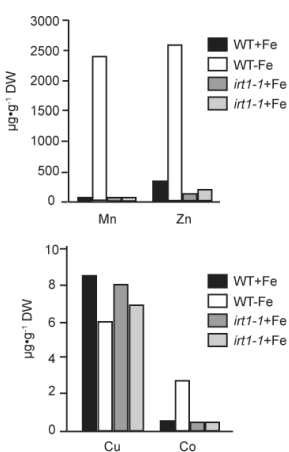 } \text { of iron for 5 days. DW = dry weight} Figure 36.2 -The IRT1 gene is responsible for most of the iron uptake activity in roots Vert et al., Plant Cell 14 [2002]:1223- 33). To determine the specificity of the IRT1 transporter in Arabidopsis plants, researchers measured the concentration of manganese, zinc, copper, and cobalt contained in wild- type and irt1- 1 mutant plants. What conclusions about IRT1 specificity can you draw from the above data? " class="answers-bank-image d-inline" loading="lazy" >
Figure 36.2
-The IRT1 gene is responsible for most of the iron uptake activity in roots Vert et al., Plant Cell 14
[2002]:1223- 33). To determine the specificity of the IRT1 transporter in Arabidopsis plants, researchers measured the concentration of manganese, zinc, copper, and cobalt contained in wild- type and irt1- 1 mutant plants.
What conclusions about IRT1 specificity can you draw from the above data?
} \text { of iron for 5 days. DW = dry weight} Figure 36.2 -The IRT1 gene is responsible for most of the iron uptake activity in roots Vert et al., Plant Cell 14 [2002]:1223- 33). To determine the specificity of the IRT1 transporter in Arabidopsis plants, researchers measured the concentration of manganese, zinc, copper, and cobalt contained in wild- type and irt1- 1 mutant plants. What conclusions about IRT1 specificity can you draw from the above data? " class="answers-bank-image d-inline" loading="lazy" >
Figure 36.2
-The IRT1 gene is responsible for most of the iron uptake activity in roots Vert et al., Plant Cell 14
[2002]:1223- 33). To determine the specificity of the IRT1 transporter in Arabidopsis plants, researchers measured the concentration of manganese, zinc, copper, and cobalt contained in wild- type and irt1- 1 mutant plants.
What conclusions about IRT1 specificity can you draw from the above data? Free
(Multiple Choice)
4.9/5 (78)
(78) Correct Answer:Verified
VerifiedE
Why do plants use cotransporters instead of ion channels to transfer anions into cells?
(Multiple Choice)
4.8/5 (79)
(79) Which of the following is not true about an essential nutrient?
(Multiple Choice)
5.0/5 (69)
(69) While hiking in a forest, you notice an unusual plant growing on the branches of a tree. What will help you to determine if this plant is epiphytic or parasitic?
(Multiple Choice)
4.8/5 (79)
(79) What is the charge on the inside of a plant cell plasma membrane?
(Multiple Choice)
4.7/5 (75)
(75) Researchers are interested in improving crop plants to enable them to form a symbiotic relationship with nitrogen- fixing bacteria. What genes would you need to transfer to a plant that does not associate with rhizobia to enable it to do so?
(Multiple Choice)
4.9/5 (77)
(77) Both ectomycorrhizal fungi and rhizobia are able to supply plants with usable forms of nitrogen. From what sources do rhizobia and ectomycorrhizal fungi that are associated with plants obtain nitrogen?
(Multiple Choice)
4.7/5 (74)
(74) Spanish moss, an epiphyte, obtains nutrients from which possible source?
(Multiple Choice)
4.8/5 (81)
(81) Which criteria allow biologists to divide chemicals into macronutrients and micronutrients?
(Multiple Choice)
4.9/5 (76)
(76) What major benefits do plants and mycorrhizal fungi receive from their symbiotic relationship?
(Multiple Choice)
4.8/5 (90)
(90) What is the function of proton pumps localized in the plant plasma membrane?
(Multiple Choice)
4.8/5 (77)
(77) After mutagenesis and screening take place, you have found a mutant that is able to grow in soil with high copper content. Protein analysis shows that the concentration of metallothioneins in the mutant is different from that in normal plants. How does the concentration of metallothioneins likely differ in the mutant relative to the normal plant?
(Multiple Choice)
4.8/5 (86)
(86) A scientist observed a plant where only the young leaves are deteriorating. What nutrient is likely in short supply?
(Multiple Choice)
4.7/5 (90)
(90) Which elements are most often the limiting nutrients for plant growth?
(Multiple Choice)
4.9/5 (84)
(84) What is the right sequence of steps during infection of plants by nitrogen- fixing bacteria?
(Multiple Choice)
4.8/5 (87)
(87) 
Filters
- Essay(0)
- Multiple Choice(0)
- Short Answer(0)
- True False(0)
- Matching(0)