



 Chat with AI
Exam 36: Plant Nutrition

Exam 1: Biology and the Tree of Life35 Questions
Exam 2: Water and Carbon: the Chemical Basis of Life53 Questions
Exam 3: Protein Structure and Function40 Questions
Exam 4: Nucleic Acids and the Rna World40 Questions
Exam 5: An Introduction to Carbohydrates42 Questions
Exam 6: Lipids, Membranes, and the First Cells53 Questions
Exam 7: Inside the Cell41 Questions
Exam 8: Energy and Enzymes59 Questions
Exam 9: Cellular Respiration and Fermentation43 Questions
Exam 10: Photosynthesis41 Questions
Exam 11: Cellcell Interactions38 Questions
Exam 12: The Cell Cycle39 Questions
Exam 13: Meiosis40 Questions
Exam 14: Mendel and the Gene47 Questions
Exam 15: Dna and the Gene: Synthesis and Repair39 Questions
Exam 16: How Genes Work39 Questions
Exam 17: Transcription, Rna Processing, and Translation37 Questions
Exam 18: Control of Gene Expression in Bacteria38 Questions
Exam 19: Control of Gene Expression in Eukaryotes40 Questions
Exam 20: The Molecular Revolution: Biotechnology and Beyond39 Questions
Exam 21: Gene Structure and Development39 Questions
Exam 22: Evolution by Natural Selection42 Questions
Exam 23: Evolutionary Processes48 Questions
Exam 24: Speciation40 Questions
Exam 25: Phylogenies and the History of Life37 Questions
Exam 26: Bacteria and Archaea38 Questions
Exam 27: Protists36 Questions
Exam 28: Green Algae and Land Plants54 Questions
Exam 29: Fungi40 Questions
Exam 30: An Introduction to Animals42 Questions
Exam 31: Protostome Animals38 Questions
Exam 32: Deuterostome Animals43 Questions
Exam 33: Viruses35 Questions
Exam 34: Plant Form and Function39 Questions
Exam 35: Water and Sugar Transport in Plants42 Questions
Exam 36: Plant Nutrition37 Questions
Exam 37: Plant Sensory Systems, Signals, and Responses64 Questions
Exam 38: Plant Reproduction and Development44 Questions
Exam 39: Animal Form and Function37 Questions
Exam 40: Water and Electrolyte Balance in Animals41 Questions
Exam 41: Animal Nutrition43 Questions
Exam 42: Gas Exchange and Circulation46 Questions
Exam 43: Animal Nervous Systems40 Questions
Exam 44: Animal Sensory Systems43 Questions
Exam 45: Animal Movement42 Questions
Exam 46: Chemical Signals in Animals38 Questions
Exam 47: Animal Reproduction and Development39 Questions
Exam 48: The Immune System in Animals38 Questions
Exam 49: An Introduction to Ecology40 Questions
Exam 50: Behavioural Ecology39 Questions
Exam 51: Population Ecology49 Questions
Exam 52: Community Ecology38 Questions
Exam 53: Ecosystems and Global Ecology41 Questions
Exam 54: Biodiversity and Conservation Biology38 Questions
Select questions type


What type of soil is most difficult for roots to penetrate?
(Multiple Choice)
4.8/5  (84)
(84) After mutagenesis, the bacteria Sinorhizobium meliloti became unable to colonize Medicago truncatula plants due to the absence of recognition by the host plant. Which of the following genes is most likely the site of mutation?
(Multiple Choice)
4.8/5 (79)
(79) How would you expect the root system of a plant grown by hydroponics to compare to the root system of a plant grown in soil?
(Multiple Choice)
4.9/5 (82)
(82) To determine the requirement of chlorine for plant growth, you decided to perform a hydroponic experiment. What solution are you going to use to grow control plants for comparison with chlorine- derived plants?
(Multiple Choice)
4.8/5 (62)
(62) The micronutrient iron is abundant in soil, but often unavailable to plants due to insolubility. Knowing that the reaction FeOH)3 + 3H+ -Fe3+ + 3H2O occurs, and assuming all soil samples have same total amount of iron in them, which type of soil would you predict to have the highest amount of soluble iron?
(Multiple Choice)
4.7/5 (88)
(88) After mutagenesis and screening, you have found a mutant that is able to grow in soil with high salt content. Chemical analysis showed that this plant has a decreased amount of Na+ relative to normal plants. What kind of mutation do you predict this plant contains?
(Multiple Choice)
4.8/5 (85)
(85) Which of the following experiments is able to determine if an element is essential for plant growth?
(Multiple Choice)
4.8/5 (104)
(104) In an experiment, you find that the addition of arbuscular mycorrhizal fungi to the soil improves the growth rate of tomato plants. Which of the following conclusions are supported by your experiment?
(Multiple Choice)
4.9/5 (74)
(74)
\text { the presence ( + \mathrm { Fe } ) or absence \(( - \mathrm { Fe } )\)}
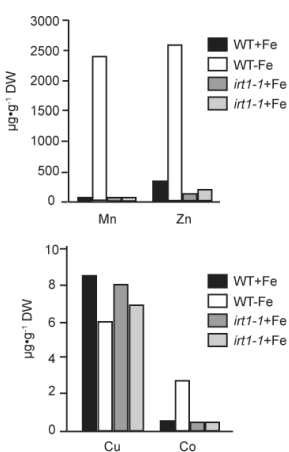 } \text { of iron for 5 days. DW = dry weight} Figure 36.2 -Which of the following is being replenished when carnivorous plants trap and digest small animals? " class="answers-bank-image d-inline" loading="lazy" >
Figure 36.2
-Which of the following is being replenished when carnivorous plants trap and digest small animals?
} \text { of iron for 5 days. DW = dry weight} Figure 36.2 -Which of the following is being replenished when carnivorous plants trap and digest small animals? " class="answers-bank-image d-inline" loading="lazy" >
Figure 36.2
-Which of the following is being replenished when carnivorous plants trap and digest small animals? (Multiple Choice)
4.9/5 (84)
(84) You want to grow a plant that prefers neutral pH in a limestone soil. What should you add to the soil to improve plant growth?
(Multiple Choice)
4.8/5 (74)
(74) 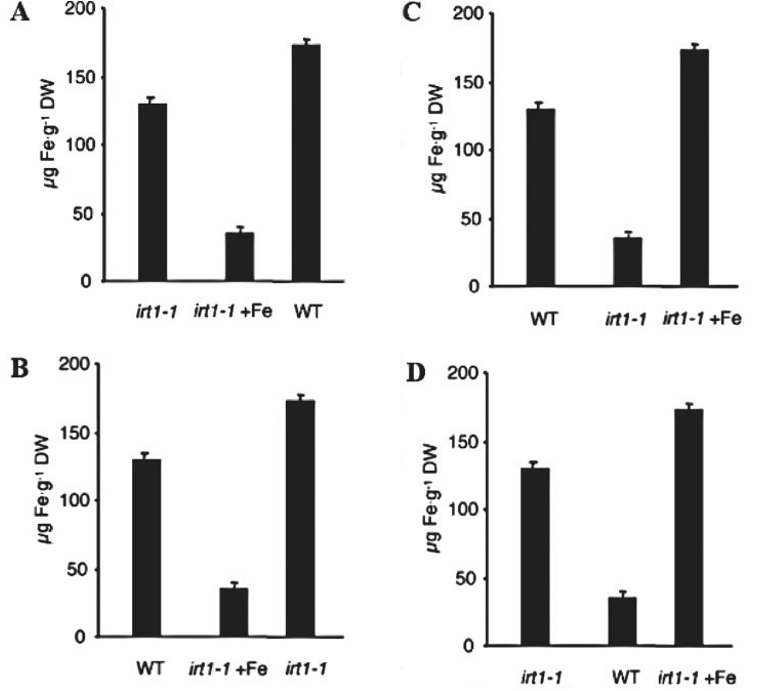 -Iron shortage is the most common human nutritional deficiency in the world. Plants are the major source of iron in most diets, so researchers are interested in understanding their mechanism of iron intake and in developing iron- rich crops. Recently, researchers showed Vert et al., IRT1, an Arabidopsis transporter essential for iron uptake from the soil and for plant growth. Plant Cell 14 [2002]:1223- 33) that under iron- deficient conditions, the IRT1 gene is responsible for most of the iron uptake activity in roots. To demonstrate the importance of IRT1 for iron accumulation, researchers measured leaf iron content in irt1- 1 mutants containing deactivated IRT1. Mutant plants were grown in iron- poor soil irt1- 1 in graph) and soil rich with iron irt1- 1 +Fe in graph).
Wild- type WT) plants grown in iron- poor soil were used as a control. Which of the graphs represent the data researchers might have received in their experiment?
-Iron shortage is the most common human nutritional deficiency in the world. Plants are the major source of iron in most diets, so researchers are interested in understanding their mechanism of iron intake and in developing iron- rich crops. Recently, researchers showed Vert et al., IRT1, an Arabidopsis transporter essential for iron uptake from the soil and for plant growth. Plant Cell 14 [2002]:1223- 33) that under iron- deficient conditions, the IRT1 gene is responsible for most of the iron uptake activity in roots. To demonstrate the importance of IRT1 for iron accumulation, researchers measured leaf iron content in irt1- 1 mutants containing deactivated IRT1. Mutant plants were grown in iron- poor soil irt1- 1 in graph) and soil rich with iron irt1- 1 +Fe in graph).
Wild- type WT) plants grown in iron- poor soil were used as a control. Which of the graphs represent the data researchers might have received in their experiment? (Short Answer)
4.8/5 (67)
(67) Which elements are responsible for the greater part of plant wet weight?
(Multiple Choice)
4.9/5 (70)
(70) 
Filters
- Essay(0)
- Multiple Choice(0)
- Short Answer(0)
- True False(0)
- Matching(0)