



 Chat with AI
Exam 41: Animal Nutrition

Exam 1: Biology and the Tree of Life35 Questions
Exam 2: Water and Carbon: the Chemical Basis of Life53 Questions
Exam 3: Protein Structure and Function40 Questions
Exam 4: Nucleic Acids and the Rna World40 Questions
Exam 5: An Introduction to Carbohydrates42 Questions
Exam 6: Lipids, Membranes, and the First Cells53 Questions
Exam 7: Inside the Cell41 Questions
Exam 8: Energy and Enzymes59 Questions
Exam 9: Cellular Respiration and Fermentation43 Questions
Exam 10: Photosynthesis41 Questions
Exam 11: Cellcell Interactions38 Questions
Exam 12: The Cell Cycle39 Questions
Exam 13: Meiosis40 Questions
Exam 14: Mendel and the Gene47 Questions
Exam 15: Dna and the Gene: Synthesis and Repair39 Questions
Exam 16: How Genes Work39 Questions
Exam 17: Transcription, Rna Processing, and Translation37 Questions
Exam 18: Control of Gene Expression in Bacteria38 Questions
Exam 19: Control of Gene Expression in Eukaryotes40 Questions
Exam 20: The Molecular Revolution: Biotechnology and Beyond39 Questions
Exam 21: Gene Structure and Development39 Questions
Exam 22: Evolution by Natural Selection42 Questions
Exam 23: Evolutionary Processes48 Questions
Exam 24: Speciation40 Questions
Exam 25: Phylogenies and the History of Life37 Questions
Exam 26: Bacteria and Archaea38 Questions
Exam 27: Protists36 Questions
Exam 28: Green Algae and Land Plants54 Questions
Exam 29: Fungi40 Questions
Exam 30: An Introduction to Animals42 Questions
Exam 31: Protostome Animals38 Questions
Exam 32: Deuterostome Animals43 Questions
Exam 33: Viruses35 Questions
Exam 34: Plant Form and Function39 Questions
Exam 35: Water and Sugar Transport in Plants42 Questions
Exam 36: Plant Nutrition37 Questions
Exam 37: Plant Sensory Systems, Signals, and Responses64 Questions
Exam 38: Plant Reproduction and Development44 Questions
Exam 39: Animal Form and Function37 Questions
Exam 40: Water and Electrolyte Balance in Animals41 Questions
Exam 41: Animal Nutrition43 Questions
Exam 42: Gas Exchange and Circulation46 Questions
Exam 43: Animal Nervous Systems40 Questions
Exam 44: Animal Sensory Systems43 Questions
Exam 45: Animal Movement42 Questions
Exam 46: Chemical Signals in Animals38 Questions
Exam 47: Animal Reproduction and Development39 Questions
Exam 48: The Immune System in Animals38 Questions
Exam 49: An Introduction to Ecology40 Questions
Exam 50: Behavioural Ecology39 Questions
Exam 51: Population Ecology49 Questions
Exam 52: Community Ecology38 Questions
Exam 53: Ecosystems and Global Ecology41 Questions
Exam 54: Biodiversity and Conservation Biology38 Questions
Select questions type


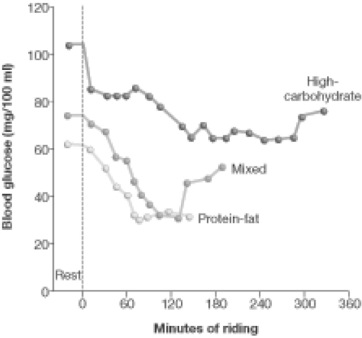 Figure 41.1
-How would you, as an athlete or trainer, interpret the data portrayed in the graph above?
Figure 41.1
-How would you, as an athlete or trainer, interpret the data portrayed in the graph above? (Multiple Choice)
5.0/5  (75)
(75) Helicobacter pylori is a bacterial organism that causes ulcers and digestive disturbances. How might they survive the acid pH of the stomach?
(Multiple Choice)
4.8/5 (68)
(68) Cattle are able to survive on a diet consisting almost entirely of plant material because cattle
(Multiple Choice)
4.7/5 (75)
(75) What condition may arise if an individual has defective insulin receptors?
(Multiple Choice)
4.8/5 (77)
(77) The parietal cells that line the stomach secrete hydrogen ions into the stomach against a concentration gradient. Based on that knowledge, which of the following transport processes is most likely involved in hydrogen ion secretion?
(Multiple Choice)
4.9/5 (82)
(82) Vitamin D is indirectly responsible for calcium uptake in the intestine. What is the mechanism by which Vitamin D and its receptor affect the calcium transporter gene?
(Multiple Choice)
4.9/5 (66)
(66) The process of obtaining is known as and requires specialized mouthparts.
(Multiple Choice)
4.8/5 (73)
(73) The process of breaking down food particles into molecules that can be transported into circulation is known as
(Multiple Choice)
4.7/5 (70)
(70) Villi and microvilli that are associated with the luminal surface of the intestinal epithelium are important in that they
(Multiple Choice)
4.9/5 (68)
(68) Ruminants have a multi- compartmented stomach. They have a symbiotic relationship with bacterial organisms resident in the first of four compartments the rumen). How do the bacteria help ruminant digestion?
(Multiple Choice)
4.8/5 (72)
(72) Amino acids, dipeptides, and sugars are transported from intestinal epithelial cells into circulation. Lipids are transported from the intestinal epithelium into
(Multiple Choice)
4.8/5 (81)
(81) What condition may arise in an individual who has defective pancreatic cells?
(Multiple Choice)
4.9/5 (83)
(83) Which of the following is a major function of the small intestine?
(Multiple Choice)
4.8/5 (74)
(74) Food and its products of degradation move through the alimentary canal by means of peristalsis. What is peristalsis?
(Multiple Choice)
4.9/5 (85)
(85) Bile, which is synthesized in the liver and stored in the gallbladder, is important in lipid digestion. What feature/function of bile makes it an effective emulsifying agent?
(Multiple Choice)
4.8/5 (68)
(68) The stomach releases hydrochloric acid to create an acidic environment. Which cells release acid?
(Multiple Choice)
4.9/5 (85)
(85) If the person consumes 2500 calories daily to maintain body weight, what percentage of the RDA for iron would this person receive from a serving of apple juice?
(Multiple Choice)
4.7/5 (94)
(94) Why did scientists originally hypothesize that proteolytic enzymes like pepsin and trypsin are secreted in inactive form?
(Multiple Choice)
4.9/5 (72)
(72) Food labels provide nutrient information and express the amount of a given nutrient as
(Multiple Choice)
4.8/5 (75)
(75) 
Filters
- Essay(0)
- Multiple Choice(0)
- Short Answer(0)
- True False(0)
- Matching(0)