



 Chat with AI
Exam 25: Phylogenies and the History of Life

Exam 1: Biology and the Tree of Life35 Questions
Exam 2: Water and Carbon: the Chemical Basis of Life53 Questions
Exam 3: Protein Structure and Function40 Questions
Exam 4: Nucleic Acids and the Rna World40 Questions
Exam 5: An Introduction to Carbohydrates42 Questions
Exam 6: Lipids, Membranes, and the First Cells53 Questions
Exam 7: Inside the Cell41 Questions
Exam 8: Energy and Enzymes59 Questions
Exam 9: Cellular Respiration and Fermentation43 Questions
Exam 10: Photosynthesis41 Questions
Exam 11: Cellcell Interactions38 Questions
Exam 12: The Cell Cycle39 Questions
Exam 13: Meiosis40 Questions
Exam 14: Mendel and the Gene47 Questions
Exam 15: Dna and the Gene: Synthesis and Repair39 Questions
Exam 16: How Genes Work39 Questions
Exam 17: Transcription, Rna Processing, and Translation37 Questions
Exam 18: Control of Gene Expression in Bacteria38 Questions
Exam 19: Control of Gene Expression in Eukaryotes40 Questions
Exam 20: The Molecular Revolution: Biotechnology and Beyond39 Questions
Exam 21: Gene Structure and Development39 Questions
Exam 22: Evolution by Natural Selection42 Questions
Exam 23: Evolutionary Processes48 Questions
Exam 24: Speciation40 Questions
Exam 25: Phylogenies and the History of Life37 Questions
Exam 26: Bacteria and Archaea38 Questions
Exam 27: Protists36 Questions
Exam 28: Green Algae and Land Plants54 Questions
Exam 29: Fungi40 Questions
Exam 30: An Introduction to Animals42 Questions
Exam 31: Protostome Animals38 Questions
Exam 32: Deuterostome Animals43 Questions
Exam 33: Viruses35 Questions
Exam 34: Plant Form and Function39 Questions
Exam 35: Water and Sugar Transport in Plants42 Questions
Exam 36: Plant Nutrition37 Questions
Exam 37: Plant Sensory Systems, Signals, and Responses64 Questions
Exam 38: Plant Reproduction and Development44 Questions
Exam 39: Animal Form and Function37 Questions
Exam 40: Water and Electrolyte Balance in Animals41 Questions
Exam 41: Animal Nutrition43 Questions
Exam 42: Gas Exchange and Circulation46 Questions
Exam 43: Animal Nervous Systems40 Questions
Exam 44: Animal Sensory Systems43 Questions
Exam 45: Animal Movement42 Questions
Exam 46: Chemical Signals in Animals38 Questions
Exam 47: Animal Reproduction and Development39 Questions
Exam 48: The Immune System in Animals38 Questions
Exam 49: An Introduction to Ecology40 Questions
Exam 50: Behavioural Ecology39 Questions
Exam 51: Population Ecology49 Questions
Exam 52: Community Ecology38 Questions
Exam 53: Ecosystems and Global Ecology41 Questions
Exam 54: Biodiversity and Conservation Biology38 Questions
Select questions type


Which of the following key adaptations is found in many animals from the Burgess Shale fauna, but not found in the Doushantuo and Ediacaran faunas?
(Multiple Choice)
4.8/5  (71)
(71) Dinosaurs were the largest land vertebrates during the eras).
(Multiple Choice)
4.7/5 (87)
(87) 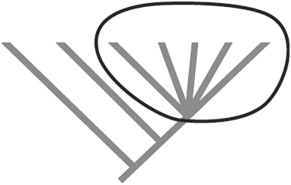 Figure 25.5
-Which of the following words describes) the circled part of the phylogenetic tree in Figure 25.5?
I. monophyletic group
II. polyphyletic group
III. homoplasic trait
IV. polytomy
Figure 25.5
-Which of the following words describes) the circled part of the phylogenetic tree in Figure 25.5?
I. monophyletic group
II. polyphyletic group
III. homoplasic trait
IV. polytomy (Multiple Choice)
4.8/5 (66)
(66) The cladistic approach to estimating phylogenetic trees is most like the approach of which species concept?
(Multiple Choice)
4.8/5 (83)
(83) You find a new fossil deposit, containing many species with shells but no soft-bodied species. What is the most likely reason for this?
(Multiple Choice)
4.9/5 (78)
(78) The largest extinction, measured as a percentage of species that disappeared, occurred at the end of which geological period?
(Multiple Choice)
4.8/5 (81)
(81) How do mass extinctions differ from background extinctions?
(Multiple Choice)
4.8/5 (63)
(63) What is still lacking in the hypothesis of an asteroid impact as the cause of the end-Cretaceous mass extinction?
(Multiple Choice)
4.9/5 (91)
(91) In plant communities today, leaf morphology is correlated with mean annual temperature, so paleobotanists use fossil leaf morphology to estimate the mean annual temperature of paleoclimates. However, the angiosperm fossil record contains an overabundance of samples fossilized near lakes or rivers where vines are especially common. Since vine leaves have a somewhat different association with temperature, use of data from vine-rich locations leads to mean average temperature estimates that are lower than actual recorded temperatures in modern plant communities. This potential bias in paleobotanical climate estimates is due to which type of bias in the fossil record? R. J. Burnham, N. C. A. Pitman, K. R. Johnson, and P. Wilf. 2001.
Habitat-related error in estimating temperature from leaf margins in a humid tropical forest. American Journal of Botany 88:1096-1102.)
(Multiple Choice)
4.8/5 (84)
(84) Which listing of geological periods is in the correct order, from oldest to most recent?
(Multiple Choice)
4.8/5 (84)
(84) Figure 25.5
-How did the pattern shown in the circled part of Figure 25.5 most likely arise?
Figure 25.5
-How did the pattern shown in the circled part of Figure 25.5 most likely arise? (Multiple Choice)
4.9/5 (78)
(78) A hypothetical island lies far from any other landmasses. There are many different types of plants, but only one animal-a beetle that can fly or walk from plant to plant and feeds by chewing leaves. Which morphological change would be most likely to trigger an adaptive radiation of the beetles?
(Multiple Choice)
4.9/5 (81)
(81) The five mass extinctions occurred at the end of which periods?
(Multiple Choice)
5.0/5 (80)
(80) Which of the following would be useful in creating a phylogenetic tree of a taxon?
(Multiple Choice)
4.9/5 (94)
(94) Why would gene duplication events, such as those seen in the Hox gene complex, set the stage for adaptive radiation?
(Multiple Choice)
4.7/5 (88)
(88) Dicynodonts were pig-sized reptiles that lived during the Permian geologic period. An increase in dicynodont species diversity occurred soon after the Permian extinction. Given what you know of this period, this increase in dicynodont species diversity represents , most likely due to .
(Multiple Choice)
4.9/5 (70)
(70) 
Filters
- Essay(0)
- Multiple Choice(0)
- Short Answer(0)
- True False(0)
- Matching(0)