



 Chat with AI
Exam 15: Dna and the Gene: Synthesis and Repair

Exam 1: Biology and the Tree of Life35 Questions
Exam 2: Water and Carbon: the Chemical Basis of Life53 Questions
Exam 3: Protein Structure and Function40 Questions
Exam 4: Nucleic Acids and the Rna World40 Questions
Exam 5: An Introduction to Carbohydrates42 Questions
Exam 6: Lipids, Membranes, and the First Cells53 Questions
Exam 7: Inside the Cell41 Questions
Exam 8: Energy and Enzymes59 Questions
Exam 9: Cellular Respiration and Fermentation43 Questions
Exam 10: Photosynthesis41 Questions
Exam 11: Cellcell Interactions38 Questions
Exam 12: The Cell Cycle39 Questions
Exam 13: Meiosis40 Questions
Exam 14: Mendel and the Gene47 Questions
Exam 15: Dna and the Gene: Synthesis and Repair39 Questions
Exam 16: How Genes Work39 Questions
Exam 17: Transcription, Rna Processing, and Translation37 Questions
Exam 18: Control of Gene Expression in Bacteria38 Questions
Exam 19: Control of Gene Expression in Eukaryotes40 Questions
Exam 20: The Molecular Revolution: Biotechnology and Beyond39 Questions
Exam 21: Gene Structure and Development39 Questions
Exam 22: Evolution by Natural Selection42 Questions
Exam 23: Evolutionary Processes48 Questions
Exam 24: Speciation40 Questions
Exam 25: Phylogenies and the History of Life37 Questions
Exam 26: Bacteria and Archaea38 Questions
Exam 27: Protists36 Questions
Exam 28: Green Algae and Land Plants54 Questions
Exam 29: Fungi40 Questions
Exam 30: An Introduction to Animals42 Questions
Exam 31: Protostome Animals38 Questions
Exam 32: Deuterostome Animals43 Questions
Exam 33: Viruses35 Questions
Exam 34: Plant Form and Function39 Questions
Exam 35: Water and Sugar Transport in Plants42 Questions
Exam 36: Plant Nutrition37 Questions
Exam 37: Plant Sensory Systems, Signals, and Responses64 Questions
Exam 38: Plant Reproduction and Development44 Questions
Exam 39: Animal Form and Function37 Questions
Exam 40: Water and Electrolyte Balance in Animals41 Questions
Exam 41: Animal Nutrition43 Questions
Exam 42: Gas Exchange and Circulation46 Questions
Exam 43: Animal Nervous Systems40 Questions
Exam 44: Animal Sensory Systems43 Questions
Exam 45: Animal Movement42 Questions
Exam 46: Chemical Signals in Animals38 Questions
Exam 47: Animal Reproduction and Development39 Questions
Exam 48: The Immune System in Animals38 Questions
Exam 49: An Introduction to Ecology40 Questions
Exam 50: Behavioural Ecology39 Questions
Exam 51: Population Ecology49 Questions
Exam 52: Community Ecology38 Questions
Exam 53: Ecosystems and Global Ecology41 Questions
Exam 54: Biodiversity and Conservation Biology38 Questions
Select questions type


What provides the energy for the polymerization reactions in DNA synthesis?
(Multiple Choice)
4.7/5  (78)
(78) Researchers found E. coli that had mutation rates 100 times higher than normal. What is a possible explanation for these results?
(Multiple Choice)
4.8/5 (74)
(74) Telomere shortening puts a limit on the number of times a cell can divide. Research has shown that telomerase can extend the life span of cultured human cells. How might adding telomerase affect cellular aging?
(Multiple Choice)
4.9/5 (60)
(60) Which of the following cells do not have active telomerase activity?
(Multiple Choice)
4.9/5 (89)
(89) What is a major difference between eukaryotic DNA replication and prokaryotic DNA replication?
(Multiple Choice)
4.9/5 (88)
(88) Watson and Crick elucidated the structure of DNA in 1953. Their research built on and helped explain the findings of other scientists, including
(Multiple Choice)
4.7/5 (78)
(78) In the polymerization of DNA, a phosphodiester bond is formed between a phosphate group of the nucleotide being added and of the last nucleotide in the polymer.
(Multiple Choice)
4.8/5 (75)
(75) Hershey and Chase set out to determine what molecule served as the unit of inheritance. They completed a series of transduction experiments in which E. coli was infected by a T2 virus. Which molecular component of the T2 virus actually ended up inside the cell?
(Multiple Choice)
4.9/5 (73)
(73) Which of the following are important in reducing the errors in DNA replication in E. coli organisms?
(Multiple Choice)
4.7/5 (70)
(70) 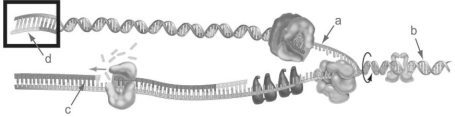 Figure 15.2
-Identify the lagging strand in Figure 15.2.
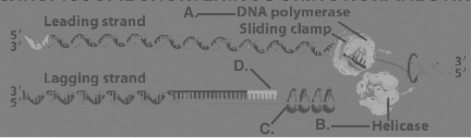 Figure 15.3
-Refer to Figure 15.3. Which structure is responsible for stabilizing DNA in its single- stranded form?
Figure 15.3
-Refer to Figure 15.3. Which structure is responsible for stabilizing DNA in its single- stranded form? (Short Answer)
4.9/5 (89)
(89) What is the difference between the leading strand and the lagging strand in DNA replication?
(Multiple Choice)
4.7/5 (88)
(88) Bodnar et al. 1998) used telomerase to extend the life span of normal human cells. Telomere shortening puts a limit on the number of times a cell can divide. How might adding telomerase affect cellular aging?
(Multiple Choice)
4.7/5 (78)
(78) Recent studies have shown that xeroderma pigmentosum an error in the nucleotide excision repair process) can result from mutations in one of seven genes. What can you infer from this finding?
(Multiple Choice)
5.0/5 (84)
(84) At a specific area of a chromosome, the following sequence of nucleotides is present where the chain opens to fo replication fork:
3' C C T A G G C T G C A A T C C 5'
An RNA primer is formed starting at the underlined T T) of the template. Which of the following represents the primer sequence?
(Multiple Choice)
5.0/5 (71)
(71) 
Filters
- Essay(0)
- Multiple Choice(0)
- Short Answer(0)
- True False(0)
- Matching(0)