



 Chat with AI
Exam 23: Evolutionary Processes

Exam 1: Biology and the Tree of Life35 Questions
Exam 2: Water and Carbon: the Chemical Basis of Life53 Questions
Exam 3: Protein Structure and Function40 Questions
Exam 4: Nucleic Acids and the Rna World40 Questions
Exam 5: An Introduction to Carbohydrates42 Questions
Exam 6: Lipids, Membranes, and the First Cells53 Questions
Exam 7: Inside the Cell41 Questions
Exam 8: Energy and Enzymes59 Questions
Exam 9: Cellular Respiration and Fermentation43 Questions
Exam 10: Photosynthesis41 Questions
Exam 11: Cellcell Interactions38 Questions
Exam 12: The Cell Cycle39 Questions
Exam 13: Meiosis40 Questions
Exam 14: Mendel and the Gene47 Questions
Exam 15: Dna and the Gene: Synthesis and Repair39 Questions
Exam 16: How Genes Work39 Questions
Exam 17: Transcription, Rna Processing, and Translation37 Questions
Exam 18: Control of Gene Expression in Bacteria38 Questions
Exam 19: Control of Gene Expression in Eukaryotes40 Questions
Exam 20: The Molecular Revolution: Biotechnology and Beyond39 Questions
Exam 21: Gene Structure and Development39 Questions
Exam 22: Evolution by Natural Selection42 Questions
Exam 23: Evolutionary Processes48 Questions
Exam 24: Speciation40 Questions
Exam 25: Phylogenies and the History of Life37 Questions
Exam 26: Bacteria and Archaea38 Questions
Exam 27: Protists36 Questions
Exam 28: Green Algae and Land Plants54 Questions
Exam 29: Fungi40 Questions
Exam 30: An Introduction to Animals42 Questions
Exam 31: Protostome Animals38 Questions
Exam 32: Deuterostome Animals43 Questions
Exam 33: Viruses35 Questions
Exam 34: Plant Form and Function39 Questions
Exam 35: Water and Sugar Transport in Plants42 Questions
Exam 36: Plant Nutrition37 Questions
Exam 37: Plant Sensory Systems, Signals, and Responses64 Questions
Exam 38: Plant Reproduction and Development44 Questions
Exam 39: Animal Form and Function37 Questions
Exam 40: Water and Electrolyte Balance in Animals41 Questions
Exam 41: Animal Nutrition43 Questions
Exam 42: Gas Exchange and Circulation46 Questions
Exam 43: Animal Nervous Systems40 Questions
Exam 44: Animal Sensory Systems43 Questions
Exam 45: Animal Movement42 Questions
Exam 46: Chemical Signals in Animals38 Questions
Exam 47: Animal Reproduction and Development39 Questions
Exam 48: The Immune System in Animals38 Questions
Exam 49: An Introduction to Ecology40 Questions
Exam 50: Behavioural Ecology39 Questions
Exam 51: Population Ecology49 Questions
Exam 52: Community Ecology38 Questions
Exam 53: Ecosystems and Global Ecology41 Questions
Exam 54: Biodiversity and Conservation Biology38 Questions
Select questions type


Which of the following statements about genetic drift is true?
(Multiple Choice)
5.0/5  (90)
(90) Which of the following is the most predictable outcome of increased gene flow between two populations?
(Multiple Choice)
4.8/5 (85)
(85) In some jacana species, males take care of the eggs and young, and females compete for territories and males aga one another. Female jacanas are significantly larger than males. Which of these statements would you predict to of this bird species?
1) Male jacana fitness is primarily limited by ability to take care of eggs and raise young.
2) Female jacana fitness is limited by the number of males with which a female mates.
3) Variation in reproductive success should be greater in male jacanas than in females.
4) Variation in reproductive success should be greater in female jacanas than in males.
5) Males and females have equal variation in reproductive success.
(Multiple Choice)
4.8/5 (79)
(79) Aendtype \#individuals 50 50 400 Use the information in the table above for the next questions).
-Given the information about the number of individuals of specific genotypes in the table above, what can you infer?
(Multiple Choice)
4.8/5 (70)
(70) Researchers Helle et al., 2004) analyzed rates of twin births in the Sami population of Northern Scandinavia during the eighteenth and nineteenth centuries. They found that 1) a baby born from a singleton pregnancy was more likely to survive to adulthood than a baby born from a twin pregnancy, and 2) the average number of offspring raised to adulthood was higher for women who had twins than for those who never had twins. These data suggest that in this population, human twinning rate was
(Multiple Choice)
4.8/5 (76)
(76) For Galápagos marine iguanas, body size is not correlated with survival, but small iguanas can sprint faster than large iguanas. If a new predator species e.g., cats) that preferably catches and eats slower iguanas is introduced to the island, iguana body size is likely to in the absence of other factors; the iguanas would then be under selection.
(Multiple Choice)
4.9/5 (87)
(87) An earthquake decimates a ground- squirrel population. The surviving population happens to have broader stripes on average than the initial population. If broadness of stripes is genetically determined, what effect has the ground- squirrel population experienced during the earthquake?
(Multiple Choice)
4.9/5 (98)
(98) Use the following information when answering the corresponding questions).
Researchers studying a small milkweed population note that some plants produce a toxin and other plants do not. They ident gene responsible for toxin production. The dominant allele T) codes for an enzyme that makes the toxin, and the recessive all
t) codes for a nonfunctional enzyme that cannot produce the toxin. Heterozygotes produce an intermediate amount of toxin. The genotypes of all individuals in the population are determined see chart) and used to determine the actual allele frequencies in the population.
 Figure 23.1
-Refer to Figure 23.1. Is this population in Hardy- Weinberg equilibrium?
Figure 23.1
-Refer to Figure 23.1. Is this population in Hardy- Weinberg equilibrium? (Multiple Choice)
4.9/5 (85)
(85) Suppose 64% of a remote mountain village can taste phenylthiocarbamide PTC) and must therefore have at least one copy of the dominant PTC taster allele. If this population conforms to Hardy- Weinberg expectations for this gene, what percentage of the population must be heterozygous for this trait?
(Multiple Choice)
4.7/5 (81)
(81) Three- spined stickleback fish Gasterosteus aculeatus) show substantial heritable variation in gill- raker length. Fish caught in open water tend to have longer gill rakers and eat different foods than those caught in shallower water. Longer gill rakers appear to function better for capturing open- water prey, while shorter gill rakers function better for capturing shallow- water prey. Which of the following types of selection is most likely to be found in a large lake open water in middle and shallow water around the sides) with a high density of these fish?
(Multiple Choice)
4.8/5 (90)
(90) If an allele is found at a frequency of 0.8 in a population that is in Hardy- Weinberg equilibrium, and an individual is heterozygous for that allele, what is the probability they will pass on that allele to their offspring?
(Multiple Choice)
4.9/5 (79)
(79) 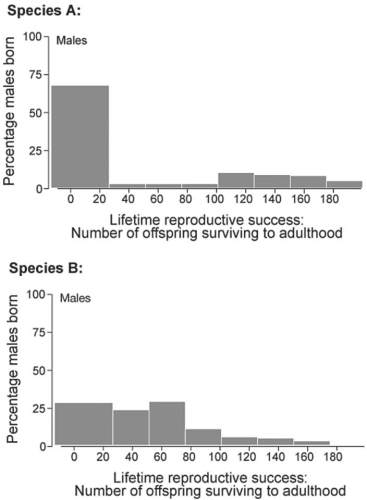 Figure 23.4
-Refer to Figure 23.4. Male reproductive success, measured as the number of offspring surviving to adulthood pupating), is found for two closely related beetle species and graphed above. Which of these statements would you expect to be true of sexual dimorphism in the two species?
Figure 23.4
-Refer to Figure 23.4. Male reproductive success, measured as the number of offspring surviving to adulthood pupating), is found for two closely related beetle species and graphed above. Which of these statements would you expect to be true of sexual dimorphism in the two species? (Multiple Choice)
4.7/5 (79)
(79) Use the following information when answering the corresponding questions).
Martin Wikelski and L. Michael Romero Body size, performance and fitness in Galápagos marine iguanas, Integrative and Comparative Biology 43 [2003]:376- 86) measured the snout- to- vent anus) length of Galápagos marine iguanas and observed the percent survival of different- sized animals. Figure 23.2 shows the log snout- vent length SVL, a measure of overall body size) plotted against the percent survival of these different size classes for males and females.
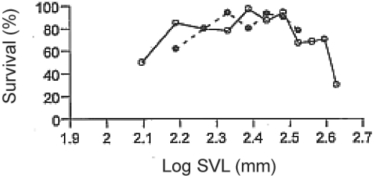 Figure 23.2
-Examine the figure above. What type of selection for body size appears to be occurring in these marine iguanas?
Figure 23.2
-Examine the figure above. What type of selection for body size appears to be occurring in these marine iguanas? (Multiple Choice)
4.9/5 (72)
(72) Speller et al. 2010) analyzed turkey mitochondrial DNA haplotypes and reported that turkeys were domesticated by precontact native North American cultures in several independent events. Which of the following would be evidence of domestication of turkeys?
(Multiple Choice)
4.8/5 (86)
(86) A beneficial point mutation occurs in a plant ovule, which is fertilized. The seed matures, falls to the ground, and starts to grow. Is the plant's population likely to show evolutionary change as a result of this mutation? Why or why not?
(Essay)
4.8/5 (83)
(83) In Kerr and Wright's experiment with 96 fruit- fly populations, only 4 males and 4 females bred in each generation. After 16 generations, 73% of their populations had only one allele present for the bristle morphology gene. Which of the following would you expect to occur if they allowed 10 males and 10 females to breed each in generation?
(Multiple Choice)
4.9/5 (82)
(82) Male turkeys have a snood, a flap of skin that hangs across their beak. Snood length is negatively correlated with parasite load e.g., males with longer snoods have fewer parasites), and females prefer to mate with long- snooded males. This is an example of
(Multiple Choice)
4.8/5 (86)
(86) Two frog populations same species) living in two neighboring lakes sing slightly different courtship songs. Predict what likely happens to the songs of the two frog populations after increased irrigation makes the land between the two lakes wetter. Females prefer loud frogs to quieter frogs, but do not distinguish between the two slightly different songs. Assume that courtship song differences have a genetic basis.
(Multiple Choice)
4.7/5 (87)
(87) Use the following information when answering the corresponding questions).
In 1983, a population of dark- eyed junco birds became established on the campus of the University of California, San Diego UCSD), which is located many miles from the junco's normal habitat in the mixed- coniferous temperate forests in the mountains. Juncos have white outer tail feathers that the males display during aggressive interactions and during courtship displays. Males with more white in their tail are more likely to win aggressive interactions, and females prefer to mate with males with more white in their tails. Females have less white in their tails than males, and display it less often. Pamela J. Yeh. 2004. Rapid evolution of a sexually selected trait following population establishment in a novel habitat. Evolution 58[1]:166- 74.)
-Based on the information given above, which of the following types of selection was most likely initially involved in the evolution of white outer tail feathers in juncos?
(Multiple Choice)
5.0/5 (81)
(81) Why doesn't inbreeding depression, by itself, cause evolution?
(Multiple Choice)
4.8/5 (66)
(66) 
Filters
- Essay(0)
- Multiple Choice(0)
- Short Answer(0)
- True False(0)
- Matching(0)