



 Chat with AI
Exam 42: Gas Exchange and Circulation

Exam 1: Biology and the Tree of Life35 Questions
Exam 2: Water and Carbon: the Chemical Basis of Life53 Questions
Exam 3: Protein Structure and Function40 Questions
Exam 4: Nucleic Acids and the Rna World40 Questions
Exam 5: An Introduction to Carbohydrates42 Questions
Exam 6: Lipids, Membranes, and the First Cells53 Questions
Exam 7: Inside the Cell41 Questions
Exam 8: Energy and Enzymes59 Questions
Exam 9: Cellular Respiration and Fermentation43 Questions
Exam 10: Photosynthesis41 Questions
Exam 11: Cellcell Interactions38 Questions
Exam 12: The Cell Cycle39 Questions
Exam 13: Meiosis40 Questions
Exam 14: Mendel and the Gene47 Questions
Exam 15: Dna and the Gene: Synthesis and Repair39 Questions
Exam 16: How Genes Work39 Questions
Exam 17: Transcription, Rna Processing, and Translation37 Questions
Exam 18: Control of Gene Expression in Bacteria38 Questions
Exam 19: Control of Gene Expression in Eukaryotes40 Questions
Exam 20: The Molecular Revolution: Biotechnology and Beyond39 Questions
Exam 21: Gene Structure and Development39 Questions
Exam 22: Evolution by Natural Selection42 Questions
Exam 23: Evolutionary Processes48 Questions
Exam 24: Speciation40 Questions
Exam 25: Phylogenies and the History of Life37 Questions
Exam 26: Bacteria and Archaea38 Questions
Exam 27: Protists36 Questions
Exam 28: Green Algae and Land Plants54 Questions
Exam 29: Fungi40 Questions
Exam 30: An Introduction to Animals42 Questions
Exam 31: Protostome Animals38 Questions
Exam 32: Deuterostome Animals43 Questions
Exam 33: Viruses35 Questions
Exam 34: Plant Form and Function39 Questions
Exam 35: Water and Sugar Transport in Plants42 Questions
Exam 36: Plant Nutrition37 Questions
Exam 37: Plant Sensory Systems, Signals, and Responses64 Questions
Exam 38: Plant Reproduction and Development44 Questions
Exam 39: Animal Form and Function37 Questions
Exam 40: Water and Electrolyte Balance in Animals41 Questions
Exam 41: Animal Nutrition43 Questions
Exam 42: Gas Exchange and Circulation46 Questions
Exam 43: Animal Nervous Systems40 Questions
Exam 44: Animal Sensory Systems43 Questions
Exam 45: Animal Movement42 Questions
Exam 46: Chemical Signals in Animals38 Questions
Exam 47: Animal Reproduction and Development39 Questions
Exam 48: The Immune System in Animals38 Questions
Exam 49: An Introduction to Ecology40 Questions
Exam 50: Behavioural Ecology39 Questions
Exam 51: Population Ecology49 Questions
Exam 52: Community Ecology38 Questions
Exam 53: Ecosystems and Global Ecology41 Questions
Exam 54: Biodiversity and Conservation Biology38 Questions
Select questions type


Use the following information when answering the corresponding questions).
Lymph hearts are pumping structures that drive lymph through the lymphatic system, returning it to the circulatory system a large veins entering the heart. Researchers examined rate and strength of pumping of lymph hearts in two species of amphibi toad Bufo marinus) and a frog Rana catesbiana). During hemorrhage or dehydration, the volume of blood in the circulatory system falls. A hormone, arginine vasotocin AVT), is released in these situations. The researchers examined the effect of AVT on lymph heart function. They found that AVT increased pressure at the lymph heart, but did not affect the rate of lymph heart pumping. They also examined the effect of atrial natriuretic peptide ANP), a hormone that is released when blood volume is higher than normal. E. A. DeGrauw and S. S. Hillman. 2004. General function and endocrine control of the posterior lymph hearts in Bufo marinus and Rana catesbiana. Physiological and Biochemical Zoology 774):594- 600.)
-What is a diagnosis of hypertension in adults based on?
(Multiple Choice)
4.8/5  (83)
(83) A significant increase in the amount of interstitial fluid surrounding the capillary beds of a human's lungs will cause
(Multiple Choice)
4.9/5 (76)
(76) 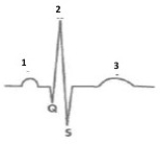 Figure 42.1
-On the ECG above, which waveform represents electrical activity within the atria?
Figure 42.1
-On the ECG above, which waveform represents electrical activity within the atria? (Multiple Choice)
4.8/5 (94)
(94) The oxygen content of water increases linearly with an increase in oxygen partial pressure, while the oxygen content of blood increases in a sigmoidal S- shaped) fashion. Why?
(Multiple Choice)
4.9/5 (74)
(74) Use the following information when answering the corresponding questions).
Lymph hearts are pumping structures that drive lymph through the lymphatic system, returning it to the circulatory system a large veins entering the heart. Researchers examined rate and strength of pumping of lymph hearts in two species of amphibi toad Bufo marinus) and a frog Rana catesbiana). During hemorrhage or dehydration, the volume of blood in the circulatory system falls. A hormone, arginine vasotocin AVT), is released in these situations. The researchers examined the effect of AVT on lymph heart function. They found that AVT increased pressure at the lymph heart, but did not affect the rate of lymph heart pumping. They also examined the effect of atrial natriuretic peptide ANP), a hormone that is released when blood volume is higher than normal. E. A. DeGrauw and S. S. Hillman. 2004. General function and endocrine control of the posterior lymph hearts in Bufo marinus and Rana catesbiana. Physiological and Biochemical Zoology 774):594- 600.)
-Many organs have adaptations to increase the rate of diffusion of a gas or solute. How are fish gills adapted to optimize oxygen absorption?
(Multiple Choice)
4.9/5 (77)
(77) Which of the following functions is not a function of insect hemolymph?
(Multiple Choice)
4.8/5 (73)
(73) 
Filters
- Essay(0)
- Multiple Choice(0)
- Short Answer(0)
- True False(0)
- Matching(0)