



 Chat with AI
Exam 42: Gas Exchange and Circulation

Exam 1: Biology and the Tree of Life35 Questions
Exam 2: Water and Carbon: the Chemical Basis of Life53 Questions
Exam 3: Protein Structure and Function40 Questions
Exam 4: Nucleic Acids and the Rna World40 Questions
Exam 5: An Introduction to Carbohydrates42 Questions
Exam 6: Lipids, Membranes, and the First Cells53 Questions
Exam 7: Inside the Cell41 Questions
Exam 8: Energy and Enzymes59 Questions
Exam 9: Cellular Respiration and Fermentation43 Questions
Exam 10: Photosynthesis41 Questions
Exam 11: Cellcell Interactions38 Questions
Exam 12: The Cell Cycle39 Questions
Exam 13: Meiosis40 Questions
Exam 14: Mendel and the Gene47 Questions
Exam 15: Dna and the Gene: Synthesis and Repair39 Questions
Exam 16: How Genes Work39 Questions
Exam 17: Transcription, Rna Processing, and Translation37 Questions
Exam 18: Control of Gene Expression in Bacteria38 Questions
Exam 19: Control of Gene Expression in Eukaryotes40 Questions
Exam 20: The Molecular Revolution: Biotechnology and Beyond39 Questions
Exam 21: Gene Structure and Development39 Questions
Exam 22: Evolution by Natural Selection42 Questions
Exam 23: Evolutionary Processes48 Questions
Exam 24: Speciation40 Questions
Exam 25: Phylogenies and the History of Life37 Questions
Exam 26: Bacteria and Archaea38 Questions
Exam 27: Protists36 Questions
Exam 28: Green Algae and Land Plants54 Questions
Exam 29: Fungi40 Questions
Exam 30: An Introduction to Animals42 Questions
Exam 31: Protostome Animals38 Questions
Exam 32: Deuterostome Animals43 Questions
Exam 33: Viruses35 Questions
Exam 34: Plant Form and Function39 Questions
Exam 35: Water and Sugar Transport in Plants42 Questions
Exam 36: Plant Nutrition37 Questions
Exam 37: Plant Sensory Systems, Signals, and Responses64 Questions
Exam 38: Plant Reproduction and Development44 Questions
Exam 39: Animal Form and Function37 Questions
Exam 40: Water and Electrolyte Balance in Animals41 Questions
Exam 41: Animal Nutrition43 Questions
Exam 42: Gas Exchange and Circulation46 Questions
Exam 43: Animal Nervous Systems40 Questions
Exam 44: Animal Sensory Systems43 Questions
Exam 45: Animal Movement42 Questions
Exam 46: Chemical Signals in Animals38 Questions
Exam 47: Animal Reproduction and Development39 Questions
Exam 48: The Immune System in Animals38 Questions
Exam 49: An Introduction to Ecology40 Questions
Exam 50: Behavioural Ecology39 Questions
Exam 51: Population Ecology49 Questions
Exam 52: Community Ecology38 Questions
Exam 53: Ecosystems and Global Ecology41 Questions
Exam 54: Biodiversity and Conservation Biology38 Questions
Select questions type


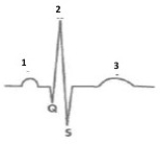 Figure 42.1
-On the ECG above, which waveform represents ventricular relaxation?
Figure 42.1
-On the ECG above, which waveform represents ventricular relaxation? (Multiple Choice)
4.8/5  (68)
(68) Why is it more difficult to obtain enough oxygen via respiration from water than from air?
(Multiple Choice)
4.8/5 (87)
(87) Which of the following statements supports the hypothesis that the bidirectional gas flow occurring in humans air goes in and out through the same passages) is less efficient than the unidirectional flow in fish?
(Multiple Choice)
4.8/5 (85)
(85) A rabbit taken from a meadow near sea level and moved to a meadow high on a mountainside would have some trouble breathing. Why?
(Multiple Choice)
4.7/5 (72)
(72) Figure 42.1
-On the ECG above, which waveform represents ventricular electrical activity?
Figure 42.1
-On the ECG above, which waveform represents ventricular electrical activity? (Multiple Choice)
4.8/5 (78)
(78) A mutation results in a form of hemoglobin with binding sites for four molecules of oxygen but does not exhibit cooperative binding. Which of the following would result?
(Multiple Choice)
4.7/5 (87)
(87) Which of the following conditions would be the most likely result of an abnormally high blood pressure in an animal, like a reptile, possessing a closed circulatory system?
(Multiple Choice)
5.0/5 (87)
(87) Which of the following is a function of the insect tracheal system?
(Multiple Choice)
4.8/5 (82)
(82) Birds generate a lot of heat, especially during flight. Yet the adipose tissue under their skin and the feathers atop their skin make it difficult to eliminate excess heat across the skin. Which of the following can absorb body heat and eliminate it from the bird most effectively?
(Multiple Choice)
4.9/5 (79)
(79) You prop open the gill covers of a fish, tie a string around its tail, and tow it backward through the water. This action forces water to flow in the back of the gill covers, from back to front over the gills, and out through the fish's mouth. What effect would this backward movement have on gas exchange?
(Multiple Choice)
5.0/5 (87)
(87) When you are jogging, your muscles are using more oxygen and releasing more carbon dioxide into the blood than when you are at home on the couch. Which of the following would occur during your jog?
(Multiple Choice)
4.8/5 (67)
(67) Which of the following mechanisms are used to regulate blood pressure in the closed circulatory system of vertebrates?
(Multiple Choice)
4.8/5 (90)
(90) Figure 42.1
-On the ECG above, within which waveform would atrial relaxation occur?
Figure 42.1
-On the ECG above, within which waveform would atrial relaxation occur? (Multiple Choice)
4.7/5 (77)
(77) The sun shining on a tidal pool during a hot day heats the water. As some water evaporates, the pool becomes saltier, causing which of the following?
(Multiple Choice)
4.9/5 (80)
(80) You are a physician, and see a patient who complains of abnormal fatigue during exercise. You find that the immediate problem is a buildup of carbon dioxide in the tissues. What is the most likely cause?
(Multiple Choice)
4.9/5 (70)
(70) In midsummer, you are fishing at a lake. You catch the most fish at the inlet of a stream into the lake, where logs and branches are creating turbulent flow and mixing deep water with the shallow water near the surface of the lake. What is the probable reason the fish are congregating in this area?
(Multiple Choice)
4.8/5 (87)
(87) Use the following information when answering the corresponding questions).
Lymph hearts are pumping structures that drive lymph through the lymphatic system, returning it to the circulatory system a large veins entering the heart. Researchers examined rate and strength of pumping of lymph hearts in two species of amphibi toad Bufo marinus) and a frog Rana catesbiana). During hemorrhage or dehydration, the volume of blood in the circulatory system falls. A hormone, arginine vasotocin AVT), is released in these situations. The researchers examined the effect of AVT on lymph heart function. They found that AVT increased pressure at the lymph heart, but did not affect the rate of lymph heart pumping. They also examined the effect of atrial natriuretic peptide ANP), a hormone that is released when blood volume is higher than normal. E. A. DeGrauw and S. S. Hillman. 2004. General function and endocrine control of the posterior lymph hearts in Bufo marinus and Rana catesbiana. Physiological and Biochemical Zoology 774):594- 600.)
-What effect would increasing lymph heart pressure have?
(Multiple Choice)
4.8/5 (92)
(92) Blood is pumped at high pressures in arteries from the heart to ensure that all parts of the body receive adequate blood flow. Capillary beds, however, would hemorrhage under direct arterial pressures. How does the design of the circulation network contribute to reducing blood pressure to avoid this scenario?
(Multiple Choice)
4.8/5 (77)
(77) Which of the following result, either directly or indirectly, when carbonic anhydrase is functioning properly?
(Multiple Choice)
4.9/5 (74)
(74) 
Filters
- Essay(0)
- Multiple Choice(0)
- Short Answer(0)
- True False(0)
- Matching(0)