



 Chat with AI
Exam 42: Circulation and Gas Exchange

Exam 1: Evolution, the Themes of Biology, and Scientific Inquiry51 Questions
Exam 2: The Chemical Context of Life61 Questions
Exam 3: Water and Life55 Questions
Exam 4: Carbon and the Molecular Diversity of Life58 Questions
Exam 5: The Structure and Function of Large Biological Molecules70 Questions
Exam 6: A Tour of the Cell66 Questions
Exam 7: Membrane Structure and Function68 Questions
Exam 8: An Introduction to Metabolism67 Questions
Exam 9: Cellular Respiration and Fermentation68 Questions
Exam 10: Photosynthesis65 Questions
Exam 11: Cell Communication65 Questions
Exam 12: The Cell Cycle66 Questions
Exam 13: Meiosis and Sexual Life Cycles64 Questions
Exam 14: Mendel and the Gene Idea62 Questions
Exam 15: The Chromosomal Basis of Inheritance58 Questions
Exam 16: The Molecular Basis of Inheritance65 Questions
Exam 17: Gene Expression: From Gene to Protein67 Questions
Exam 18: Regulation of Gene Expression66 Questions
Exam 19: Viruses54 Questions
Exam 20: Dna Tools and Biotechnology57 Questions
Exam 21: Genomes and Their Evolution44 Questions
Exam 22: Descent With Modification: a Darwinian View of Life60 Questions
Exam 23: The Evolution of Populations64 Questions
Exam 24: The Origin of Species67 Questions
Exam 25: The History of Life on Earth59 Questions
Exam 26: Phylogeny and the Tree of Life75 Questions
Exam 27: Bacteria and Archaea75 Questions
Exam 28: Protists79 Questions
Exam 29: Plant Diversity I: How Plants Colonised Land82 Questions
Exam 30: Plant Diversity Ii: the Evolution of Seed Plants80 Questions
Exam 31: Fungi70 Questions
Exam 32: An Overview of Animal Diversity67 Questions
Exam 33: An Introduction to Invertebrates83 Questions
Exam 34: The Origin and Evolution of Vertebrates82 Questions
Exam 35: Vascular Plant Structure, Growth, and Development65 Questions
Exam 36: Resource Acquisition and Transport in Vascular Plants74 Questions
Exam 37: Soil and Plant Nutrition52 Questions
Exam 38: Angiosperm Reproduction and Biotechnology60 Questions
Exam 39: Plant Responses to Internal and External Signals61 Questions
Exam 40: Basic Principles of Animal Form and Function68 Questions
Exam 41: Animal Nutrition64 Questions
Exam 42: Circulation and Gas Exchange67 Questions
Exam 43: The Immune System69 Questions
Exam 44: Osmoregulation and Excretion64 Questions
Exam 45: Hormones and the Endocrine System66 Questions
Exam 46: Animal Reproduction68 Questions
Exam 47: Animal Development70 Questions
Exam 48: Neurons, Synapses, and Signalling68 Questions
Exam 49: Nervous Systems65 Questions
Exam 50: Sensory and Motor Mechanisms67 Questions
Select questions type


During aerobic exercise, the partial pressure of oxygen in muscle cells will ________, thus the rate of diffusion of oxygen into the muscle tissue from the blood will ________.
(Multiple Choice)
4.8/5  (80)
(80) Large proteins such as albumin remain in capillaries rather than diffusing out, resulting in the ________.
(Multiple Choice)
4.7/5 (80)
(80) While jogging, a person has a stroke volume of 130 ml/beat and a heart rate of 120 beats/minute. If their resting stroke volume was 70 ml/beat and resting heart rate was 60 beats/minute, how did this person's cardiac output change?
(Multiple Choice)
4.9/5 (76)
(76) Atmospheric pressure at the summit of Mount Everest is about one-third the pressure at sea level, which is 760 mm Hg. If oxygen makes up 21% of the atmosphere by volume, the partial pressure of oxygen (PO₂) on Mount Everest is approximately ________.
(Multiple Choice)
4.9/5 (72)
(72) What would be the consequence if we were to reverse the direction of water flow over the gills of a fish, moving water inward past the operculum, past the gills, then out the mouth? This reversal of water flow would ________.
(Multiple Choice)
4.7/5 (94)
(94) Which of the following statements comparing respiration in fish and in mammals is correct?
(Multiple Choice)
4.9/5 (78)
(78) A rabbit taken from a paddock near sea level and moved to a paddock high on a mountainside would have some trouble breathing. Why?
(Multiple Choice)
4.8/5 (88)
(88) Blood returning to the mammalian heart in a pulmonary vein drains first into the
(Multiple Choice)
4.8/5 (78)
(78) To become bound to haemoglobin for transport in mammals, atmospheric molecules of oxygen must cross ________.
(Multiple Choice)
5.0/5 (75)
(75) Carbon dioxide levels in the blood and cerebrospinal fluid affect pH. This enables the organism to sense a disturbance in gas levels as ________.
(Multiple Choice)
4.9/5 (90)
(90) Countercurrent exchange in the fish gill helps to maximise ________.
(Multiple Choice)
4.8/5 (67)
(67) Small swollen areas in the neck, groin, and axillary region are associated with ________.
(Multiple Choice)
4.9/5 (76)
(76) An electrocardiogram (ECG) provides information about ________.
(Multiple Choice)
4.8/5 (71)
(71) Compared to mammals that are not adapted for diving, diving mammals ________.
(Multiple Choice)
4.9/5 (70)
(70) A patient with a heart rate of 70 beats/minute and a stroke volume of 70 mL/beat will have a cardiac output of ________.
(Multiple Choice)
4.9/5 (87)
(87) To adjust blood pressure independently in the capillaries of the gas-exchange surface and in the capillaries of the general body circulation, an organism would need a(n) ________.
(Multiple Choice)
4.9/5 (90)
(90) Which of the following conditions would most likely be due to high blood pressure in a mammal?
(Multiple Choice)
4.9/5 (73)
(73) Which of the following events would you predict as carbon dioxide is released from your muscles into the surrounding capillary bed?
(Multiple Choice)
4.8/5 (74)
(74) Based on the graph, which of the following statements is correct? 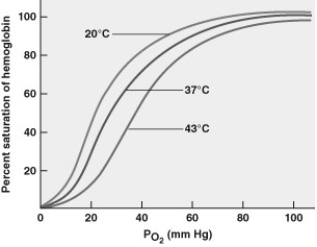
(Multiple Choice)
4.7/5 (86)
(86) 
Filters
- Essay(0)
- Multiple Choice(0)
- Short Answer(0)
- True False(0)
- Matching(0)