



 Chat with AI
Exam 57: Community Ecology

Exam 1: Studying Life 97 Questions
Exam 2: Small Molecules and the Chemistry of Life145 Questions
Exam 3: Proteins, Carbohydrates, and Lipids145 Questions
Exam 4: Nucleic Acids and the Origin of Life117 Questions
Exam 5: Cells: the Working Units of Life153 Questions
Exam 6: Cell Membranes136 Questions
Exam 7: Cell Signaling and Communication150 Questions
Exam 8: Energy, Enzymes, and Metabolism153 Questions
Exam 9: Pathways That Harvest Chemical Energy154 Questions
Exam 10: Photosynthesis: Energy From Sunlight158 Questions
Exam 11: The Cell Cycle and Cell Division176 Questions
Exam 12: Inheritance, Genes, and Chromosomes150 Questions
Exam 13: Dna and Its Role in Heredity155 Questions
Exam 14: From Dna to Protein: Gene Expression151 Questions
Exam 15: Gene Mutation and Molecular Medicine141 Questions
Exam 16: Regulation of Gene Expression151 Questions
Exam 17: Genomes145 Questions
Exam 18: Recombinent Dna and Biotechnology141 Questions
Exam 19: Differential Gene Expression in Development147 Questions
Exam 20: Development and Evolutionary Change120 Questions
Exam 21: Evidence and Mechanisms of Evolution151 Questions
Exam 22: Reconstructing and Using Phylogenies137 Questions
Exam 23: Species and Their Formation140 Questions
Exam 24: Evolution of Genes and Genomes141 Questions
Exam 25: The History of Life on Earth145 Questions
Exam 26: Bacteria and Archaea: the Prokaryotic Domains156 Questions
Exam 27: The Origin and Diversification of Eukaryotes148 Questions
Exam 28: Plants Without Seeds: From Water to Land144 Questions
Exam 29: The Evolution of Seed Plants141 Questions
Exam 30: Fungi: Recyclers, Pathogens, Parasites, and Plant Partners144 Questions
Exam 31: Animal Origins and the Evolution of Body Plans122 Questions
Exam 32: Protostome Animals146 Questions
Exam 33: Deuterostome Animals150 Questions
Exam 34: The Plant Body132 Questions
Exam 35: Transport in Plants133 Questions
Exam 36: Plant Nutrition134 Questions
Exam 37: Regulation of Plant Growth137 Questions
Exam 38: Reproduction in Flowering Plants140 Questions
Exam 39: Plant Responses to Environmental Challenges131 Questions
Exam 40: Physiology, Homeostasis, and Temperature Regulation146 Questions
Exam 41: Animal Hormones147 Questions
Exam 42: Immunology: Animal Defense Systems150 Questions
Exam 43: Animal Reproduction150 Questions
Exam 44: Animal Development147 Questions
Exam 45: Neurons and Nervous Systems145 Questions
Exam 46: Sensory Systems150 Questions
Exam 47: The Mammalian Nervous System: Structure and Higher Function150 Questions
Exam 48: Musculoskeletal Systems150 Questions
Exam 49: Gas Exchange in Animals149 Questions
Exam 50: Circulatory Systems150 Questions
Exam 51: Nutrition, Digestion, and Absorption149 Questions
Exam 52: Salt and Water Balance and Nitrogen145 Questions
Exam 53: Animal Behavior149 Questions
Exam 54: Ecology and the Distribution of Life150 Questions
Exam 55: Population Ecology123 Questions
Exam 56: Species Interaction and Coevolution131 Questions
Exam 57: Community Ecology133 Questions
Exam 58: Ecosystems and Global Ecology142 Questions
Exam 59: Conservation Biology116 Questions
Select questions type


Although ecologists often diagram the interactions of who eats whom by means of a food chain, depicting the complexity of real-life interactions often requires the construction of a _______.
(Short Answer)
4.8/5  (79)
(79) Suppose that you are responsible for managing community succession to provide suitable habitat for an endangered animal species that is long-lived and has a low reproductive rate. Would you expect this species to be adapted to early or late successional stages?
(Essay)
4.7/5 (91)
(91) The theory of _______ biogeography was developed to explain _______ relationships.
(Short Answer)
4.8/5 (89)
(89) Where do biomass pyramids like the one shown below occur, and what are the conditions that create them? 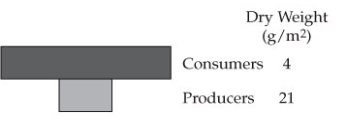
(Essay)
4.8/5 (64)
(64) In comparison with temperate regions at higher latitudes, tropical communities show greater species richness. Which of the following is a hypothesis that has been proposed to explain this difference?
(Multiple Choice)
4.8/5 (84)
(84) Which of the following represents the correct chronological order (from earliest to latest) in which the organisms below appear on a dead body?
(Multiple Choice)
4.8/5 (70)
(70) For most communities, species richness will _______ if fertilizer is added when productivity is low, and it will _______ if fertilizer is added when productivity is high.
(Multiple Choice)
4.8/5 (90)
(90) Species such as beavers, which create structures in the environment that serve as habitat for other species, are called _______.
(Short Answer)
4.9/5 (81)
(81) In the open ocean, the biomass of a community is usually highest at the _______ trophic level because the _______ have a high reproductive rate.
(Short Answer)
4.8/5 (61)
(61) Cows, which eat grass and other plant materials, belong to the _______ trophic level.
(Short Answer)
4.8/5 (78)
(78) Which of the following is a hypothesis generated by biologists to explain species richness gradients?
(Multiple Choice)
4.8/5 (77)
(77) David Tilman's experiments showed that as species richness increases, productivity _______ and the variation in productivity _______.
(Multiple Choice)
4.8/5 (85)
(85) Refer to the graph below showing the effect of species number on arrival and extinction rates. According to the theory of island biogeography, which of the following statements about the graph is true? 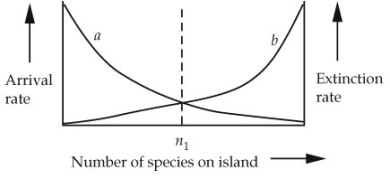
(Multiple Choice)
4.7/5 (77)
(77) In which of the following ecosystems would you expect to observe the lowest biomass of primary consumers relative to the biomass of the primary producers?
(Multiple Choice)
4.9/5 (73)
(73) 
Filters
- Essay(0)
- Multiple Choice(0)
- Short Answer(0)
- True False(0)
- Matching(0)