



 Chat with AI
Exam 57: Community Ecology

Exam 1: Studying Life 97 Questions
Exam 2: Small Molecules and the Chemistry of Life145 Questions
Exam 3: Proteins, Carbohydrates, and Lipids145 Questions
Exam 4: Nucleic Acids and the Origin of Life117 Questions
Exam 5: Cells: the Working Units of Life153 Questions
Exam 6: Cell Membranes136 Questions
Exam 7: Cell Signaling and Communication150 Questions
Exam 8: Energy, Enzymes, and Metabolism153 Questions
Exam 9: Pathways That Harvest Chemical Energy154 Questions
Exam 10: Photosynthesis: Energy From Sunlight158 Questions
Exam 11: The Cell Cycle and Cell Division176 Questions
Exam 12: Inheritance, Genes, and Chromosomes150 Questions
Exam 13: Dna and Its Role in Heredity155 Questions
Exam 14: From Dna to Protein: Gene Expression151 Questions
Exam 15: Gene Mutation and Molecular Medicine141 Questions
Exam 16: Regulation of Gene Expression151 Questions
Exam 17: Genomes145 Questions
Exam 18: Recombinent Dna and Biotechnology141 Questions
Exam 19: Differential Gene Expression in Development147 Questions
Exam 20: Development and Evolutionary Change120 Questions
Exam 21: Evidence and Mechanisms of Evolution151 Questions
Exam 22: Reconstructing and Using Phylogenies137 Questions
Exam 23: Species and Their Formation140 Questions
Exam 24: Evolution of Genes and Genomes141 Questions
Exam 25: The History of Life on Earth145 Questions
Exam 26: Bacteria and Archaea: the Prokaryotic Domains156 Questions
Exam 27: The Origin and Diversification of Eukaryotes148 Questions
Exam 28: Plants Without Seeds: From Water to Land144 Questions
Exam 29: The Evolution of Seed Plants141 Questions
Exam 30: Fungi: Recyclers, Pathogens, Parasites, and Plant Partners144 Questions
Exam 31: Animal Origins and the Evolution of Body Plans122 Questions
Exam 32: Protostome Animals146 Questions
Exam 33: Deuterostome Animals150 Questions
Exam 34: The Plant Body132 Questions
Exam 35: Transport in Plants133 Questions
Exam 36: Plant Nutrition134 Questions
Exam 37: Regulation of Plant Growth137 Questions
Exam 38: Reproduction in Flowering Plants140 Questions
Exam 39: Plant Responses to Environmental Challenges131 Questions
Exam 40: Physiology, Homeostasis, and Temperature Regulation146 Questions
Exam 41: Animal Hormones147 Questions
Exam 42: Immunology: Animal Defense Systems150 Questions
Exam 43: Animal Reproduction150 Questions
Exam 44: Animal Development147 Questions
Exam 45: Neurons and Nervous Systems145 Questions
Exam 46: Sensory Systems150 Questions
Exam 47: The Mammalian Nervous System: Structure and Higher Function150 Questions
Exam 48: Musculoskeletal Systems150 Questions
Exam 49: Gas Exchange in Animals149 Questions
Exam 50: Circulatory Systems150 Questions
Exam 51: Nutrition, Digestion, and Absorption149 Questions
Exam 52: Salt and Water Balance and Nitrogen145 Questions
Exam 53: Animal Behavior149 Questions
Exam 54: Ecology and the Distribution of Life150 Questions
Exam 55: Population Ecology123 Questions
Exam 56: Species Interaction and Coevolution131 Questions
Exam 57: Community Ecology133 Questions
Exam 58: Ecosystems and Global Ecology142 Questions
Exam 59: Conservation Biology116 Questions
Select questions type


In the lodgepole pine community, periodic disturbances occur in the form of
(Multiple Choice)
4.9/5  (76)
(76) In the figure below, the species numbers of many islands of different sizes were plotted against their distance from the mainland, and data points for islands of similar size were connected to form the four curves. Circle the letter of the curve corresponding to the group of islands with the smallest size. 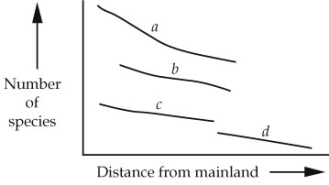
(Short Answer)
4.9/5 (81)
(81) How is an understanding of heterotrophic succession useful in the field of law enforcement?
(Essay)
4.9/5 (72)
(72) To quantify _______ diversity (diversity within a single community), biologists often use the _______ diversity index, which takes into account relative abundance as well as number of species.
(Short Answer)
4.8/5 (89)
(89) According to the island biogeography model, _______ and _______ determine the number of species on an island.
(Multiple Choice)
4.8/5 (91)
(91) The species that live and interact in a given area constitute an ecological
(Multiple Choice)
4.8/5 (79)
(79) Growing crops as monocultures is standard practice in modern agriculture. Why are monocultures unstable? What agricultural practices might result in more stable ecological communities?
(Essay)
4.7/5 (95)
(95) A change in community composition following a disturbance is called _______ succession.
(Multiple Choice)
4.8/5 (93)
(93) A termite mound alters the environment in such a way that it creates new habitats for a variety of organisms. In constructing these mounds, therefore, termites can be considered
(Multiple Choice)
4.7/5 (80)
(80) Organisms that receive their energy from several trophic levels are said to be
(Multiple Choice)
4.8/5 (77)
(77) Which of the following is the correct chronological order (from youngest to oldest) for the succession of species in Glacier Park?
(Multiple Choice)
4.8/5 (87)
(87) Which of the following statements about cheese skippers is true?
(Multiple Choice)
4.7/5 (96)
(96) One assumption of the theory of island biogeography is that _______ population sizes of species will _______.
(Multiple Choice)
4.8/5 (93)
(93) Tilman's experiments showed that increasing species richness enhanced community stability because
(Multiple Choice)
4.9/5 (73)
(73) Organisms that are most likely to tolerate harsh conditions are found during
(Multiple Choice)
4.7/5 (85)
(85) Suppose that the gamma diversity for a marshy habitat and the gamma diversity for a sandy habitat are comparable for a particular geographic region, but the alpha diversity for marshy habitats tends to be much greater than the alpha diversity for sandy habitats. We could conclude that
(Multiple Choice)
4.9/5 (71)
(71) Pyramid diagrams of energy and biomass distribution for forests and grasslands differ because
(Multiple Choice)
4.8/5 (87)
(87) 
Filters
- Essay(0)
- Multiple Choice(0)
- Short Answer(0)
- True False(0)
- Matching(0)