



 Chat with AI
Exam 59: The Biosphere

Exam 1: The Science of Biology67 Questions
Exam 2: The Nature of Molecules73 Questions
Exam 3: The Chemical Building Blocks of Life70 Questions
Exam 4: Cell Structure72 Questions
Exam 5: Membranes58 Questions
Exam 6: Energy and Metabolism68 Questions
Exam 7: How Cells Harvest Energy76 Questions
Exam 8: Photosynthesis72 Questions
Exam 9: Cell Communication57 Questions
Exam 10: How Cells Divide71 Questions
Exam 11: Sexual Reproduction and Meiosis58 Questions
Exam 12: Patterns of Inheritance62 Questions
Exam 13: Chromosomes Mapping and the Meiosis - Inheritance Connection57 Questions
Exam 14: Dna: the Genetic Material64 Questions
Exam 15: Genes and How They Work96 Questions
Exam 16: Control of Gene Expression65 Questions
Exam 17: Biotechnology70 Questions
Exam 18: Genomics59 Questions
Exam 19: Cellular Mechanisms of Development60 Questions
Exam 20: Genes Within Populations71 Questions
Exam 21: The Evidence for Evolution59 Questions
Exam 22: The Origin of Species61 Questions
Exam 23: Systematics and the Phylogenetic Revolution60 Questions
Exam 24: Genome Evolution53 Questions
Exam 25: Evolution of Development46 Questions
Exam 26: The Tree of Life68 Questions
Exam 27: Viruses63 Questions
Exam 28: Prokaryotes67 Questions
Exam 29: Protists61 Questions
Exam 30: Overview of Green Plants75 Questions
Exam 31: Fungi61 Questions
Exam 32: Overview of Animal Diversity56 Questions
Exam 33: Noncoelomate Invertebrates58 Questions
Exam 34: Coelomate Invertebrates106 Questions
Exam 35: Vertebrates94 Questions
Exam 36: Plant Form63 Questions
Exam 37: Vegetative Plant Development54 Questions
Exam 38: Transport in Plants54 Questions
Exam 39: Plant Nutrition and Soils53 Questions
Exam 40: Plant Defense Responses45 Questions
Exam 41: Sensory Systems in Plants62 Questions
Exam 42: Plant Reproduction57 Questions
Exam 43: The Animal Body and Principles of Regulation54 Questions
Exam 44: The Nervous System65 Questions
Exam 45: Sensory Systems65 Questions
Exam 46: The Endocrine System86 Questions
Exam 47: The Musculoskeletal System54 Questions
Exam 48: The Digestive System73 Questions
Exam 49: The Respiratory System58 Questions
Exam 50: The Circulatory System59 Questions
Exam 51: Osmotic Regulation and the Urinary System54 Questions
Exam 52: The Immune System71 Questions
Exam 53: The Reproductive System77 Questions
Exam 54: Animal Development72 Questions
Exam 55: Behavioral Biology76 Questions
Exam 56: Population Ecology65 Questions
Exam 57: Community of Ecology74 Questions
Exam 58: Dynamics of Ecosystems69 Questions
Exam 59: The Biosphere79 Questions
Exam 60: Conservation Biology62 Questions
Select questions type


Biomagnification is a significant problem in aquatic communities.The amounts of chemicals magnify (increase or accumulate)at each new link in a food chain.Use the following information to calculate the level of chemical X in the large-mouth bass.One small plant can accumulate 1 unit of chemical X.A microscopic animal eats 15 small plants.A minnow consumes 10 microscopic animals,a large-mouth bass consumes 20 minnows.
(Multiple Choice)
4.7/5  (70)
(70) Choose the letter of the best match from the following:
-Very high solar energy input;temperature and moisture not limiting;high biomass,high total productivity;many species.
(Multiple Choice)
4.9/5 (75)
(75) Which one of the following statements about the causes and effects of global warming is false?
(Multiple Choice)
4.8/5 (87)
(87) Choose the letter of the best match from the following:
-Spruce,fir;moose;deep snow,brief summer;vast sameness;marshes,lakes,and ponds.
(Multiple Choice)
5.0/5 (78)
(78) A friend asks you about what has caused global warming.You explain
(Multiple Choice)
4.7/5 (70)
(70) About 40% of the world's photosynthetic productivity occurs in _________floating in the oceans.
(Multiple Choice)
5.0/5 (72)
(72) A layer of ozone in the upper atmosphere shields Earth from most
(Multiple Choice)
4.9/5 (87)
(87) The eastern sides of the Sierra Nevada mountains are much drier than the western sides,and the vegetation is often different;this phenomenon is called the
(Multiple Choice)
4.9/5 (85)
(85) Open tropical and subtropical grasslands with scattered shrubs and trees are called
(Multiple Choice)
4.7/5 (78)
(78) One of the most serious and rapidly accelerating of all global environmental problems is the loss of
(Multiple Choice)
4.7/5 (77)
(77) Biomes are broad regional areas with defined flora and fauna.Which one of the following choices correctly identifies the biomes shown plotted in the included graph of precipitation versus temperature? 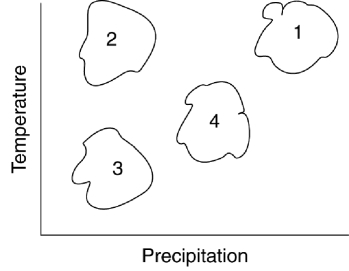
(Multiple Choice)
4.8/5 (81)
(81) Which one of the following statements about acid precipitation is false?
(Multiple Choice)
4.7/5 (90)
(90) The orbit of Earth's revolution around the sun is inclined at an angle of 23.5 ,and this causes seasonal variation in the amount of solar energy reaching a given region.Which of the following does not differ for the tropics and polar regions?
(Multiple Choice)
4.9/5 (75)
(75) Tropical climates are warmer than temperate climates because
(Multiple Choice)
5.0/5 (91)
(91) The equatorial region of rising warm,moist air of low pressure causes
(Multiple Choice)
4.9/5 (80)
(80) Which one of the following statements about ozone depletion is false?
(Multiple Choice)
4.7/5 (89)
(89) Which of the following choices best describes the relationship that exists between moisture and air temperature?
(Multiple Choice)
4.7/5 (84)
(84) Which of the following gases is most associated with global warming?
(Multiple Choice)
4.7/5 (69)
(69) 
Filters
- Essay(0)
- Multiple Choice(0)
- Short Answer(0)
- True False(0)
- Matching(0)