



 Chat with AI
Exam 55: Behavioral Biology

Exam 1: The Science of Biology67 Questions
Exam 2: The Nature of Molecules73 Questions
Exam 3: The Chemical Building Blocks of Life70 Questions
Exam 4: Cell Structure72 Questions
Exam 5: Membranes58 Questions
Exam 6: Energy and Metabolism68 Questions
Exam 7: How Cells Harvest Energy76 Questions
Exam 8: Photosynthesis72 Questions
Exam 9: Cell Communication57 Questions
Exam 10: How Cells Divide71 Questions
Exam 11: Sexual Reproduction and Meiosis58 Questions
Exam 12: Patterns of Inheritance62 Questions
Exam 13: Chromosomes Mapping and the Meiosis - Inheritance Connection57 Questions
Exam 14: Dna: the Genetic Material64 Questions
Exam 15: Genes and How They Work96 Questions
Exam 16: Control of Gene Expression65 Questions
Exam 17: Biotechnology70 Questions
Exam 18: Genomics59 Questions
Exam 19: Cellular Mechanisms of Development60 Questions
Exam 20: Genes Within Populations71 Questions
Exam 21: The Evidence for Evolution59 Questions
Exam 22: The Origin of Species61 Questions
Exam 23: Systematics and the Phylogenetic Revolution60 Questions
Exam 24: Genome Evolution53 Questions
Exam 25: Evolution of Development46 Questions
Exam 26: The Tree of Life68 Questions
Exam 27: Viruses63 Questions
Exam 28: Prokaryotes67 Questions
Exam 29: Protists61 Questions
Exam 30: Overview of Green Plants75 Questions
Exam 31: Fungi61 Questions
Exam 32: Overview of Animal Diversity56 Questions
Exam 33: Noncoelomate Invertebrates58 Questions
Exam 34: Coelomate Invertebrates106 Questions
Exam 35: Vertebrates94 Questions
Exam 36: Plant Form63 Questions
Exam 37: Vegetative Plant Development54 Questions
Exam 38: Transport in Plants54 Questions
Exam 39: Plant Nutrition and Soils53 Questions
Exam 40: Plant Defense Responses45 Questions
Exam 41: Sensory Systems in Plants62 Questions
Exam 42: Plant Reproduction57 Questions
Exam 43: The Animal Body and Principles of Regulation54 Questions
Exam 44: The Nervous System65 Questions
Exam 45: Sensory Systems65 Questions
Exam 46: The Endocrine System86 Questions
Exam 47: The Musculoskeletal System54 Questions
Exam 48: The Digestive System73 Questions
Exam 49: The Respiratory System58 Questions
Exam 50: The Circulatory System59 Questions
Exam 51: Osmotic Regulation and the Urinary System54 Questions
Exam 52: The Immune System71 Questions
Exam 53: The Reproductive System77 Questions
Exam 54: Animal Development72 Questions
Exam 55: Behavioral Biology76 Questions
Exam 56: Population Ecology65 Questions
Exam 57: Community of Ecology74 Questions
Exam 58: Dynamics of Ecosystems69 Questions
Exam 59: The Biosphere79 Questions
Exam 60: Conservation Biology62 Questions
Select questions type


Courtship is often dependent on

Free
(Multiple Choice)
4.9/5  (81)
(81) Correct Answer: Verified
B
In birds,if the offspring require extensive care,usually involving both the male and female,they are called
Free
(Multiple Choice)
4.9/5 (77)
(77) Correct Answer:Verified
VerifiedB
A friend asks you the following question: "would you please explain the differences between home range and territory?" Which choice would be the best response to your friend's question?
Free
(Multiple Choice)
4.8/5 (89)
(89) Correct Answer:Verified
VerifiedC
The vertical dive of a moth for cover when it hears the ultrasound chirps of an approaching bat is an example of a(n)
(Multiple Choice)
4.9/5 (78)
(78) Which one of the following is not an example of associative learning?
(Multiple Choice)
4.8/5 (72)
(72) Habituation belongs to which of the following types of learning?
(Multiple Choice)
4.9/5 (82)
(82) Recent research revealed that the development of psychological well-being and growth is influenced by
(Multiple Choice)
4.7/5 (84)
(84) The scientist who described inclusive fitness as the effect an individual has on propagating its alleles through its own reproduction and through kin selection was
(Multiple Choice)
4.8/5 (82)
(82) Male Mormon crickets choose larger females as mate choices.Which of the following statements best interprets the graph? 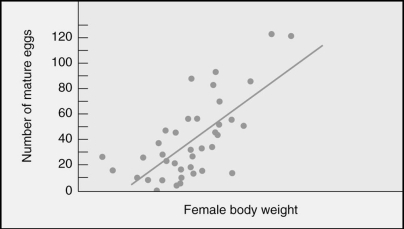
(Multiple Choice)
4.8/5 (69)
(69) Animal behavioral researchers have identified some specific _________ that control behaviors.
(Multiple Choice)
4.8/5 (80)
(80) Hamilton explained the origin of altruism in selected insect societies with his kin selection model of sex determination.Since males are haploid and females are diploid,the workers share a very high proportion of alleles,theoretically as high as 75%;this model is called
(Multiple Choice)
4.9/5 (68)
(68) Choose the letter of the best match from the following:
-Social attachments are formed between parents and offspring.
(Multiple Choice)
4.9/5 (71)
(71) If a scientist is conducting a study of how a male bird's song and the female bird's response evolved,she would be asking about the
(Multiple Choice)
4.7/5 (88)
(88) Which of the following treatment outcomes would not be expected based on our current understanding of the genetic basis of pair bonding in the prairie vole (Microtus ochrogaster)and montane voles (Microtus montanus)?
(Multiple Choice)
4.9/5 (91)
(91) Animals tend to feed on prey that maximize their net energy intake.This is called the __________ theory.
(Multiple Choice)
4.9/5 (81)
(81) A nonassociative learning called __________ can be defined as a decrease in response to a repeated stimulus that has no positive or negative consequences.
(Multiple Choice)
4.9/5 (73)
(73) The name of the study of behavior,behavioral genetics,and comparative psychology is _______.
(Multiple Choice)
4.8/5 (63)
(63) As an animal matures,it forms attachments to other individuals and develops preferences.This process is called
(Multiple Choice)
4.9/5 (76)
(76) Foraging bees communicate with other bees in a waggle dance to give information about the food.The important cue in the dance that conveys information about the required flight direction to the food source relative to the hive-sun direction is the
(Multiple Choice)
4.9/5 (90)
(90) Choose the letter of the best match from the following:
-Information processing that suggests thinking.
(Multiple Choice)
5.0/5 (65)
(65) 
Filters
- Essay(0)
- Multiple Choice(0)
- Short Answer(0)
- True False(0)
- Matching(0)