



 Chat with AI
Exam 55: Behavioral Biology

Exam 1: The Science of Biology67 Questions
Exam 2: The Nature of Molecules73 Questions
Exam 3: The Chemical Building Blocks of Life70 Questions
Exam 4: Cell Structure72 Questions
Exam 5: Membranes58 Questions
Exam 6: Energy and Metabolism68 Questions
Exam 7: How Cells Harvest Energy76 Questions
Exam 8: Photosynthesis72 Questions
Exam 9: Cell Communication57 Questions
Exam 10: How Cells Divide71 Questions
Exam 11: Sexual Reproduction and Meiosis58 Questions
Exam 12: Patterns of Inheritance62 Questions
Exam 13: Chromosomes Mapping and the Meiosis - Inheritance Connection57 Questions
Exam 14: Dna: the Genetic Material64 Questions
Exam 15: Genes and How They Work96 Questions
Exam 16: Control of Gene Expression65 Questions
Exam 17: Biotechnology70 Questions
Exam 18: Genomics59 Questions
Exam 19: Cellular Mechanisms of Development60 Questions
Exam 20: Genes Within Populations71 Questions
Exam 21: The Evidence for Evolution59 Questions
Exam 22: The Origin of Species61 Questions
Exam 23: Systematics and the Phylogenetic Revolution60 Questions
Exam 24: Genome Evolution53 Questions
Exam 25: Evolution of Development46 Questions
Exam 26: The Tree of Life68 Questions
Exam 27: Viruses63 Questions
Exam 28: Prokaryotes67 Questions
Exam 29: Protists61 Questions
Exam 30: Overview of Green Plants75 Questions
Exam 31: Fungi61 Questions
Exam 32: Overview of Animal Diversity56 Questions
Exam 33: Noncoelomate Invertebrates58 Questions
Exam 34: Coelomate Invertebrates106 Questions
Exam 35: Vertebrates94 Questions
Exam 36: Plant Form63 Questions
Exam 37: Vegetative Plant Development54 Questions
Exam 38: Transport in Plants54 Questions
Exam 39: Plant Nutrition and Soils53 Questions
Exam 40: Plant Defense Responses45 Questions
Exam 41: Sensory Systems in Plants62 Questions
Exam 42: Plant Reproduction57 Questions
Exam 43: The Animal Body and Principles of Regulation54 Questions
Exam 44: The Nervous System65 Questions
Exam 45: Sensory Systems65 Questions
Exam 46: The Endocrine System86 Questions
Exam 47: The Musculoskeletal System54 Questions
Exam 48: The Digestive System73 Questions
Exam 49: The Respiratory System58 Questions
Exam 50: The Circulatory System59 Questions
Exam 51: Osmotic Regulation and the Urinary System54 Questions
Exam 52: The Immune System71 Questions
Exam 53: The Reproductive System77 Questions
Exam 54: Animal Development72 Questions
Exam 55: Behavioral Biology76 Questions
Exam 56: Population Ecology65 Questions
Exam 57: Community of Ecology74 Questions
Exam 58: Dynamics of Ecosystems69 Questions
Exam 59: The Biosphere79 Questions
Exam 60: Conservation Biology62 Questions
Select questions type


Which one of the following statements comparing the naked mole rat social system with social insect societies is false?
(Multiple Choice)
4.8/5  (66)
(66) You place an empty dog-food dish across the room from a puppy that then goes over to investigate the dish.You pick the dish up and ten minutes later you place it in a different part of the room,and you keep repeating this pattern.After the fifth time the puppy no longer goes over to the empty dish.Which of the following terms best describes this form of learning?
(Multiple Choice)
4.9/5 (80)
(80) Young birds see objects flying overhead and respond by crouching down into the nest and remaining still.Over time some objects become familiar and the young birds do not crouch down.This type of learning is referred to as
(Multiple Choice)
5.0/5 (75)
(75) The area over which an animal moves in the course of daily activity,but which it does not necessarily defend against other animals,is its
(Multiple Choice)
4.9/5 (94)
(94) The degree of parental investment required often results in the non-random mating behavior called ___________.
(Multiple Choice)
4.9/5 (81)
(81) The genetic basis of behavior is supported by all of the following except
(Multiple Choice)
4.8/5 (100)
(100) All of the following are examples of animal behavioral responses to environmental cues except
(Multiple Choice)
4.8/5 (74)
(74) Chemical signals that mediate interactions between two or more members of a given species are called ________________.
(Multiple Choice)
4.8/5 (77)
(77) Choose the letter of the best match from the following:
-Move long distances using sun and stars.
(Multiple Choice)
4.9/5 (76)
(76) Artificial selection and hybridization can demonstrate the __________ basis of behavior.
(Multiple Choice)
4.8/5 (79)
(79) Konrad Lorenz demonstrated that newly hatched birds would direct their social behavior toward him if they saw him first after they hatched from their eggs.This is referred to as
(Multiple Choice)
4.9/5 (80)
(80) The modification of behavior as a result of experience is called
(Multiple Choice)
4.8/5 (78)
(78) In species where the young are precocial,meaning requiring little parental care,males may be more likely to be
(Multiple Choice)
4.9/5 (76)
(76) Which of the following is an appropriate interpretation for these graphs? 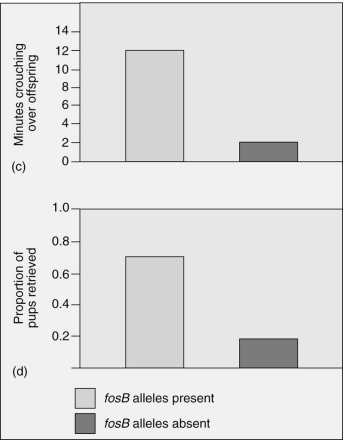 Maternal care (as measured by minutes crouching over offspring and proportion of pups retrieved)in female mice that have the fosB allele is
 (Multiple Choice)
4.8/5 (78)
(78) Choose the letter of the best match from the following:
-Innate motor program.
(Multiple Choice)
5.0/5 (86)
(86) A behavior that has evolved to aid relatives,although at personal risk,and thus increases the chance of your genes being passed on to the next generation is known as
(Multiple Choice)
4.9/5 (82)
(82) Which one of the following examples describes a communication mode that would be best for signaling over the greatest distance in a dark,densely forested environment?
(Multiple Choice)
4.8/5 (78)
(78) Choose the letter of the best match from the following:
-A form of communication in honeybees.
(Multiple Choice)
4.9/5 (69)
(69) Pea fowl (peacocks and peahens)show sexual dimorphism.Which statement best describes the graphed data? 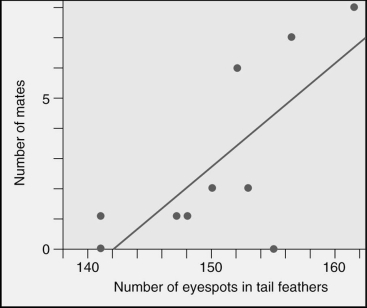
(Multiple Choice)
4.8/5 (88)
(88) Alarm calling seems to be an example of ________,that is,it favors relatives.
(Multiple Choice)
4.8/5 (65)
(65) 
Filters
- Essay(0)
- Multiple Choice(0)
- Short Answer(0)
- True False(0)
- Matching(0)