



 Chat with AI
Exam 56: Population Ecology

Exam 1: The Science of Biology67 Questions
Exam 2: The Nature of Molecules73 Questions
Exam 3: The Chemical Building Blocks of Life70 Questions
Exam 4: Cell Structure72 Questions
Exam 5: Membranes58 Questions
Exam 6: Energy and Metabolism68 Questions
Exam 7: How Cells Harvest Energy76 Questions
Exam 8: Photosynthesis72 Questions
Exam 9: Cell Communication57 Questions
Exam 10: How Cells Divide71 Questions
Exam 11: Sexual Reproduction and Meiosis58 Questions
Exam 12: Patterns of Inheritance62 Questions
Exam 13: Chromosomes Mapping and the Meiosis - Inheritance Connection57 Questions
Exam 14: Dna: the Genetic Material64 Questions
Exam 15: Genes and How They Work96 Questions
Exam 16: Control of Gene Expression65 Questions
Exam 17: Biotechnology70 Questions
Exam 18: Genomics59 Questions
Exam 19: Cellular Mechanisms of Development60 Questions
Exam 20: Genes Within Populations71 Questions
Exam 21: The Evidence for Evolution59 Questions
Exam 22: The Origin of Species61 Questions
Exam 23: Systematics and the Phylogenetic Revolution60 Questions
Exam 24: Genome Evolution53 Questions
Exam 25: Evolution of Development46 Questions
Exam 26: The Tree of Life68 Questions
Exam 27: Viruses63 Questions
Exam 28: Prokaryotes67 Questions
Exam 29: Protists61 Questions
Exam 30: Overview of Green Plants75 Questions
Exam 31: Fungi61 Questions
Exam 32: Overview of Animal Diversity56 Questions
Exam 33: Noncoelomate Invertebrates58 Questions
Exam 34: Coelomate Invertebrates106 Questions
Exam 35: Vertebrates94 Questions
Exam 36: Plant Form63 Questions
Exam 37: Vegetative Plant Development54 Questions
Exam 38: Transport in Plants54 Questions
Exam 39: Plant Nutrition and Soils53 Questions
Exam 40: Plant Defense Responses45 Questions
Exam 41: Sensory Systems in Plants62 Questions
Exam 42: Plant Reproduction57 Questions
Exam 43: The Animal Body and Principles of Regulation54 Questions
Exam 44: The Nervous System65 Questions
Exam 45: Sensory Systems65 Questions
Exam 46: The Endocrine System86 Questions
Exam 47: The Musculoskeletal System54 Questions
Exam 48: The Digestive System73 Questions
Exam 49: The Respiratory System58 Questions
Exam 50: The Circulatory System59 Questions
Exam 51: Osmotic Regulation and the Urinary System54 Questions
Exam 52: The Immune System71 Questions
Exam 53: The Reproductive System77 Questions
Exam 54: Animal Development72 Questions
Exam 55: Behavioral Biology76 Questions
Exam 56: Population Ecology65 Questions
Exam 57: Community of Ecology74 Questions
Exam 58: Dynamics of Ecosystems69 Questions
Exam 59: The Biosphere79 Questions
Exam 60: Conservation Biology62 Questions
Select questions type


The rate at which a population of a given species will increase when no limits are placed on its rate of growth is called its __________.

Free
(Multiple Choice)
4.8/5  (78)
(78) Correct Answer: Verified
C
Population pyramids are primarily used to show
Free
(Multiple Choice)
4.8/5 (67)
(67) Correct Answer:Verified
VerifiedD
The r-selected populations are characterized by all of the following except
Free
(Multiple Choice)
4.8/5 (79)
(79) Correct Answer:Verified
VerifiedE
Spacing within a population for a species that is strongly territorial would be expected to be
(Multiple Choice)
4.9/5 (84)
(84) Effects that are dependent on the size of the population and regulate the growth of populations are called ___________ effects.
(Multiple Choice)
4.9/5 (75)
(75) What point on the graph (marked by A,B,C,D,or E)shows the result of a density independent change in the size of the population?
(Multiple Choice)
4.9/5 (74)
(74) In the sigmoid growth curve,the carrying capacity of the environment is
(Multiple Choice)
5.0/5 (75)
(75) Clumped or patched populations that undergo local periodic extinction and recolonization are called
(Multiple Choice)
4.9/5 (79)
(79) In the logistic growth model,as the number of individuals in the population (N)approaches the carrying capacity (K),the intrinsic rate of growth (r)
(Multiple Choice)
4.9/5 (67)
(67) In the logistic growth model,as the number of individuals in the population (N)approaches the carrying capacity (K),the rate of growth (dN/dt)
(Multiple Choice)
4.9/5 (88)
(88) Organisms that produce offspring several times over many seasons exhibit a life history adaptation called
(Multiple Choice)
5.0/5 (85)
(85) Parental care of the young is usually associated with species with a Type ___ survivorship curve.
(Multiple Choice)
5.0/5 (94)
(94) Population studies include all of the following features except
(Multiple Choice)
4.8/5 (87)
(87) What is the most reasonable conclusion that can be made from data graphed in the figure. 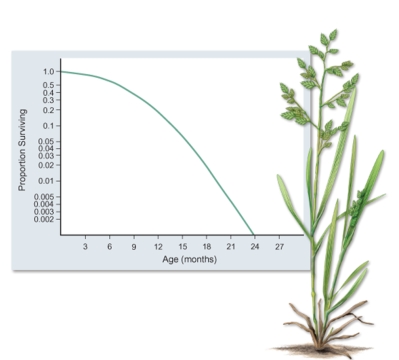
(Multiple Choice)
4.8/5 (73)
(73) During the late 1800s,cattle egrets arrived in South America from Africa and began to colonize.Their range has expanded dramatically over the years.They were able to do this because
(Multiple Choice)
4.8/5 (89)
(89) A small group of mice are released on an island without mice but with abundant food for mice and no predators.After the population size stabilizes for several years,a hurricane drastically reduces it,we can now say that
(Multiple Choice)
4.9/5 (64)
(64) Which of the following factors is not one that increases the likelihood of population extinction?
(Multiple Choice)
4.9/5 (76)
(76) The biotic potential representing growth without limits at its maximal rate is given the symbol
(Multiple Choice)
4.8/5 (74)
(74) 
Filters
- Essay(0)
- Multiple Choice(0)
- Short Answer(0)
- True False(0)
- Matching(0)