



 Chat with AI
Exam 56: Population Ecology

Exam 1: The Science of Biology67 Questions
Exam 2: The Nature of Molecules73 Questions
Exam 3: The Chemical Building Blocks of Life70 Questions
Exam 4: Cell Structure72 Questions
Exam 5: Membranes58 Questions
Exam 6: Energy and Metabolism68 Questions
Exam 7: How Cells Harvest Energy76 Questions
Exam 8: Photosynthesis72 Questions
Exam 9: Cell Communication57 Questions
Exam 10: How Cells Divide71 Questions
Exam 11: Sexual Reproduction and Meiosis58 Questions
Exam 12: Patterns of Inheritance62 Questions
Exam 13: Chromosomes Mapping and the Meiosis - Inheritance Connection57 Questions
Exam 14: Dna: the Genetic Material64 Questions
Exam 15: Genes and How They Work96 Questions
Exam 16: Control of Gene Expression65 Questions
Exam 17: Biotechnology70 Questions
Exam 18: Genomics59 Questions
Exam 19: Cellular Mechanisms of Development60 Questions
Exam 20: Genes Within Populations71 Questions
Exam 21: The Evidence for Evolution59 Questions
Exam 22: The Origin of Species61 Questions
Exam 23: Systematics and the Phylogenetic Revolution60 Questions
Exam 24: Genome Evolution53 Questions
Exam 25: Evolution of Development46 Questions
Exam 26: The Tree of Life68 Questions
Exam 27: Viruses63 Questions
Exam 28: Prokaryotes67 Questions
Exam 29: Protists61 Questions
Exam 30: Overview of Green Plants75 Questions
Exam 31: Fungi61 Questions
Exam 32: Overview of Animal Diversity56 Questions
Exam 33: Noncoelomate Invertebrates58 Questions
Exam 34: Coelomate Invertebrates106 Questions
Exam 35: Vertebrates94 Questions
Exam 36: Plant Form63 Questions
Exam 37: Vegetative Plant Development54 Questions
Exam 38: Transport in Plants54 Questions
Exam 39: Plant Nutrition and Soils53 Questions
Exam 40: Plant Defense Responses45 Questions
Exam 41: Sensory Systems in Plants62 Questions
Exam 42: Plant Reproduction57 Questions
Exam 43: The Animal Body and Principles of Regulation54 Questions
Exam 44: The Nervous System65 Questions
Exam 45: Sensory Systems65 Questions
Exam 46: The Endocrine System86 Questions
Exam 47: The Musculoskeletal System54 Questions
Exam 48: The Digestive System73 Questions
Exam 49: The Respiratory System58 Questions
Exam 50: The Circulatory System59 Questions
Exam 51: Osmotic Regulation and the Urinary System54 Questions
Exam 52: The Immune System71 Questions
Exam 53: The Reproductive System77 Questions
Exam 54: Animal Development72 Questions
Exam 55: Behavioral Biology76 Questions
Exam 56: Population Ecology65 Questions
Exam 57: Community of Ecology74 Questions
Exam 58: Dynamics of Ecosystems69 Questions
Exam 59: The Biosphere79 Questions
Exam 60: Conservation Biology62 Questions
Select questions type


The size at which a population stabilizes in a particular place is defined as the __________ for that species.
(Multiple Choice)
4.9/5  (72)
(72) Examples of organisms showing K-selected adaptations include all of the following except
(Multiple Choice)
4.9/5 (77)
(77) Many times species are composed of networks of distinct populations called metapopulations.Metapopulations occur in areas where
(Multiple Choice)
4.9/5 (76)
(76) A small group of mice are released on an island without mice but with abundant food for mice and no predators.Initially,the growth of the mouse population will be limited mainly by
(Multiple Choice)
4.8/5 (90)
(90) You construct a life table for a plant species and find that in all cases about the same proportion of the cohort survive to the beginning of the next time interval.Such a plant would have
(Multiple Choice)
4.7/5 (70)
(70) Select the description of a population pyramid for a population that has the largest potential for exponential growth.
(Multiple Choice)
5.0/5 (70)
(70) Which one of the following is not a correct distinction about source-sink metapopulations?
(Multiple Choice)
4.9/5 (67)
(67) The figure included shows the body temperature of lizards versus air temperature in two different habitats-open and shaded forest.Which one of the following conclusions is best supported by these data. 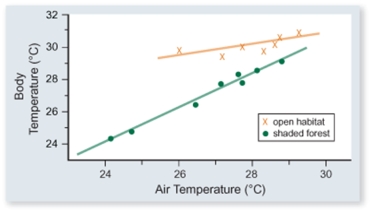
(Multiple Choice)
4.8/5 (90)
(90) The human population growth rate has declined over the past 30 years.This means
(Multiple Choice)
4.8/5 (86)
(86) The trade-off between investments in current reproduction and in growth that promotes future reproduction is referred to as the total cost of
(Multiple Choice)
4.8/5 (81)
(81) A community and the nonliving factors with which it interacts is called a(n)
(Multiple Choice)
4.7/5 (88)
(88) A small group of mice are released on an island without mice but with abundant food for mice and no predators.When the population stabilizes
(Multiple Choice)
4.8/5 (73)
(73) Some population parameters vary directly (as one increases,the second increases)and some vary inversely (as one increases,the second decreases)with population density.Which one of the following would be expected to vary inversely with population density?
(Multiple Choice)
4.9/5 (64)
(64) All of the following apply to density-dependent factors except that they
(Multiple Choice)
4.9/5 (79)
(79) A species whose population growth is not well described by the logistic growth equation is likely to have all of the following traits except
(Multiple Choice)
4.9/5 (74)
(74) In the sigmoid growth curve,the number of individuals at any one time is
(Multiple Choice)
4.8/5 (78)
(78) Most density-dependent factors show negative feedback relative to population size.Which one of the following is more likely to show positive feedback relative to population size?
(Multiple Choice)
4.7/5 (77)
(77) 
Filters
- Essay(0)
- Multiple Choice(0)
- Short Answer(0)
- True False(0)
- Matching(0)