



 Chat with AI
Exam 48: Animal Reproduction

Exam 1: Biology and the Tree of Life40 Questions
Exam 2: Water and Carbon: the Chemical Basis of Life50 Questions
Exam 3: Protein Structure and Function47 Questions
Exam 4: Nucleic Acids and the Rna World33 Questions
Exam 5: An Introduction to Carbohydrates30 Questions
Exam 6: Lipids, membranes, and the First Cells47 Questions
Exam 7: Inside the Cell28 Questions
Exam 8: Cell-Cell Interactions27 Questions
Exam 9: Cellular Respiration and Fermentation27 Questions
Exam 10: Photosynthesis32 Questions
Exam 11: The Cell Cycle31 Questions
Exam 12: Meiosis34 Questions
Exam 13: Mendel and the Gene32 Questions
Exam 14: Dna and the Gene: Synthesis and Repair37 Questions
Exam 15: How Genes Work34 Questions
Exam 16: Transcription and Translation38 Questions
Exam 17: Control of Gene Expression in Bacteria31 Questions
Exam 18: Control of Gene Expression in Eukaryotes37 Questions
Exam 19: Analyzing and Engineering Genes40 Questions
Exam 20: Genomics38 Questions
Exam 21: Principles of Development25 Questions
Exam 22: An Introduction to Animal Development22 Questions
Exam 23: An Introduction to Plant Development21 Questions
Exam 24: Evolution by Natural Selection32 Questions
Exam 25: Evolutionary Processes32 Questions
Exam 26: Speciation33 Questions
Exam 27: Phylogenies and the History of Life38 Questions
Exam 28: Bacteria and Archaea38 Questions
Exam 29: Protists34 Questions
Exam 30: Green Plants49 Questions
Exam 31: Fungi37 Questions
Exam 32: An Introduction to Animals38 Questions
Exam 33: Protostome Animals38 Questions
Exam 34: Deuterostome Animals46 Questions
Exam 35: Viruses31 Questions
Exam 36: Plant Form and Function39 Questions
Exam 37: Water and Sugar Transport in Plants42 Questions
Exam 38: Plant Nutrition36 Questions
Exam 39: Plant Sensory Systems, signals, and Responses66 Questions
Exam 40: Plant Reproduction41 Questions
Exam 41: Animal Form and Function29 Questions
Exam 42: Water and Electrolyte Balance in Animals38 Questions
Exam 43: Animal Nutrition37 Questions
Exam 44: Gas Exchange and Circulation37 Questions
Exam 45: Electrical Signals in Animals33 Questions
Exam 46: Animal Sensory Systems and Movement36 Questions
Exam 47: Chemical Signals in Animals33 Questions
Exam 48: Animal Reproduction34 Questions
Exam 49: The Immune System in Animals32 Questions
Exam 50: An Introduction to Ecology38 Questions
Exam 51: Behavioral Ecology37 Questions
Exam 52: Population Ecology46 Questions
Exam 53: Community Ecology39 Questions
Exam 54: Ecosystems41 Questions
Exam 55: Biodiversity and Conservation Biology39 Questions
Select questions type


Figure 48.1
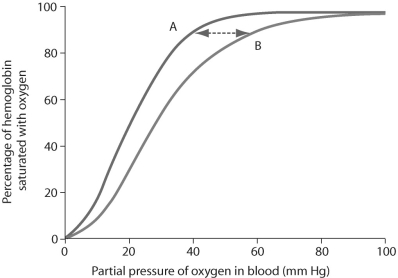 -Based on Figure 48.1 above,showing fetal (A)and adult (B)oxygen-hemoglobin saturation curves,which of the following conclusions is true?
 (Multiple Choice)
4.9/5  (75)
(75) Use the following information when answering the corresponding question(s).
For your internship at the local zoo,you have been assigned to help with the new orangutan-breeding program.Little is known about orangutan reproductive hormones,but hormone feedback cycles are often the same in closely related animals.You have been asked to use your knowledge of the interactions of human reproductive hormones to recommend injections to promote ovulation in a female orangutan when a visiting male arrives for a brief breeding visit.
-A pregnant woman comes into the hospital past her due date.The doctor decides it is time for the baby to be delivered.Before performing a cesarean section,the doctor wants to try to induce labor.Which of the following would she most likely inject?
(Multiple Choice)
4.9/5 (77)
(77) Why was it informative for researchers to study the proximate causation of Daphnia switching reproductive tactics in the laboratory?
(Multiple Choice)
4.8/5 (74)
(74) Which of the following correctly describes a difference between spermatogenesis and oogenesis?
(Multiple Choice)
5.0/5 (88)
(88) Which of the following is a challenge to the hypothesis that bats produce an unusually large number of sperm in order to increase the probability of conception when females engage in multiple matings?
(Multiple Choice)
4.8/5 (80)
(80) Which of the following represents the correct sequence of events for sexual reproduction?
(Multiple Choice)
4.8/5 (81)
(81) You decide to study two species of birds,both of which form monogamous pairs (one male and one female).In species 1,you find that the eggs in a pair's nest are in fact almost always the offspring of that pair.In species 2,you are surprised to find that many of the eggs in a nest were actually fathered by males of neighboring pairs.Apparently,mating outside of monogamous pairings is widespread in species 2.Given this information,what would be the logical prediction to make before comparing testis size of males of the two species?
(Multiple Choice)
4.9/5 (90)
(90) Which embryonic tissue is responsible for forming the membrane that can be found completely surrounding the embryo while in utero?
(Multiple Choice)
4.8/5 (89)
(89) During the menstrual cycle,_____ peaks first,_____ peak next,and finally _____ surges.
(Multiple Choice)
4.7/5 (87)
(87) Which of the following correctly describes the reproduction of males in Daphnia?
(Multiple Choice)
4.8/5 (79)
(79) Which of the following is the most likely explanation for the lack of a filter blocking the passage of alcohol between the maternal and fetal circulations in humans?
(Multiple Choice)
4.8/5 (80)
(80) Use the following information when answering the corresponding question(s).
Estrogens found in the environment have raised concerns about effects on reproductive health of animals.Researchers studied the effects that estrogens in the water have on sexual differentiation in zebrafish.They exposed embryo-larval (0-21 days post-hatching),juvenile (21-42 days post-hatching),and adult (over 200 days post-hatching)fish to three concentrations of 17β-estradiol (5,25,and 100 nanograms/liter)that are within the range of concentrations found in water leaving sewage treatment plants in different countries.They then examined the proportion of males and females when the fish exposed at embryo-larval and juvenile stages reached adulthood.Embryo-larval stage fish that had been exposed to 100 ng/l 17β-estradiol resulted in adult populations that had substantially more females than males compared to control groups.Embryo-larval fish that had been exposed to 5 and 25 ng/l of 17β-estradiol did not show a statistically significant shift in the proportion of females.(Brion,F. ,C.R.Tyler,X.Palazzi,B.Laillet,J.M.Porcher,J.Garric,and P.Flammarion.2004.Impacts of 17β-estradiol,including environmentally relevant concentrations,on reproduction after exposure during embryo-larval-,juvenile-,and adult-life stages in zebrafish (Danio rerio).Aquatic Toxicology 68:193-217. )
-Refer to the paragraph on the effects of estrogens in the environment.You are assigned to write the report to the Environmental Protection Agency,which needs to decide what level of 17β-estradiol to permit in sewage output.You do not want to make the level any lower than necessary,because it requires substantial additional money for the extra treatment of sewage.Given the data presented above,what level of 17β-estradiol would you suggest is safe to prevent feminization of fish?
(Multiple Choice)
4.9/5 (79)
(79) Animals that have external fertilization are most likely to reproduce in which of the following areas?
(Multiple Choice)
4.8/5 (83)
(83) In an animal that switches between sexual and asexual reproduction,when is sexual reproduction more likely to occur?
(Multiple Choice)
4.8/5 (83)
(83) 
Filters
- Essay(0)
- Multiple Choice(0)
- Short Answer(0)
- True False(0)
- Matching(0)