



 Chat with AI
Exam 42: Water and Electrolyte Balance in Animals

Exam 1: Biology and the Tree of Life40 Questions
Exam 2: Water and Carbon: the Chemical Basis of Life50 Questions
Exam 3: Protein Structure and Function47 Questions
Exam 4: Nucleic Acids and the Rna World33 Questions
Exam 5: An Introduction to Carbohydrates30 Questions
Exam 6: Lipids, membranes, and the First Cells47 Questions
Exam 7: Inside the Cell28 Questions
Exam 8: Cell-Cell Interactions27 Questions
Exam 9: Cellular Respiration and Fermentation27 Questions
Exam 10: Photosynthesis32 Questions
Exam 11: The Cell Cycle31 Questions
Exam 12: Meiosis34 Questions
Exam 13: Mendel and the Gene32 Questions
Exam 14: Dna and the Gene: Synthesis and Repair37 Questions
Exam 15: How Genes Work34 Questions
Exam 16: Transcription and Translation38 Questions
Exam 17: Control of Gene Expression in Bacteria31 Questions
Exam 18: Control of Gene Expression in Eukaryotes37 Questions
Exam 19: Analyzing and Engineering Genes40 Questions
Exam 20: Genomics38 Questions
Exam 21: Principles of Development25 Questions
Exam 22: An Introduction to Animal Development22 Questions
Exam 23: An Introduction to Plant Development21 Questions
Exam 24: Evolution by Natural Selection32 Questions
Exam 25: Evolutionary Processes32 Questions
Exam 26: Speciation33 Questions
Exam 27: Phylogenies and the History of Life38 Questions
Exam 28: Bacteria and Archaea38 Questions
Exam 29: Protists34 Questions
Exam 30: Green Plants49 Questions
Exam 31: Fungi37 Questions
Exam 32: An Introduction to Animals38 Questions
Exam 33: Protostome Animals38 Questions
Exam 34: Deuterostome Animals46 Questions
Exam 35: Viruses31 Questions
Exam 36: Plant Form and Function39 Questions
Exam 37: Water and Sugar Transport in Plants42 Questions
Exam 38: Plant Nutrition36 Questions
Exam 39: Plant Sensory Systems, signals, and Responses66 Questions
Exam 40: Plant Reproduction41 Questions
Exam 41: Animal Form and Function29 Questions
Exam 42: Water and Electrolyte Balance in Animals38 Questions
Exam 43: Animal Nutrition37 Questions
Exam 44: Gas Exchange and Circulation37 Questions
Exam 45: Electrical Signals in Animals33 Questions
Exam 46: Animal Sensory Systems and Movement36 Questions
Exam 47: Chemical Signals in Animals33 Questions
Exam 48: Animal Reproduction34 Questions
Exam 49: The Immune System in Animals32 Questions
Exam 50: An Introduction to Ecology38 Questions
Exam 51: Behavioral Ecology37 Questions
Exam 52: Population Ecology46 Questions
Exam 53: Community Ecology39 Questions
Exam 54: Ecosystems41 Questions
Exam 55: Biodiversity and Conservation Biology39 Questions
Select questions type


Which of the following affects the osmolarity of a solution?
(Multiple Choice)
4.8/5  (79)
(79) Reabsorption of water in the hindgut of insects is controlled by which of the following?
(Multiple Choice)
4.9/5 (86)
(86) Table 42.1
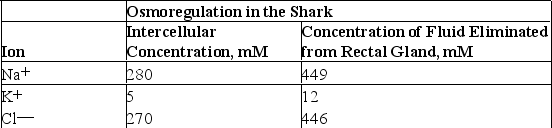 -Refer to Table 42.1:
Because the shark rectal gland functions only when ATP molecules are present,what can you infer about the movement of Na⁺,K⁺,and Cl⁻?
-Refer to Table 42.1:
Because the shark rectal gland functions only when ATP molecules are present,what can you infer about the movement of Na⁺,K⁺,and Cl⁻? (Multiple Choice)
4.8/5 (89)
(89) Malpighian tubules form pre-urine,which is further processed by which of the following anatomical structures?
(Multiple Choice)
4.9/5 (78)
(78) When a cell is in equilibrium with its environment which of the following occurs for substances that can diffuse through the cell?
(Multiple Choice)
4.8/5 (94)
(94) In flour beetles and desert locusts,how is water conserved?
(Multiple Choice)
4.8/5 (73)
(73) Paramecia live in pond water (a hypotonic environment).They have a structural feature,a contractile vacuole,that enables them to osmoregulate.If you observed paramecia in the following solutions,at which sucrose concentration would you expect the contractile vacuole to be most active?
(Multiple Choice)
5.0/5 (80)
(80) Terrestrial organisms lose water through evaporation.In what ecosystem might an entomologist find a good study organism to examine the prevention of water loss?
(Multiple Choice)
4.7/5 (77)
(77) Your doctor takes a urine sample and finds protein in your urine.She orders one urine sample a day for one week.After analysis of the urine she does not see the protein elevation in any of the samples.Which of the following questions should she ask to determine what might have lead to this transient protein elevation?
(Multiple Choice)
4.9/5 (82)
(82) Table 42.1
-The intercellular concentration of three electrolytes is compared with the concentration of these electrolytes in fluid eliminated from the shark rectal gland in Table 42.1.Based on the data,which of the following is a likely function of the rectal gland?
-The intercellular concentration of three electrolytes is compared with the concentration of these electrolytes in fluid eliminated from the shark rectal gland in Table 42.1.Based on the data,which of the following is a likely function of the rectal gland? (Multiple Choice)
5.0/5 (84)
(84) The products of filtration in the renal corpuscle enter the renal tubule through which of the following structures?
(Multiple Choice)
4.7/5 (78)
(78) Figure 42.1
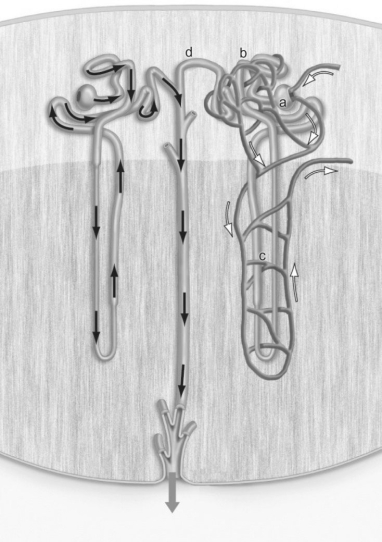 -Figure 42.1 shows a nephron.Where does filtration take place in the nephron?
 (Short Answer)
4.8/5 (75)
(75) Tissues of sharks are isotonic to seawater,but their concentrations of sodium ions,potassium ions,and chloride ions in cells and extracellular fluids are similar to those of freshwater fishes.What can you infer about the movement of sodium and chloride in these animals?
(Multiple Choice)
4.9/5 (86)
(86) How does ion composition of pre-urine differ from hemolymph?
(Multiple Choice)
4.9/5 (85)
(85) What role does Na⁺/K⁺-ATPase play in salt excretion by the shark rectal gland?
(Multiple Choice)
5.0/5 (83)
(83) What is the function of the osmotic gradient found in the kidney?
(Multiple Choice)
4.8/5 (84)
(84) 
Filters
- Essay(0)
- Multiple Choice(0)
- Short Answer(0)
- True False(0)
- Matching(0)