



 Chat with AI
Exam 36: Plant Form and Function

Exam 1: Biology and the Tree of Life40 Questions
Exam 2: Water and Carbon: the Chemical Basis of Life50 Questions
Exam 3: Protein Structure and Function47 Questions
Exam 4: Nucleic Acids and the Rna World33 Questions
Exam 5: An Introduction to Carbohydrates30 Questions
Exam 6: Lipids, membranes, and the First Cells47 Questions
Exam 7: Inside the Cell28 Questions
Exam 8: Cell-Cell Interactions27 Questions
Exam 9: Cellular Respiration and Fermentation27 Questions
Exam 10: Photosynthesis32 Questions
Exam 11: The Cell Cycle31 Questions
Exam 12: Meiosis34 Questions
Exam 13: Mendel and the Gene32 Questions
Exam 14: Dna and the Gene: Synthesis and Repair37 Questions
Exam 15: How Genes Work34 Questions
Exam 16: Transcription and Translation38 Questions
Exam 17: Control of Gene Expression in Bacteria31 Questions
Exam 18: Control of Gene Expression in Eukaryotes37 Questions
Exam 19: Analyzing and Engineering Genes40 Questions
Exam 20: Genomics38 Questions
Exam 21: Principles of Development25 Questions
Exam 22: An Introduction to Animal Development22 Questions
Exam 23: An Introduction to Plant Development21 Questions
Exam 24: Evolution by Natural Selection32 Questions
Exam 25: Evolutionary Processes32 Questions
Exam 26: Speciation33 Questions
Exam 27: Phylogenies and the History of Life38 Questions
Exam 28: Bacteria and Archaea38 Questions
Exam 29: Protists34 Questions
Exam 30: Green Plants49 Questions
Exam 31: Fungi37 Questions
Exam 32: An Introduction to Animals38 Questions
Exam 33: Protostome Animals38 Questions
Exam 34: Deuterostome Animals46 Questions
Exam 35: Viruses31 Questions
Exam 36: Plant Form and Function39 Questions
Exam 37: Water and Sugar Transport in Plants42 Questions
Exam 38: Plant Nutrition36 Questions
Exam 39: Plant Sensory Systems, signals, and Responses66 Questions
Exam 40: Plant Reproduction41 Questions
Exam 41: Animal Form and Function29 Questions
Exam 42: Water and Electrolyte Balance in Animals38 Questions
Exam 43: Animal Nutrition37 Questions
Exam 44: Gas Exchange and Circulation37 Questions
Exam 45: Electrical Signals in Animals33 Questions
Exam 46: Animal Sensory Systems and Movement36 Questions
Exam 47: Chemical Signals in Animals33 Questions
Exam 48: Animal Reproduction34 Questions
Exam 49: The Immune System in Animals32 Questions
Exam 50: An Introduction to Ecology38 Questions
Exam 51: Behavioral Ecology37 Questions
Exam 52: Population Ecology46 Questions
Exam 53: Community Ecology39 Questions
Exam 54: Ecosystems41 Questions
Exam 55: Biodiversity and Conservation Biology39 Questions
Select questions type


Imagine that you bought three identical young tomato plants.One you put to grow in the sunny location in a tranquil part of your garden,one on the windy and sunny hill nearby,and one in the shady part of the garden.How will these plants look in two months' time?
(Multiple Choice)
4.8/5  (70)
(70) You find a plant unfamiliar to you and observe that it has vascular bundles scattered throughout the stem cross section.What do you conclude about the plant?
(Multiple Choice)
4.7/5 (82)
(82) Monocot vascular bundles do not have a vascular cambium between the xylem and phloem.This means that _____.
(Multiple Choice)
4.8/5 (70)
(70) Apical meristems of dicots are at the tips of stems.Apical meristems of grasses are at ground level or slightly below,concealed by the leaves.The leaves also have an intercalary meristem at their bases.What does this mean when considering care of a lawn or soccer field?
(Multiple Choice)
4.8/5 (68)
(68) For each of the structures indicated on the diagram of a cross section of a plant leaf (below),indicate the function from the following list,for which it is most likely an adaptation to life on land.
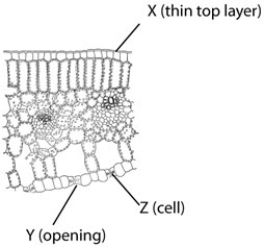 A)absorption of CO₂
B)retention of water
C)evaporation of water
D)collection of light
E)release of CO₂
1)Structure X
2)Structure Y
3)Structure Z
A)absorption of CO₂
B)retention of water
C)evaporation of water
D)collection of light
E)release of CO₂
1)Structure X
2)Structure Y
3)Structure Z (Short Answer)
4.8/5 (80)
(80) Where are the youngest wood and the youngest bark in a tree trunk?
(Multiple Choice)
4.8/5 (87)
(87) When comparing root systems of plants growing on a square foot in a cornfield and on a meadow,what result do you expect to receive?
(Multiple Choice)
4.7/5 (66)
(66) In 2005,a spot 1 centimeter from the center of a woody stem is in the bark.In what tissue will the same spot (1 cm from the center)be in 2050?
(Multiple Choice)
4.9/5 (82)
(82) The main source of water necessary for photosynthesis to occur in the leaf mesophyll is _____.
(Multiple Choice)
4.8/5 (75)
(75) The center of many stems contains only parenchyma cells;it is therefore best called a _____.
(Multiple Choice)
4.9/5 (82)
(82) In a meristematic region,the cell plate during mitosis is perpendicular to the side of the stem.In what direction will the stem grow?
(Multiple Choice)
4.7/5 (64)
(64) Plant leaf epidermal cells have an amazing array of trichomes.What is not a function of trichomes?
(Multiple Choice)
4.7/5 (65)
(65) Girdling is a procedure to kill unwanted tress by cutting a groove into the bark of the tree.The groove must completely encircle the trunk and should penetrate into the wood to a depth of at least 1/2 inch on small trees,and 1 to 1-1/2 inches on larger trees.Why does this procedure cause tree death?
(Multiple Choice)
4.8/5 (88)
(88) The surface area of a plant's root system is substantially larger than the surface area of its shoot system.Which hypothesis best explains the extensive surface area of roots?
(Multiple Choice)
4.9/5 (91)
(91) What best describes the shape of the entire vascular cambium system in trees? Visualizing a pine tree helps with this question.
(Multiple Choice)
4.9/5 (70)
(70) 
Filters
- Essay(0)
- Multiple Choice(0)
- Short Answer(0)
- True False(0)
- Matching(0)