



 Chat with AI
Exam 28: Bacteria and Archaea

Exam 1: Biology and the Tree of Life40 Questions
Exam 2: Water and Carbon: the Chemical Basis of Life50 Questions
Exam 3: Protein Structure and Function47 Questions
Exam 4: Nucleic Acids and the Rna World33 Questions
Exam 5: An Introduction to Carbohydrates30 Questions
Exam 6: Lipids, membranes, and the First Cells47 Questions
Exam 7: Inside the Cell28 Questions
Exam 8: Cell-Cell Interactions27 Questions
Exam 9: Cellular Respiration and Fermentation27 Questions
Exam 10: Photosynthesis32 Questions
Exam 11: The Cell Cycle31 Questions
Exam 12: Meiosis34 Questions
Exam 13: Mendel and the Gene32 Questions
Exam 14: Dna and the Gene: Synthesis and Repair37 Questions
Exam 15: How Genes Work34 Questions
Exam 16: Transcription and Translation38 Questions
Exam 17: Control of Gene Expression in Bacteria31 Questions
Exam 18: Control of Gene Expression in Eukaryotes37 Questions
Exam 19: Analyzing and Engineering Genes40 Questions
Exam 20: Genomics38 Questions
Exam 21: Principles of Development25 Questions
Exam 22: An Introduction to Animal Development22 Questions
Exam 23: An Introduction to Plant Development21 Questions
Exam 24: Evolution by Natural Selection32 Questions
Exam 25: Evolutionary Processes32 Questions
Exam 26: Speciation33 Questions
Exam 27: Phylogenies and the History of Life38 Questions
Exam 28: Bacteria and Archaea38 Questions
Exam 29: Protists34 Questions
Exam 30: Green Plants49 Questions
Exam 31: Fungi37 Questions
Exam 32: An Introduction to Animals38 Questions
Exam 33: Protostome Animals38 Questions
Exam 34: Deuterostome Animals46 Questions
Exam 35: Viruses31 Questions
Exam 36: Plant Form and Function39 Questions
Exam 37: Water and Sugar Transport in Plants42 Questions
Exam 38: Plant Nutrition36 Questions
Exam 39: Plant Sensory Systems, signals, and Responses66 Questions
Exam 40: Plant Reproduction41 Questions
Exam 41: Animal Form and Function29 Questions
Exam 42: Water and Electrolyte Balance in Animals38 Questions
Exam 43: Animal Nutrition37 Questions
Exam 44: Gas Exchange and Circulation37 Questions
Exam 45: Electrical Signals in Animals33 Questions
Exam 46: Animal Sensory Systems and Movement36 Questions
Exam 47: Chemical Signals in Animals33 Questions
Exam 48: Animal Reproduction34 Questions
Exam 49: The Immune System in Animals32 Questions
Exam 50: An Introduction to Ecology38 Questions
Exam 51: Behavioral Ecology37 Questions
Exam 52: Population Ecology46 Questions
Exam 53: Community Ecology39 Questions
Exam 54: Ecosystems41 Questions
Exam 55: Biodiversity and Conservation Biology39 Questions
Select questions type


To establish a link between a specific bacterium and a skin disease,researchers have shown that bacterium was present in sick persons but not in healthy individuals.They isolated the bacterium in a pure culture and demonstrated that experimental healthy animals injected with this culture became sick.What other experiment do researchers need to perform to be absolutely sure that the bacterium is responsible for the disease?
(Multiple Choice)
4.8/5  (81)
(81) You might be interested to know how many different types of bacteria live on the shower curtain in your bathroom.What is the most efficient method for answering this question?
(Multiple Choice)
4.9/5 (87)
(87) Bacteria and Archaea are most easily distinguished from each other by their _____.
(Multiple Choice)
4.7/5 (71)
(71) Imagine that you are given some chemoorganotrophic bacteria to grow.What should you use as a source of energy for this type of bacteria?
(Multiple Choice)
4.9/5 (69)
(69) Figure 28.1
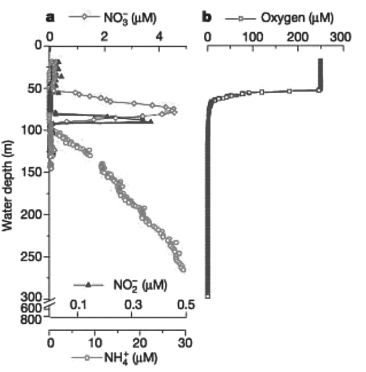 -Bacteria able to perform the NH₄⁺ + NO₂⁻ → N₂ + 2H₂O reaction have been discovered in laboratory bioreactors and wastewater treatment systems.Researchers predicted that these bacteria should exist in oceans.They measured the concentration of NH₄⁺,NO₂⁻,NO₃⁻,and O₂ in the Black Sea as a function of water depth (M.Kuypers et al.2003 Anaerobic ammonium oxidation by anammox bacteria in the Black Sea.Nature 422:
608-11)to determine where in the sea the bacteria might live.Analyzing data presented in Figure 28.1 above,at what depth would you expect to find the bacteria? (Note:
In the figure,different scales are used to show concentrations of NH₄⁺,NO₂⁻,NO₃⁻,and O₂. )
-Bacteria able to perform the NH₄⁺ + NO₂⁻ → N₂ + 2H₂O reaction have been discovered in laboratory bioreactors and wastewater treatment systems.Researchers predicted that these bacteria should exist in oceans.They measured the concentration of NH₄⁺,NO₂⁻,NO₃⁻,and O₂ in the Black Sea as a function of water depth (M.Kuypers et al.2003 Anaerobic ammonium oxidation by anammox bacteria in the Black Sea.Nature 422:
608-11)to determine where in the sea the bacteria might live.Analyzing data presented in Figure 28.1 above,at what depth would you expect to find the bacteria? (Note:
In the figure,different scales are used to show concentrations of NH₄⁺,NO₂⁻,NO₃⁻,and O₂. ) (Multiple Choice)
4.7/5 (84)
(84) Biologists sometimes divide living organisms into two groups:
Autotrophs and heterotrophs.How do these two groups differ?
(Multiple Choice)
4.9/5 (82)
(82) What kind of molecules serve as electron acceptors in cellular respiration?
(Multiple Choice)
4.9/5 (97)
(97) You run an osteology lab,where students are able to study the bone structure of various species.To produce clean bones,you introduce insects and bacteria to remove all remaining flesh.Which bacteria would be the best purchase for your lab?
(Multiple Choice)
5.0/5 (73)
(73) A bacterium was grown in two test tubes filled with media rich in glucose.One tube was sealed to produce anaerobic conditions,and the other was not.A third uninoculated,unsealed tube was used as a control.Glucose utilization by this bacterium causes acid production,which is indicated by a lightening of the media color.If the bacterium is able to produce ATP only by respiration,which result do you expect to receive?
(Multiple Choice)
4.8/5 (79)
(79) Which of the following extremophiles might researchers most likely use as a model for the earliest organisms on Earth?
(Multiple Choice)
4.9/5 (91)
(91) While examining a rock surface,you have discovered an interesting new organism.Which of the following criteria will allow you to classify the organism as belonging to Bacteria but not Archaea or Eukarya?
(Multiple Choice)
4.8/5 (70)
(70) You need to identify the major type of bacteria living on the shower curtain in your bathroom and find out what they use as a food source.What is the most efficient method for answering this question?
(Multiple Choice)
4.9/5 (81)
(81) Which of the following lineages do not contain bacteria that are photosynthetic?
(Multiple Choice)
4.8/5 (76)
(76) The purple non-sulfur bacterium Rhodospirillum grows best as a photoheterotroph.What are the most favorable sources of energy and carbon for this bacterium?
(Multiple Choice)
4.9/5 (79)
(79) What experiment can distinguish between high-GC Gram-positive bacteria and low-GC Gram-positive bacteria?
(Multiple Choice)
4.7/5 (72)
(72) 
Filters
- Essay(0)
- Multiple Choice(0)
- Short Answer(0)
- True False(0)
- Matching(0)