



 Chat with AI
Exam 15: Monopoly

Exam 1: Ten Principles of Economics455 Questions
Exam 2: Thinking Like an Economist643 Questions
Exam 3: Interdependence and the Gains From Trade547 Questions
Exam 4: The Market Forces of Supply and Demand693 Questions
Exam 5: Elasticity and Its Application626 Questions
Exam 6: Supply, Demand, and Government Policies668 Questions
Exam 7: Consumers, Producers, and the Efficiency of Markets547 Questions
Exam 8: Applications: the Costs of Taxation509 Questions
Exam 9: Application: International Trade521 Questions
Exam 10: Externalities543 Questions
Exam 11: Public Goods and Common Resources452 Questions
Exam 12: The Design of the Tax System664 Questions
Exam 13: The Costs of Production649 Questions
Exam 14: Firms in Competitive Markets604 Questions
Exam 15: Monopoly662 Questions
Exam 16: Monopolistic Competition649 Questions
Exam 17: Oligopoly522 Questions
Exam 18: The Markets for the Factors of Production592 Questions
Exam 19: Earnings and Discrimination511 Questions
Exam 20: Income Inequality and Poverty478 Questions
Exam 21: The Theory of Consumer Choice570 Questions
Exam 22: Frontiers in Microeconomics461 Questions
Exam 23: Measuring a Nation S Income547 Questions
Exam 24: Measuring the Cost of Living565 Questions
Exam 25: Production and Growth527 Questions
Exam 26: Saving, Investment, and the Financial System637 Questions
Exam 27: Tools of Finance534 Questions
Exam 28: Unemployment and Its Natural Rate701 Questions
Exam 29: The Monetary System540 Questions
Exam 30: Money Growth and Inflation504 Questions
Exam 31: Open-Economy Macroeconomics: Basic Concepts540 Questions
Exam 32: A Macroeconomic Theory of the Open Economy511 Questions
Exam 33: Aggregate Demand and Aggregate Supply572 Questions
Exam 34: The Influence of Monetary and Fiscal Policy on Aggregate Demand523 Questions
Exam 35: The Short-Run Tradeoff Between Inflation and Unemployment536 Questions
Exam 36: Six Debates Over Macroeconomic Policy354 Questions
Select questions type


Figure 15-14 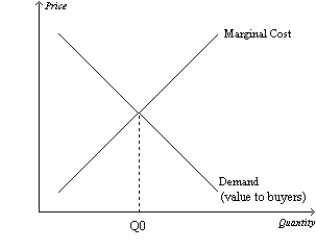 -Refer to Figure 15-14. A benevolent social planner would have the monopoly operate at an output level
 (Multiple Choice)
4.9/5  (88)
(88) Table 15-21
Tommy's Tie Company, a monopolist, has the following cost and revenue information. Assume that Tommy's is able to engage in perfect price discrimination. 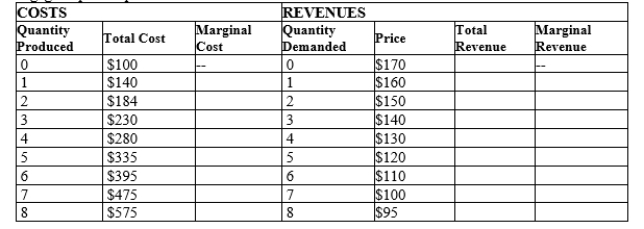 -Refer to Table 15-21. If the monopolist can engage in perfect price discrimination, what is the total revenue when 3 ties are sold?
 (Multiple Choice)
4.7/5 (83)
(83) Figure 15-10 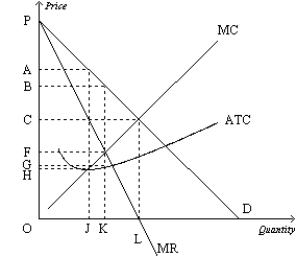 -Refer to Figure 15-10. What area measures the deadweight loss?
 (Multiple Choice)
4.8/5 (64)
(64) The collection of statutes aimed at curbing monopoly power is called
(Multiple Choice)
4.8/5 (90)
(90) Consumers' willingness to pay for a good minus the amount they actually pay for it equals
(Multiple Choice)
4.7/5 (90)
(90) Figure 15-6 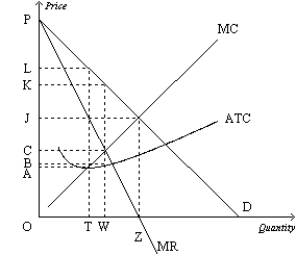 -Refer to Figure 15-6. How much output will the monopolist produce?
 (Multiple Choice)
4.9/5 (81)
(81) The practice of selling the same goods to different customers at different prices, but with the same marginal cost, is known as
(Multiple Choice)
4.9/5 (77)
(77) If the government deems a newly-invented drug to be truly original, the pharmaceutical company is given the exclusive right to manufacture and sell the drug for 50 years.
(True/False)
4.8/5 (69)
(69) For a monopoly, the level of output at which marginal revenue equals zero is also the level of output at which
(Multiple Choice)
4.9/5 (86)
(86) A rational pricing strategy for a profit-maximizing monopolist is
(Multiple Choice)
4.9/5 (89)
(89) Table 15-20
A monopolist faces the following demand curve: 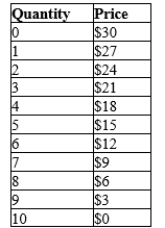 -Refer to Table 15-20. If a monopolist faces a constant marginal cost of $10, how much output should the firm produce in order to maximize profit?
 (Multiple Choice)
4.8/5 (87)
(87) Table 15-1 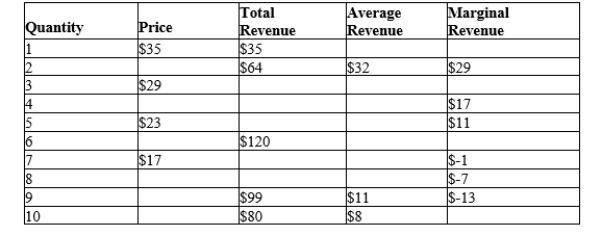 -Refer to Table 15-1. Assume this monopolist's marginal cost is constant at $12. What quantity of output (Q) will it produce and what price (P) will it charge?
 (Multiple Choice)
4.9/5 (77)
(77) Scenario 15-1
Vincent operates a scenic tour business in Boston. He has one bus which can fit 50 people per tour and each tour lasts 2 hours. His total cost of operating one tour is fixed at $450. Vincent's cost is not reduced if he runs a tour with a partially full bus. While his cost is the same for all tours, Vincent charges each passenger his/her willingness to pay: adults $18 per trip, children $10 per trip, and senior citizens $12 per trip. At those rates, on a typical day Vincent's demand is:
Passenger Type
Willingness to Pay
Demand per day
Adults
$18
70
Children
$10
25
Senior Citizens
$12
55
Assume that Vincent's customers are always available for the tour; therefore, he can fill his bus for each tour as long as there is sufficient total demand for the day.
-Refer to Scenario 15-1. What is Vincent's cost of serving all passengers demanding a tour on a typical day?
(Short Answer)
4.7/5 (74)
(74) Movie theatres charge different prices to different groups of people based on the differing marginal costs that exist from group to group.
(True/False)
4.8/5 (84)
(84) One solution to the problems of marginal-cost pricing of a regulated natural monopolist is average cost pricing. In this model, the monopolist is allowed to price its production at average total cost. How does average-cost pricing differ from marginal-cost pricing? Does this solution maximize social well-being?
(Essay)
4.9/5 (80)
(80) Scenario 15-7
Black Box Cable TV is able to purchase an exclusive right to sell a premium movie channel (PMC) in its market area. Let's assume that Black Box Cable pays $150,000 a year for the exclusive marketing rights to PMC. Since Black Box has already installed cable to all of the homes in its market area, the marginal cost of delivering PMC to subscribers is zero. The manager of Black Box needs to know what price to charge for the PMC service to maximize her profit. Before setting price, she hires an economist to estimate demand for the PMC service. The economist discovers that there are two types of subscribers who value premium movie channels. First are the 4,000 die-hard TV viewers who will pay as much as $150 a year for the new PMC premium channel. Second, the PMC channel will appeal to 20,000 occasional TV viewers who will pay as much as $20 a year for a subscription to PMC.
-Refer to Scenario 15-7. What is the deadweight loss associated with the nondiscriminating pricing policy compared to the price discriminating policy?
(Multiple Choice)
4.9/5 (65)
(65) 
Filters
- Essay(0)
- Multiple Choice(0)
- Short Answer(0)
- True False(0)
- Matching(0)