



 Chat with AI
Exam 15: Monopoly

Exam 1: Ten Principles of Economics455 Questions
Exam 2: Thinking Like an Economist643 Questions
Exam 3: Interdependence and the Gains From Trade547 Questions
Exam 4: The Market Forces of Supply and Demand693 Questions
Exam 5: Elasticity and Its Application626 Questions
Exam 6: Supply, Demand, and Government Policies668 Questions
Exam 7: Consumers, Producers, and the Efficiency of Markets547 Questions
Exam 8: Applications: the Costs of Taxation509 Questions
Exam 9: Application: International Trade521 Questions
Exam 10: Externalities543 Questions
Exam 11: Public Goods and Common Resources452 Questions
Exam 12: The Design of the Tax System664 Questions
Exam 13: The Costs of Production649 Questions
Exam 14: Firms in Competitive Markets604 Questions
Exam 15: Monopoly662 Questions
Exam 16: Monopolistic Competition649 Questions
Exam 17: Oligopoly522 Questions
Exam 18: The Markets for the Factors of Production592 Questions
Exam 19: Earnings and Discrimination511 Questions
Exam 20: Income Inequality and Poverty478 Questions
Exam 21: The Theory of Consumer Choice570 Questions
Exam 22: Frontiers in Microeconomics461 Questions
Exam 23: Measuring a Nation S Income547 Questions
Exam 24: Measuring the Cost of Living565 Questions
Exam 25: Production and Growth527 Questions
Exam 26: Saving, Investment, and the Financial System637 Questions
Exam 27: Tools of Finance534 Questions
Exam 28: Unemployment and Its Natural Rate701 Questions
Exam 29: The Monetary System540 Questions
Exam 30: Money Growth and Inflation504 Questions
Exam 31: Open-Economy Macroeconomics: Basic Concepts540 Questions
Exam 32: A Macroeconomic Theory of the Open Economy511 Questions
Exam 33: Aggregate Demand and Aggregate Supply572 Questions
Exam 34: The Influence of Monetary and Fiscal Policy on Aggregate Demand523 Questions
Exam 35: The Short-Run Tradeoff Between Inflation and Unemployment536 Questions
Exam 36: Six Debates Over Macroeconomic Policy354 Questions
Select questions type


Figure 15-22
The diagram depicts the market situation for a monopoly pastry shop called Bearclaws. 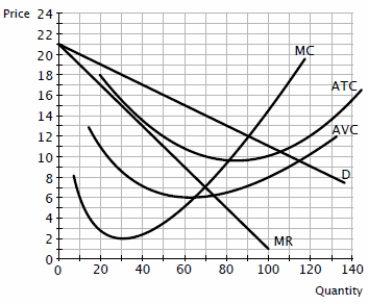 -Refer to Figure 15-22. Based upon the information shown, what are total costs for Bearclaws, given that it maximizes profits?
 (Multiple Choice)
5.0/5  (78)
(78) A common solution to monopoly in European countries is public ownership.
(True/False)
4.8/5 (77)
(77) Table 15-13
The following table gives information on the price, quantity, and total cost of production for a monopolist. 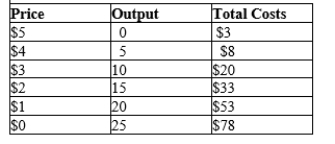 -Refer to Table 15-13. If the monopolist maximizes profits, he will charge a price of
 (Multiple Choice)
5.0/5 (75)
(75) Which of the following is not a characteristic of a monopoly?
(Multiple Choice)
4.9/5 (73)
(73) Scenario 15-10
Vincent operates a scenic tour business in Boston. He has one bus which can fit 50 people per tour and each tour lasts 2 hours. His total cost of operating one tour is fixed at $450. Vincent's cost is not reduced if he runs a tour with a partially full bus. While his cost is the same for all tours, Vincent charges each passenger his/her willingness to pay: adults $18 per trip, children $10 per trip, and senior citizens $12 per trip. At those rates, on a typical day Vincent's demand is:  Assume that Vincent's customers are always available for the tour; therefore, he can fill his bus for each tour as long as there is sufficient total demand for the day.
-Refer to Scenario 15-10. What is Vincent's total revenue on a typical day?
Assume that Vincent's customers are always available for the tour; therefore, he can fill his bus for each tour as long as there is sufficient total demand for the day.
-Refer to Scenario 15-10. What is Vincent's total revenue on a typical day? (Multiple Choice)
4.8/5 (69)
(69) When the market for a good is a natural monopoly, this results in
(Multiple Choice)
4.9/5 (87)
(87) Suppose a firm has a monopoly on the sale of a computer game and faces a downward-sloping demand curve. When selling the 50th game, the firm will always receive
(Multiple Choice)
4.7/5 (78)
(78) The amount of power that a monopoly has depends on whether there are close substitutes for its product.
(True/False)
4.9/5 (75)
(75) Some companies merge in order to lower costs through efficient joint production.
(True/False)
4.8/5 (88)
(88) Explain how a profit-maximizing monopolist chooses its level of output and the price of its goods.
(Essay)
4.8/5 (86)
(86) If the monopolist's linear demand curve intersects the quantity axis at Q = 30, then the monopolist's marginal revenue will be equal to zero at
(Multiple Choice)
5.0/5 (77)
(77) Table 15-8
The following table provides information on the price, quantity, and average total cost for a monopoly. 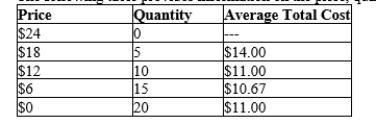 -Refer to Table 15-8. At what price will the monopolist maximize his profit?
 (Multiple Choice)
4.8/5 (84)
(84) If a social planner were running a monopoly, that planner could achieve an efficient outcome by charging the price that is determined by the
(Multiple Choice)
4.9/5 (78)
(78) Scenario 15-3
A monopoly firm maximizes its profit by producing Q = 500 units of output. At that level of output, its marginal revenue is $30, its average revenue is $60, and its average total cost is $34.
-Refer to Scenario 15-3. At Q = 500, the firm's total revenue is
(Multiple Choice)
4.8/5 (76)
(76) Figure 15-7 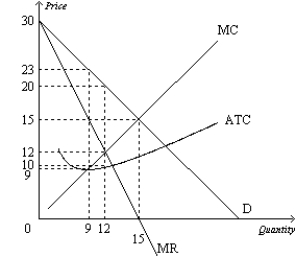 -Refer to Figure 15-7. A profit-maximizing monopolist would earn total revenues of
 (Multiple Choice)
4.9/5 (64)
(64) Table 15-11
The following table shows quantity, price, and marginal cost information for a monopoly: 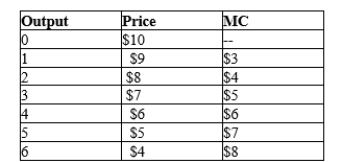 -Refer to Table 15-11. What level of output should the firm produce to maximize its profit?
 (Multiple Choice)
4.7/5 (76)
(76) Figure 15-3 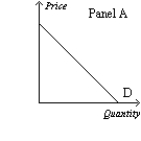
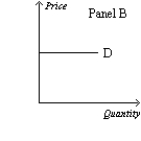
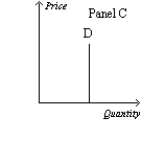
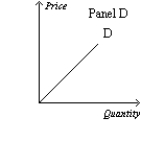 -Refer to Figure 15-3. Which panel could represent the demand curve facing a local cable television provider if that firm in a monopolist?
 (Multiple Choice)
4.9/5 (87)
(87) 
Filters
- Essay(0)
- Multiple Choice(0)
- Short Answer(0)
- True False(0)
- Matching(0)