



 Chat with AI
Exam 15: Monopoly

Exam 1: Ten Principles of Economics455 Questions
Exam 2: Thinking Like an Economist643 Questions
Exam 3: Interdependence and the Gains From Trade547 Questions
Exam 4: The Market Forces of Supply and Demand693 Questions
Exam 5: Elasticity and Its Application626 Questions
Exam 6: Supply, Demand, and Government Policies668 Questions
Exam 7: Consumers, Producers, and the Efficiency of Markets547 Questions
Exam 8: Applications: the Costs of Taxation509 Questions
Exam 9: Application: International Trade521 Questions
Exam 10: Externalities543 Questions
Exam 11: Public Goods and Common Resources452 Questions
Exam 12: The Design of the Tax System664 Questions
Exam 13: The Costs of Production649 Questions
Exam 14: Firms in Competitive Markets604 Questions
Exam 15: Monopoly662 Questions
Exam 16: Monopolistic Competition649 Questions
Exam 17: Oligopoly522 Questions
Exam 18: The Markets for the Factors of Production592 Questions
Exam 19: Earnings and Discrimination511 Questions
Exam 20: Income Inequality and Poverty478 Questions
Exam 21: The Theory of Consumer Choice570 Questions
Exam 22: Frontiers in Microeconomics461 Questions
Exam 23: Measuring a Nation S Income547 Questions
Exam 24: Measuring the Cost of Living565 Questions
Exam 25: Production and Growth527 Questions
Exam 26: Saving, Investment, and the Financial System637 Questions
Exam 27: Tools of Finance534 Questions
Exam 28: Unemployment and Its Natural Rate701 Questions
Exam 29: The Monetary System540 Questions
Exam 30: Money Growth and Inflation504 Questions
Exam 31: Open-Economy Macroeconomics: Basic Concepts540 Questions
Exam 32: A Macroeconomic Theory of the Open Economy511 Questions
Exam 33: Aggregate Demand and Aggregate Supply572 Questions
Exam 34: The Influence of Monetary and Fiscal Policy on Aggregate Demand523 Questions
Exam 35: The Short-Run Tradeoff Between Inflation and Unemployment536 Questions
Exam 36: Six Debates Over Macroeconomic Policy354 Questions
Select questions type


Figure 15-2 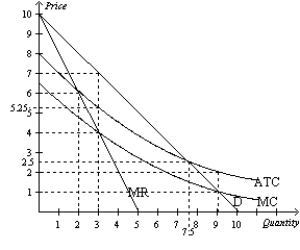 -Refer to Figure 15-2. If a regulator requires the firm to charge an average cost price, what quantity will the firm produce?
 (Short Answer)
4.9/5  (77)
(77) Drug companies are allowed to be monopolists in the drugs they discover in order to
(Multiple Choice)
4.8/5 (93)
(93) A patent gives a single person or firm the exclusive right to sell some good or service forever.
(True/False)
4.8/5 (87)
(87) Figure 15-4 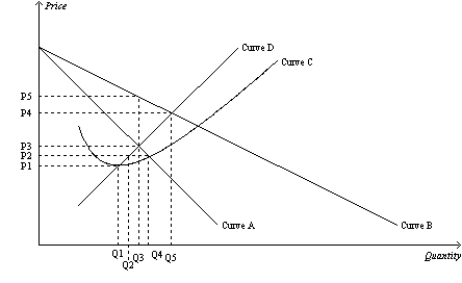 -Refer to Figure 15-4. If the monopoly firm is currently producing Q3 units of output, then a decrease in output will necessarily cause profit to
 (Multiple Choice)
4.8/5 (83)
(83) The deadweight loss that arises from a monopoly is a consequence of the fact that the monopoly
(Multiple Choice)
4.9/5 (80)
(80) When a monopolist increases the quantity that it sells, price decreases, which, all else equal, decreases total revenue; this is called the price effect.
(True/False)
4.9/5 (85)
(85) Suppose that the DeBeers company faces very little competition from other firms in the wholesale diamond market. Why isn't the price of wholesale diamonds $10,000 per carat?
(Multiple Choice)
4.9/5 (91)
(91) Table 15-3
Consider the following demand and cost information for a monopoly. 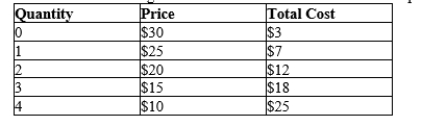 -Refer to Table 15-3. The marginal cost of the 4th unit is
 (Multiple Choice)
4.8/5 (95)
(95) Table 15-7
Sally owns the only shoe store in town. She has the following cost and revenue information. 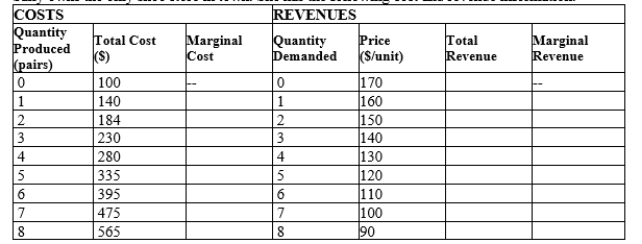 -Refer to Table 15-7. What is the marginal cost of the 6th pair of shoes?
 (Multiple Choice)
4.8/5 (79)
(79) The reason to regulate utilities instead of using antitrust laws to promote competition is that a utility is usually a
(Multiple Choice)
4.9/5 (73)
(73) Figure 15-8 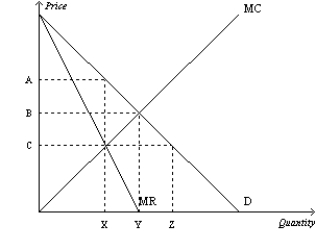 -Refer to Figure 15-8. What is the monopoly price and quantity?
 (Multiple Choice)
4.8/5 (86)
(86) A key for a monopoly that wants to practice price discrimination is to be able to control the resale of its product.
(True/False)
4.7/5 (85)
(85) Figure 15-19 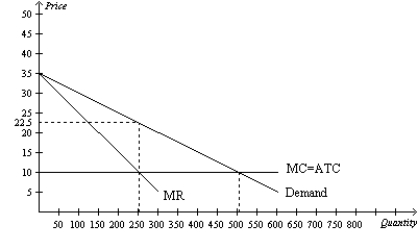 -Refer to Figure 15-19. If the monopoly firm perfectly price discriminates, then consumer surplus amounts to
 (Multiple Choice)
4.7/5 (83)
(83) Figure 15-7 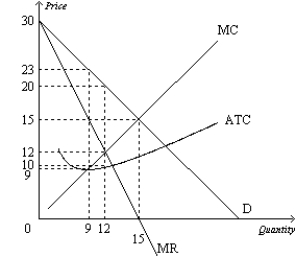 -Refer to Figure 15-7. A profit-maximizing monopolist would earn profits of
 (Multiple Choice)
4.9/5 (98)
(98) Figure 15-5 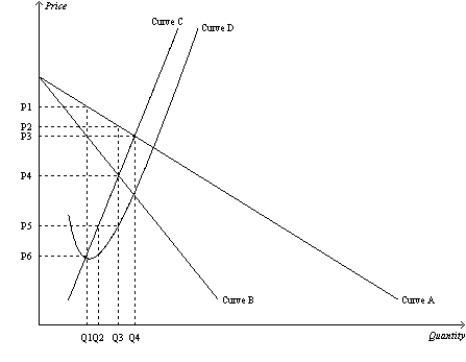 -Refer to Figure 15-5. A profit-maximizing monopoly's total cost is equal to
 (Multiple Choice)
4.7/5 (93)
(93) Table 15-1 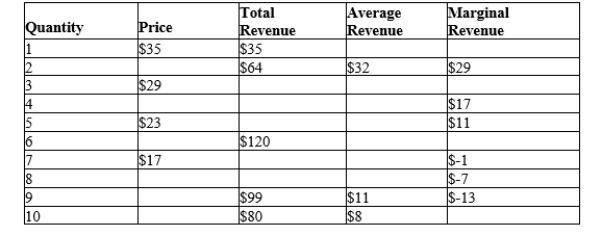 -Refer to Table 15-1. If the monopolist wants to maximize its revenue, how many units of its product should it sell?
 (Multiple Choice)
4.7/5 (84)
(84) When a monopolist increases the quantity that it sells, all else equal, total revenue increases, which is called the output effect.
(True/False)
4.7/5 (77)
(77) Figure 15-19
-Refer to Figure 15-19. If the monopoly firm is not allowed to price discriminate, then the deadweight loss amounts to
-Refer to Figure 15-19. If the monopoly firm is not allowed to price discriminate, then the deadweight loss amounts to (Multiple Choice)
4.9/5 (86)
(86) Which of the following are necessary characteristics of a monopoly?
(i)The firm is the sole seller of its product.
(ii)The firm's product does not have close substitutes.
(iii)The firm generates a large economic profit.
(iv)The firm is located in a small geographic market.
(Multiple Choice)
4.9/5 (73)
(73) 
Filters
- Essay(0)
- Multiple Choice(0)
- Short Answer(0)
- True False(0)
- Matching(0)