



 Chat with AI
Exam 15: Monopoly

Exam 1: Ten Principles of Economics455 Questions
Exam 2: Thinking Like an Economist643 Questions
Exam 3: Interdependence and the Gains From Trade547 Questions
Exam 4: The Market Forces of Supply and Demand693 Questions
Exam 5: Elasticity and Its Application626 Questions
Exam 6: Supply, Demand, and Government Policies668 Questions
Exam 7: Consumers, Producers, and the Efficiency of Markets547 Questions
Exam 8: Applications: the Costs of Taxation509 Questions
Exam 9: Application: International Trade521 Questions
Exam 10: Externalities543 Questions
Exam 11: Public Goods and Common Resources452 Questions
Exam 12: The Design of the Tax System664 Questions
Exam 13: The Costs of Production649 Questions
Exam 14: Firms in Competitive Markets604 Questions
Exam 15: Monopoly662 Questions
Exam 16: Monopolistic Competition649 Questions
Exam 17: Oligopoly522 Questions
Exam 18: The Markets for the Factors of Production592 Questions
Exam 19: Earnings and Discrimination511 Questions
Exam 20: Income Inequality and Poverty478 Questions
Exam 21: The Theory of Consumer Choice570 Questions
Exam 22: Frontiers in Microeconomics461 Questions
Exam 23: Measuring a Nation S Income547 Questions
Exam 24: Measuring the Cost of Living565 Questions
Exam 25: Production and Growth527 Questions
Exam 26: Saving, Investment, and the Financial System637 Questions
Exam 27: Tools of Finance534 Questions
Exam 28: Unemployment and Its Natural Rate701 Questions
Exam 29: The Monetary System540 Questions
Exam 30: Money Growth and Inflation504 Questions
Exam 31: Open-Economy Macroeconomics: Basic Concepts540 Questions
Exam 32: A Macroeconomic Theory of the Open Economy511 Questions
Exam 33: Aggregate Demand and Aggregate Supply572 Questions
Exam 34: The Influence of Monetary and Fiscal Policy on Aggregate Demand523 Questions
Exam 35: The Short-Run Tradeoff Between Inflation and Unemployment536 Questions
Exam 36: Six Debates Over Macroeconomic Policy354 Questions
Select questions type


The monopolist's profit-maximizing quantity of output is determined by the intersection of which of the following two curves?
(Multiple Choice)
4.9/5  (79)
(79) Table 15-20
A monopolist faces the following demand curve: 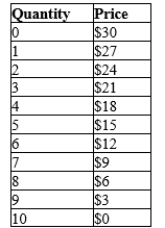 -Refer to Table 15-20. If a monopolist faces a constant marginal cost of $20, how much output should the firm produce in order to maximize profit?
 (Multiple Choice)
4.8/5 (89)
(89) Table 15-4
A monopolist faces the following demand curve: 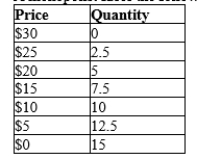 -Refer to Table 15-4. The monopolist will not produce
 (Multiple Choice)
4.8/5 (80)
(80) Table 15-17
A monopolist faces the following demand curve: 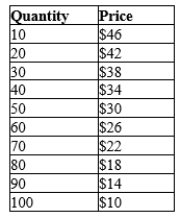 -Refer to Table 15-17. Which of the following statements best describes the relationship between the price and the marginal revenue associated with values in the table?
 (Multiple Choice)
4.8/5 (83)
(83) Scenario 15-6
The concert promoters of a heavy-metal band, WeR2Loud, know that there are two types of concert-goers: die-hard fans and casual fans. For a particular WeR2Loud concert, there are 1,000 die-hard fans who will pay $150 for a ticket and 500 casual fans who will pay $50 for a ticket. There are 1,500 seats available at the concert venue. Suppose the cost of putting on the concert is $50,000, which includes the cost of the band, lighting, security, etc.
-Refer to Scenario 15-6. How much profit will the concert promoters earn if they engage in price discrimination?
(Multiple Choice)
4.8/5 (75)
(75) Scenario 15-7
Black Box Cable TV is able to purchase an exclusive right to sell a premium movie channel (PMC) in its market area. Let's assume that Black Box Cable pays $150,000 a year for the exclusive marketing rights to PMC. Since Black Box has already installed cable to all of the homes in its market area, the marginal cost of delivering PMC to subscribers is zero. The manager of Black Box needs to know what price to charge for the PMC service to maximize her profit. Before setting price, she hires an economist to estimate demand for the PMC service. The economist discovers that there are two types of subscribers who value premium movie channels. First are the 4,000 die-hard TV viewers who will pay as much as $150 a year for the new PMC premium channel. Second, the PMC channel will appeal to 20,000 occasional TV viewers who will pay as much as $20 a year for a subscription to PMC.
-Refer to Scenario 15-7. If Black Box Cable TV is unable to price discriminate, what price will it choose to maximize its profit, and what is the amount of the profit?
(Multiple Choice)
5.0/5 (74)
(74) Which of the following is not an example of a barrier to entry?
(Multiple Choice)
4.7/5 (87)
(87) Figure 15-4 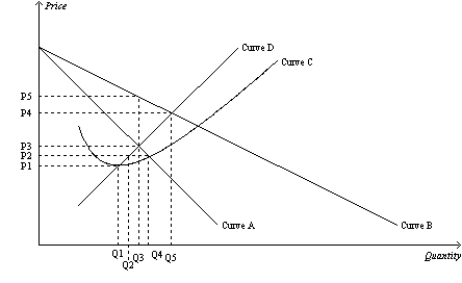 -Refer to Figure 15-4. If the monopoly firm wants to maximize its profit, it should operate at a level of output equal to
 (Multiple Choice)
4.9/5 (73)
(73) For a monopolist, when the output effect is greater than the price effect, marginal revenue is
(Multiple Choice)
4.8/5 (86)
(86) Table 15-6
A monopolist faces the following demand curve: 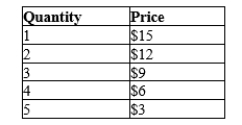 -Refer to Table 15-6. What is the marginal revenue from the sale of the 2nd unit?
 (Multiple Choice)
4.8/5 (78)
(78) A monopoly is an inefficient way to produce a product because
(Multiple Choice)
4.8/5 (78)
(78) Suppose that a professional photographer takes a prize-winning digital photo. She can sell a 5"x7" color print of the photo for $10. She can also sell the digital file for $20. There are 500 people willing to buy the color print and 2,000 people willing to buy the digital file. Assume the costs to the photographer are zero and that the people who purchase the digital file cannot resell the file itself or any prints made from it. What should she do in order to maximize her profits?
(Multiple Choice)
5.0/5 (89)
(89) Table 15-1 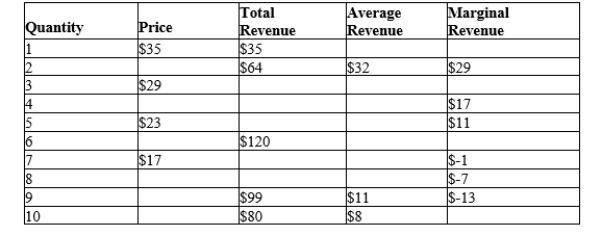 -Refer to Table 15-1. If the monopolist sells 8 units of its product, how much total revenue will it receive from the sale?
 (Multiple Choice)
4.7/5 (82)
(82) Table 15-10
The monopolist faces the following demand curve: 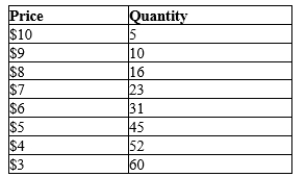 -Refer to Table 15-10. If the monopolist has total fixed costs of $40 and a constant marginal cost of $5, how much profit can the firm earn at the profit-maximizing level of output?
 (Multiple Choice)
4.8/5 (70)
(70) When a firm experiences continually declining average total costs,
(Multiple Choice)
4.7/5 (75)
(75) If the distribution of water is a natural monopoly, then
(i)multiple firms would likely each have to pay large fixed costs to develop their own network of pipes.
(ii)allowing for competition among different firms in the water-distribution industry is efficient.
(iii)a single firm can serve the market at the lowest possible average total cost.
(Multiple Choice)
4.7/5 (70)
(70) Figure 15-4 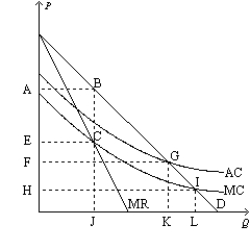 -Refer to Figure 15-4. If this firm profit maximizes, which letter represents the quantity it will produce?
 (Short Answer)
4.8/5 (74)
(74) 
Filters
- Essay(0)
- Multiple Choice(0)
- Short Answer(0)
- True False(0)
- Matching(0)