



 Chat with AI
Exam 15: Monopoly

Exam 1: Ten Principles of Economics455 Questions
Exam 2: Thinking Like an Economist643 Questions
Exam 3: Interdependence and the Gains From Trade547 Questions
Exam 4: The Market Forces of Supply and Demand693 Questions
Exam 5: Elasticity and Its Application626 Questions
Exam 6: Supply, Demand, and Government Policies668 Questions
Exam 7: Consumers, Producers, and the Efficiency of Markets547 Questions
Exam 8: Applications: the Costs of Taxation509 Questions
Exam 9: Application: International Trade521 Questions
Exam 10: Externalities543 Questions
Exam 11: Public Goods and Common Resources452 Questions
Exam 12: The Design of the Tax System664 Questions
Exam 13: The Costs of Production649 Questions
Exam 14: Firms in Competitive Markets604 Questions
Exam 15: Monopoly662 Questions
Exam 16: Monopolistic Competition649 Questions
Exam 17: Oligopoly522 Questions
Exam 18: The Markets for the Factors of Production592 Questions
Exam 19: Earnings and Discrimination511 Questions
Exam 20: Income Inequality and Poverty478 Questions
Exam 21: The Theory of Consumer Choice570 Questions
Exam 22: Frontiers in Microeconomics461 Questions
Exam 23: Measuring a Nation S Income547 Questions
Exam 24: Measuring the Cost of Living565 Questions
Exam 25: Production and Growth527 Questions
Exam 26: Saving, Investment, and the Financial System637 Questions
Exam 27: Tools of Finance534 Questions
Exam 28: Unemployment and Its Natural Rate701 Questions
Exam 29: The Monetary System540 Questions
Exam 30: Money Growth and Inflation504 Questions
Exam 31: Open-Economy Macroeconomics: Basic Concepts540 Questions
Exam 32: A Macroeconomic Theory of the Open Economy511 Questions
Exam 33: Aggregate Demand and Aggregate Supply572 Questions
Exam 34: The Influence of Monetary and Fiscal Policy on Aggregate Demand523 Questions
Exam 35: The Short-Run Tradeoff Between Inflation and Unemployment536 Questions
Exam 36: Six Debates Over Macroeconomic Policy354 Questions
Select questions type


Figure 15-1 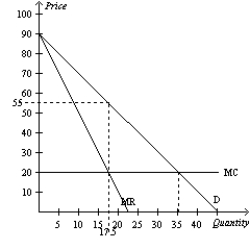 -Refer to Figure 15-1. If the monopolist uses perfect price discrimination, how much output does the firm produce?
 (Short Answer)
4.9/5  (72)
(72) For a monopoly, the socially efficient level of output occurs where
(Multiple Choice)
4.9/5 (77)
(77) If a monopolist sells 100 units at $8 per unit and realizes an average total cost of $6 per unit, what is the monopolist's profit?
(Multiple Choice)
5.0/5 (73)
(73) Which of the following is a characteristic of a natural monopoly?
(Multiple Choice)
4.9/5 (72)
(72) When a monopolist increases the amount of output that it produces and sells, average revenue
(Multiple Choice)
4.9/5 (78)
(78) Table 15-13
The following table gives information on the price, quantity, and total cost of production for a monopolist. 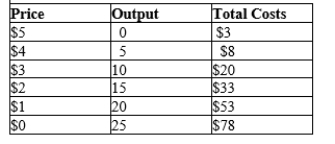 -Refer to Table 15-13. How much profit will the firm earn at the profit-maximizing price?
 (Multiple Choice)
4.9/5 (73)
(73) Which of the following is an example of price discrimination?
(Multiple Choice)
4.7/5 (74)
(74) Table 15-19
A monopolist faces the following demand curve: 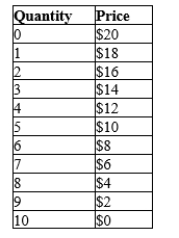 -Refer to Table 15-19. If a monopolist faces a constant marginal cost of $3, how much output should the firm produce?
 (Multiple Choice)
4.9/5 (74)
(74) Table 15-4
A monopolist faces the following demand curve: 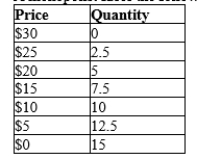 -Refer to Table 15-4. If the monopolist produces 10 units, what is its average revenue?
 (Multiple Choice)
4.8/5 (93)
(93) Scenario 15-6
The concert promoters of a heavy-metal band, WeR2Loud, know that there are two types of concert-goers: die-hard fans and casual fans. For a particular WeR2Loud concert, there are 1,000 die-hard fans who will pay $150 for a ticket and 500 casual fans who will pay $50 for a ticket. There are 1,500 seats available at the concert venue. Suppose the cost of putting on the concert is $50,000, which includes the cost of the band, lighting, security, etc.
-Refer to Scenario 15-6. How much additional profit can the concert promoters earn by charging each customer their willingness to pay relative to charging a flat price of $50 per ticket?
(Multiple Choice)
4.7/5 (99)
(99) Figure 15-18 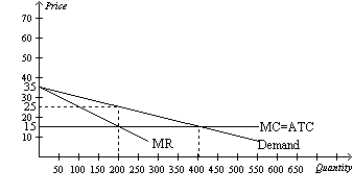 -Refer to Figure 15-18. If the monopoly firm perfectly price discriminates, then the deadweight loss amounts to
 (Multiple Choice)
4.8/5 (86)
(86) Table 15-19
A monopolist faces the following demand curve:
-Refer to Table 15-19. If a monopolist faces a constant marginal cost of $5, how much output should the firm produce in order to equate marginal revenue with marginal cost?
-Refer to Table 15-19. If a monopolist faces a constant marginal cost of $5, how much output should the firm produce in order to equate marginal revenue with marginal cost? (Multiple Choice)
4.9/5 (83)
(83) A monopolist does not have a supply curve because the firm's decision about how much to supply is impossible to separate from the demand curve it faces.
(True/False)
4.8/5 (86)
(86) Table 15-6
A monopolist faces the following demand curve: 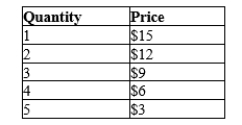 -Refer to Table 15-6. If the monopolist has a constant marginal cost for her product equal to $7, what is her profit-maximizing price?
 (Multiple Choice)
4.8/5 (73)
(73) Scenario 15-2
Consider a local, privately-owned electrical cooperative named Poweshiek Power Company (PPCo). PPCo has just completed a clean-coal-burning electrical power plant in Iowa. Currently, PPCo can meet the electricity needs of all residents in the county. In fact, its capacity far exceeds the needs of the county. After just a few years of operation, the shareholders of PPCo experienced incredibly high rates of return on their investment due to the profitability of the corporation.
-Refer to Scenario 15-2. Which of the following statements is most likely to be true?
(i)New entrants to the market know they will have a smaller market share than PPCo currently has.
(ii)PPCo is a natural monopoly.
(iii)PPCo would experience higher profits if it were government-run.
(Multiple Choice)
4.9/5 (82)
(82) 
Filters
- Essay(0)
- Multiple Choice(0)
- Short Answer(0)
- True False(0)
- Matching(0)