



 Chat with AI
Exam 15: Monopoly

Exam 1: Ten Principles of Economics455 Questions
Exam 2: Thinking Like an Economist643 Questions
Exam 3: Interdependence and the Gains From Trade547 Questions
Exam 4: The Market Forces of Supply and Demand693 Questions
Exam 5: Elasticity and Its Application626 Questions
Exam 6: Supply, Demand, and Government Policies668 Questions
Exam 7: Consumers, Producers, and the Efficiency of Markets547 Questions
Exam 8: Applications: the Costs of Taxation509 Questions
Exam 9: Application: International Trade521 Questions
Exam 10: Externalities543 Questions
Exam 11: Public Goods and Common Resources452 Questions
Exam 12: The Design of the Tax System664 Questions
Exam 13: The Costs of Production649 Questions
Exam 14: Firms in Competitive Markets604 Questions
Exam 15: Monopoly662 Questions
Exam 16: Monopolistic Competition649 Questions
Exam 17: Oligopoly522 Questions
Exam 18: The Markets for the Factors of Production592 Questions
Exam 19: Earnings and Discrimination511 Questions
Exam 20: Income Inequality and Poverty478 Questions
Exam 21: The Theory of Consumer Choice570 Questions
Exam 22: Frontiers in Microeconomics461 Questions
Exam 23: Measuring a Nation S Income547 Questions
Exam 24: Measuring the Cost of Living565 Questions
Exam 25: Production and Growth527 Questions
Exam 26: Saving, Investment, and the Financial System637 Questions
Exam 27: Tools of Finance534 Questions
Exam 28: Unemployment and Its Natural Rate701 Questions
Exam 29: The Monetary System540 Questions
Exam 30: Money Growth and Inflation504 Questions
Exam 31: Open-Economy Macroeconomics: Basic Concepts540 Questions
Exam 32: A Macroeconomic Theory of the Open Economy511 Questions
Exam 33: Aggregate Demand and Aggregate Supply572 Questions
Exam 34: The Influence of Monetary and Fiscal Policy on Aggregate Demand523 Questions
Exam 35: The Short-Run Tradeoff Between Inflation and Unemployment536 Questions
Exam 36: Six Debates Over Macroeconomic Policy354 Questions
Select questions type


Because monopoly firms do not have to compete with other firms, the outcome in a market with a monopoly
(Multiple Choice)
4.8/5  (76)
(76) Table 15-4
A monopolist faces the following demand curve: 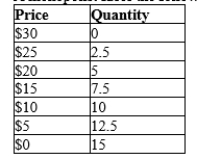 -Refer to Table 15-4. If the monopolist increases production from 7.5 to 10 units, what is its marginal revenue?
 (Multiple Choice)
4.8/5 (75)
(75) One method used to control the ability of firms to capture monopoly profit in the United States is through
(Multiple Choice)
4.8/5 (87)
(87) One problem with regulating a monopolist on the basis of cost is that
(Multiple Choice)
4.9/5 (86)
(86) When a monopolist decreases the price of its good, consumers
(Multiple Choice)
4.9/5 (80)
(80) When a certain monopoly sets its price at $8 it sells 64 units. When the monopoly sets its price at $10 it sells 60 units. The marginal revenue for the firm over this range is
(Multiple Choice)
4.8/5 (72)
(72) Perfect price discrimination describes a situation in which the monopolist
(Multiple Choice)
4.9/5 (78)
(78) Which of the following is an example of a barrier to entry?
(i)A key resource is owned by a single firm.
(ii)The costs of production make a single producer more efficient than a large number of producers.
(iii)The government has given the existing monopolist the exclusive right to produce the good.
(Multiple Choice)
5.0/5 (68)
(68) Which of the following is not a reason for the existence of a monopoly?
(Multiple Choice)
4.9/5 (77)
(77) Figure 15-8 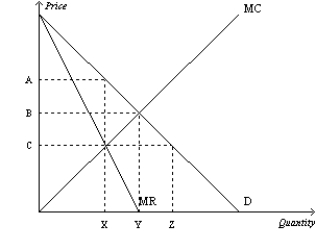 -Refer to Figure 15-8. What is the area of deadweight loss?
 (Multiple Choice)
4.9/5 (84)
(84) Figure 15-11 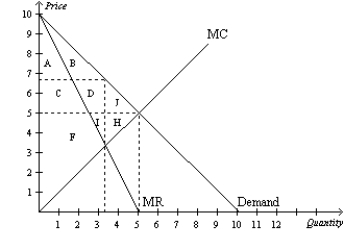 -Refer to Figure 15-11. Which area represents the deadweight loss from monopoly?
 (Multiple Choice)
4.8/5 (72)
(72) Table 15-6
A monopolist faces the following demand curve: 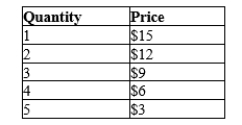 -Refer to Table 15-6. Suppose the monopolist has total fixed costs equal to $5 and a variable cost equal to $4 per unit for all units produced. What is the profit-maximizing price?
 (Multiple Choice)
4.9/5 (77)
(77) Figure 15-2 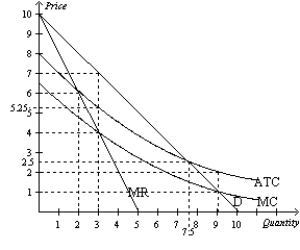 -Refer to Figure 15-2. If the firm profit-maximizes, how much profit will it earn?
 (Short Answer)
4.9/5 (75)
(75) Figure 15-21 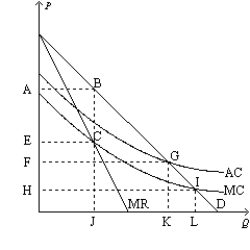 -Refer to Figure 15-21. What is the price and quantity for this natural monopolist under socially optimal pricing?
 (Multiple Choice)
4.9/5 (60)
(60) Scenario 15-9
Suppose executives at an art museum know that 100 adults are willing to pay $12 for admission to the museum on a weekday. Suppose the executives also know that 200 students are willing to pay $8 for admission on a weekday. The cost of operating the museum on a weekday is $2,000.
-Refer to Scenario 15-9. How much profit will the museum earn if it charges all customers $8 for admission?
(Multiple Choice)
4.7/5 (80)
(80) Table 15-7
Sally owns the only shoe store in town. She has the following cost and revenue information. 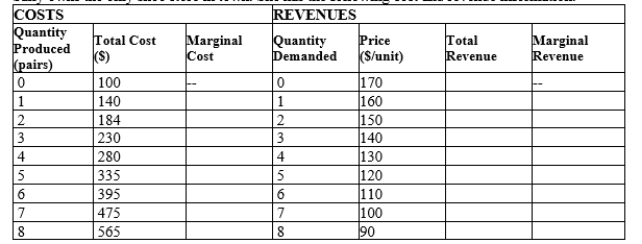 -Refer to Table 15-7. What is the total variable cost of production when Sally produces six pairs of shoes?
 (Multiple Choice)
4.9/5 (81)
(81) Price discrimination is a rational strategy for a profit-maximizing monopolist when
(Multiple Choice)
4.9/5 (85)
(85) Table 15-11
The following table shows quantity, price, and marginal cost information for a monopoly: 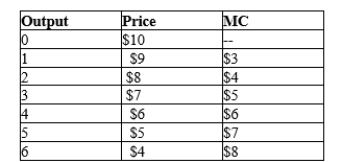 -Refer to Table 15-11. What would be the firm's marginal revenue at the profit-maximizing level of output?
 (Multiple Choice)
4.8/5 (88)
(88) 
Filters
- Essay(0)
- Multiple Choice(0)
- Short Answer(0)
- True False(0)
- Matching(0)