



 Chat with AI
Exam 15: Monopoly

Exam 1: Ten Principles of Economics455 Questions
Exam 2: Thinking Like an Economist643 Questions
Exam 3: Interdependence and the Gains From Trade547 Questions
Exam 4: The Market Forces of Supply and Demand693 Questions
Exam 5: Elasticity and Its Application626 Questions
Exam 6: Supply, Demand, and Government Policies668 Questions
Exam 7: Consumers, Producers, and the Efficiency of Markets547 Questions
Exam 8: Applications: the Costs of Taxation509 Questions
Exam 9: Application: International Trade521 Questions
Exam 10: Externalities543 Questions
Exam 11: Public Goods and Common Resources452 Questions
Exam 12: The Design of the Tax System664 Questions
Exam 13: The Costs of Production649 Questions
Exam 14: Firms in Competitive Markets604 Questions
Exam 15: Monopoly662 Questions
Exam 16: Monopolistic Competition649 Questions
Exam 17: Oligopoly522 Questions
Exam 18: The Markets for the Factors of Production592 Questions
Exam 19: Earnings and Discrimination511 Questions
Exam 20: Income Inequality and Poverty478 Questions
Exam 21: The Theory of Consumer Choice570 Questions
Exam 22: Frontiers in Microeconomics461 Questions
Exam 23: Measuring a Nation S Income547 Questions
Exam 24: Measuring the Cost of Living565 Questions
Exam 25: Production and Growth527 Questions
Exam 26: Saving, Investment, and the Financial System637 Questions
Exam 27: Tools of Finance534 Questions
Exam 28: Unemployment and Its Natural Rate701 Questions
Exam 29: The Monetary System540 Questions
Exam 30: Money Growth and Inflation504 Questions
Exam 31: Open-Economy Macroeconomics: Basic Concepts540 Questions
Exam 32: A Macroeconomic Theory of the Open Economy511 Questions
Exam 33: Aggregate Demand and Aggregate Supply572 Questions
Exam 34: The Influence of Monetary and Fiscal Policy on Aggregate Demand523 Questions
Exam 35: The Short-Run Tradeoff Between Inflation and Unemployment536 Questions
Exam 36: Six Debates Over Macroeconomic Policy354 Questions
Select questions type


A movie theater can increase its profits through price discrimination by charging a higher price to adults and a lower price to children if it
(Multiple Choice)
4.9/5  (82)
(82) Table 15-8
The following table provides information on the price, quantity, and average total cost for a monopoly. 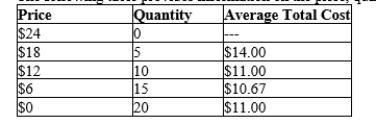 -Refer to Table 15-8. What is the maximum profit that the monopolist can earn?
 (Multiple Choice)
4.9/5 (75)
(75) Which of the following is an example of a barrier to entry?
(Multiple Choice)
4.8/5 (84)
(84) Scenario 15-10
Vincent operates a scenic tour business in Boston. He has one bus which can fit 50 people per tour and each tour lasts 2 hours. His total cost of operating one tour is fixed at $450. Vincent's cost is not reduced if he runs a tour with a partially full bus. While his cost is the same for all tours, Vincent charges each passenger his/her willingness to pay: adults $18 per trip, children $10 per trip, and senior citizens $12 per trip. At those rates, on a typical day Vincent's demand is:  Assume that Vincent's customers are always available for the tour; therefore, he can fill his bus for each tour as long as there is sufficient total demand for the day.
-Refer to Scenario 15-10. What is Vincent's profit on a typical day?
Assume that Vincent's customers are always available for the tour; therefore, he can fill his bus for each tour as long as there is sufficient total demand for the day.
-Refer to Scenario 15-10. What is Vincent's profit on a typical day? (Multiple Choice)
4.8/5 (81)
(81) Table 15-4
A monopolist faces the following demand curve: 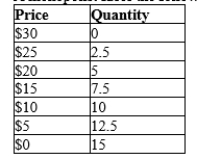 -Refer to Table 15-4. If the monopolist produces 5 units, what is its average revenue?
 (Multiple Choice)
4.8/5 (76)
(76) At the profit-maximizing quantity of output for a monopolist, average revenue, marginal revenue, and price are all equal.
(True/False)
4.9/5 (85)
(85) Comparing firms in perfectly competitive markets to monopoly firms, which can earn economic profits in the long run?
(Short Answer)
5.0/5 (64)
(64) Suppose a profit-maximizing monopolist faces a constant marginal cost of $10, produces an output level of 100 units, and charges a price of $50. The socially efficient level of output is 200 units. Assume that the demand curve and marginal revenue curve are the typical downward-sloping straight lines. The monopoly deadweight loss equals $4,000.
(True/False)
4.9/5 (69)
(69) The legislation passed by Congress in 1914 to strengthen the government's powers and authorize private lawsuits was the
(Multiple Choice)
5.0/5 (84)
(84) Figure 15-2 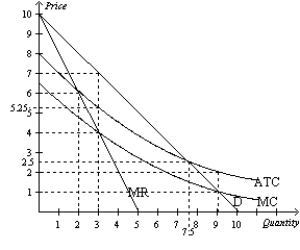 -Refer to Figure 15-2. If the firm profit-maximizes, what amount of output will it produce?
 (Short Answer)
4.8/5 (94)
(94) Scenario 15-7
Black Box Cable TV is able to purchase an exclusive right to sell a premium movie channel (PMC) in its market area. Let's assume that Black Box Cable pays $150,000 a year for the exclusive marketing rights to PMC. Since Black Box has already installed cable to all of the homes in its market area, the marginal cost of delivering PMC to subscribers is zero. The manager of Black Box needs to know what price to charge for the PMC service to maximize her profit. Before setting price, she hires an economist to estimate demand for the PMC service. The economist discovers that there are two types of subscribers who value premium movie channels. First are the 4,000 die-hard TV viewers who will pay as much as $150 a year for the new PMC premium channel. Second, the PMC channel will appeal to 20,000 occasional TV viewers who will pay as much as $20 a year for a subscription to PMC.
-Refer to Scenario 15-7. If Black Box Cable TV is able to price discriminate, what would be the maximum amount of profit it could generate?
(Multiple Choice)
5.0/5 (69)
(69) Figure 15-18 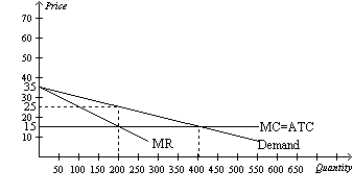 -Refer to Figure 15-18. If the monopoly firm is not allowed to price discriminate, then the deadweight loss amounts to
 (Multiple Choice)
4.8/5 (78)
(78) Table 15-7
Sally owns the only shoe store in town. She has the following cost and revenue information. 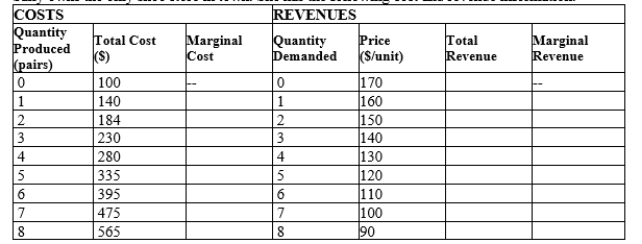 -Refer to Table 15-7. What is total profit at the profit-maximizing quantity?
 (Multiple Choice)
4.9/5 (88)
(88) Firms with substantial monopoly power are quite common because many goods are unique.
(True/False)
4.8/5 (91)
(91) Which of the following is not an example of a barrier to entry?
(Multiple Choice)
4.8/5 (64)
(64) Table 15-1 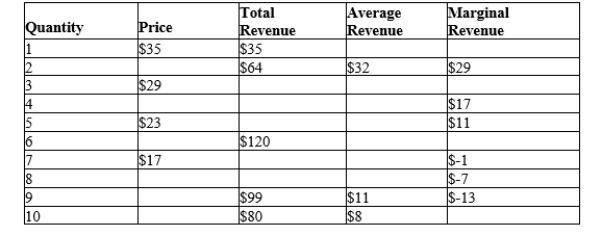 -Refer to Table 15-1. When 4 units of output are produced and sold, what is average revenue?
 (Multiple Choice)
4.9/5 (69)
(69) For a monopolist, when the price effect is greater than the output effect, marginal revenue is
(Multiple Choice)
4.9/5 (87)
(87) Table 15-18
A monopolist faces the following demand curve: 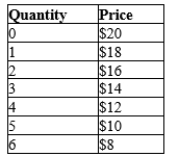 Suppose marginal cost is constant at $8 per unit.
-Refer to Table 15-18. Suppose the firm depicted in the table is selling a prescription drug for which it had a patent, but the patent has expired. As new firms enter the market and sell the generic version of this drug competitively, what quantity will be sold?
Suppose marginal cost is constant at $8 per unit.
-Refer to Table 15-18. Suppose the firm depicted in the table is selling a prescription drug for which it had a patent, but the patent has expired. As new firms enter the market and sell the generic version of this drug competitively, what quantity will be sold? (Multiple Choice)
4.7/5 (66)
(66) 
Filters
- Essay(0)
- Multiple Choice(0)
- Short Answer(0)
- True False(0)
- Matching(0)