



 Chat with AI
Exam 15: Monopoly

Exam 1: Ten Principles of Economics455 Questions
Exam 2: Thinking Like an Economist643 Questions
Exam 3: Interdependence and the Gains From Trade547 Questions
Exam 4: The Market Forces of Supply and Demand693 Questions
Exam 5: Elasticity and Its Application626 Questions
Exam 6: Supply, Demand, and Government Policies668 Questions
Exam 7: Consumers, Producers, and the Efficiency of Markets547 Questions
Exam 8: Applications: the Costs of Taxation509 Questions
Exam 9: Application: International Trade521 Questions
Exam 10: Externalities543 Questions
Exam 11: Public Goods and Common Resources452 Questions
Exam 12: The Design of the Tax System664 Questions
Exam 13: The Costs of Production649 Questions
Exam 14: Firms in Competitive Markets604 Questions
Exam 15: Monopoly662 Questions
Exam 16: Monopolistic Competition649 Questions
Exam 17: Oligopoly522 Questions
Exam 18: The Markets for the Factors of Production592 Questions
Exam 19: Earnings and Discrimination511 Questions
Exam 20: Income Inequality and Poverty478 Questions
Exam 21: The Theory of Consumer Choice570 Questions
Exam 22: Frontiers in Microeconomics461 Questions
Exam 23: Measuring a Nation S Income547 Questions
Exam 24: Measuring the Cost of Living565 Questions
Exam 25: Production and Growth527 Questions
Exam 26: Saving, Investment, and the Financial System637 Questions
Exam 27: Tools of Finance534 Questions
Exam 28: Unemployment and Its Natural Rate701 Questions
Exam 29: The Monetary System540 Questions
Exam 30: Money Growth and Inflation504 Questions
Exam 31: Open-Economy Macroeconomics: Basic Concepts540 Questions
Exam 32: A Macroeconomic Theory of the Open Economy511 Questions
Exam 33: Aggregate Demand and Aggregate Supply572 Questions
Exam 34: The Influence of Monetary and Fiscal Policy on Aggregate Demand523 Questions
Exam 35: The Short-Run Tradeoff Between Inflation and Unemployment536 Questions
Exam 36: Six Debates Over Macroeconomic Policy354 Questions
Select questions type


Scenario 15-8
Mega Media Cable TV is able to purchase an exclusive right to sell a premium sports channel in its market area. Let's assume that Mega Media pays $100,000 a year for the exclusive marketing rights to the sports channel. Since Mega Media has already installed cable to all of the homes in its market area, the marginal cost of delivering the sports channel to subscribers is zero. The manager of Mega Media needs to know what price to charge for the sports channel service to maximize her profit. Before setting price, she hires an economist to estimate demand for the sports channel. The economist discovers that there are two types of subscribers who value premium sporting channels. First are the 3,000 die-hard sports fans who will pay as much as $150 a year for the new channel. Second, the premium sports channel will appeal to 20,000 occasional sports viewers who will pay as much as $25 a year for a subscription to it.
-Refer to Scenario 15-8. How much profit will Mega Media Cable TV earn if it sets the price at $150?
(Multiple Choice)
4.9/5  (82)
(82) Since monopolists that practice price discrimination generally increase market output, compared to a monopoly that charges a single price, practicing price discrimination generally leads to a smaller deadweight loss.
(True/False)
5.0/5 (79)
(79) Table 15-7
Sally owns the only shoe store in town. She has the following cost and revenue information. 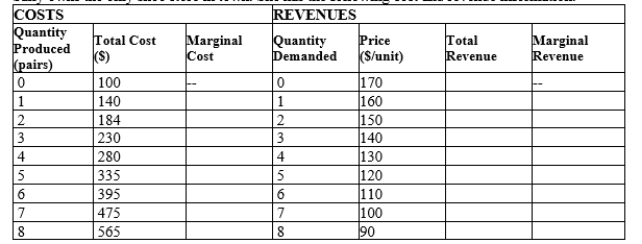 -Refer to Table 15-7. What is the total revenue from selling 6 pairs of shoes?
 (Multiple Choice)
4.9/5 (74)
(74) Table 15-7
Sally owns the only shoe store in town. She has the following cost and revenue information.
-Refer to Table 15-7. What are Sally's fixed costs?
-Refer to Table 15-7. What are Sally's fixed costs? (Multiple Choice)
4.9/5 (70)
(70) The price effect describes the situation when a monopolist lowers the price of output and, all else equal, total revenue
(Multiple Choice)
4.8/5 (82)
(82) Table 15-6
A monopolist faces the following demand curve: 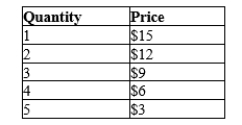 -Refer to Table 15-6. Suppose the monopolist has total fixed costs equal to $5 and a variable cost equal to $4 per unit for all units produced. What would the total profit be if she charged $6 per unit for her product?
 (Multiple Choice)
4.9/5 (72)
(72) Allowing an inventor to have the exclusive rights to market her new invention will lead to
(i)a product that is priced higher than it would be without the exclusive rights.
(ii)desirable behavior in the sense that inventors are encouraged to invent.
(iii)higher profits for the inventor.
(Multiple Choice)
4.9/5 (84)
(84) Price discrimination can increase both the monopolist's profits and society's welfare.
(True/False)
4.9/5 (76)
(76) Table 15-12
The following table provides information on the price, quantity, and average total cost for a monopoly. 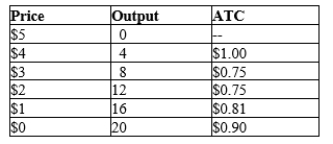 -Refer to Table 15-12. In order to maximize profits, the firm should produce
 (Multiple Choice)
4.7/5 (75)
(75) Microsoft faces very little competition from other firms for its Windows software. Why isn't the price of the software $1,000 per copy?
(Multiple Choice)
4.7/5 (82)
(82) In the majority of cases where there is a natural monopoly in the United States, the government usually deals with the problem
(Multiple Choice)
4.8/5 (79)
(79) A natural monopoly has economies of scale for most if not all of its range of output.
(True/False)
4.9/5 (78)
(78) A natural monopoly will always operate in the region of the long run average total cost curve where the cost per unit is constant.
(True/False)
4.9/5 (67)
(67) Bob's Butcher Shop is the only place within 100 miles that sells bison burgers. Assuming that Bob is maximizing his profit, which of the following statements is true?
(Multiple Choice)
4.9/5 (84)
(84) Figure 15-19 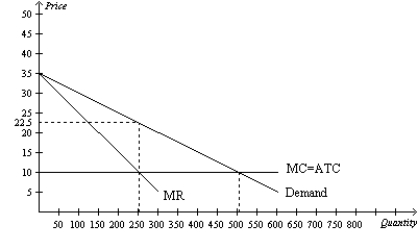 -Refer to Figure 15-19. If there are no fixed costs of production, monopoly profit with perfect price discrimination equals
 (Multiple Choice)
4.7/5 (76)
(76) Table 15-1 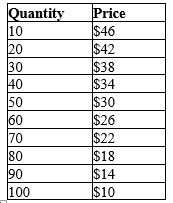 -Refer to Table 15-1. The marginal revenue, when the quantity changes from 30 to 40 units, is
 (Short Answer)
4.7/5 (74)
(74) 
Filters
- Essay(0)
- Multiple Choice(0)
- Short Answer(0)
- True False(0)
- Matching(0)