



 Chat with AI
Exam 15: Monopoly

Exam 1: Ten Principles of Economics455 Questions
Exam 2: Thinking Like an Economist643 Questions
Exam 3: Interdependence and the Gains From Trade547 Questions
Exam 4: The Market Forces of Supply and Demand693 Questions
Exam 5: Elasticity and Its Application626 Questions
Exam 6: Supply, Demand, and Government Policies668 Questions
Exam 7: Consumers, Producers, and the Efficiency of Markets547 Questions
Exam 8: Applications: the Costs of Taxation509 Questions
Exam 9: Application: International Trade521 Questions
Exam 10: Externalities543 Questions
Exam 11: Public Goods and Common Resources452 Questions
Exam 12: The Design of the Tax System664 Questions
Exam 13: The Costs of Production649 Questions
Exam 14: Firms in Competitive Markets604 Questions
Exam 15: Monopoly662 Questions
Exam 16: Monopolistic Competition649 Questions
Exam 17: Oligopoly522 Questions
Exam 18: The Markets for the Factors of Production592 Questions
Exam 19: Earnings and Discrimination511 Questions
Exam 20: Income Inequality and Poverty478 Questions
Exam 21: The Theory of Consumer Choice570 Questions
Exam 22: Frontiers in Microeconomics461 Questions
Exam 23: Measuring a Nation S Income547 Questions
Exam 24: Measuring the Cost of Living565 Questions
Exam 25: Production and Growth527 Questions
Exam 26: Saving, Investment, and the Financial System637 Questions
Exam 27: Tools of Finance534 Questions
Exam 28: Unemployment and Its Natural Rate701 Questions
Exam 29: The Monetary System540 Questions
Exam 30: Money Growth and Inflation504 Questions
Exam 31: Open-Economy Macroeconomics: Basic Concepts540 Questions
Exam 32: A Macroeconomic Theory of the Open Economy511 Questions
Exam 33: Aggregate Demand and Aggregate Supply572 Questions
Exam 34: The Influence of Monetary and Fiscal Policy on Aggregate Demand523 Questions
Exam 35: The Short-Run Tradeoff Between Inflation and Unemployment536 Questions
Exam 36: Six Debates Over Macroeconomic Policy354 Questions
Select questions type


When we compare economic welfare in a monopoly market to a competitive market, the profits earned by the monopolist represent
(Multiple Choice)
4.7/5  (80)
(80) If a product can be produced by a natural monopoly, society will benefit in the form of lower prices if the monopolist is broken up into several smaller firms.
(True/False)
4.8/5 (75)
(75) Figure 15-2 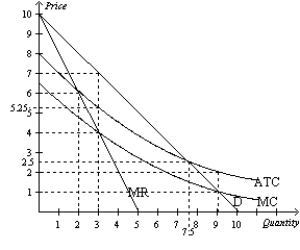 -Refer to Figure 15-2. If the firm profit-maximizes, what price will it charge?
 (Short Answer)
4.8/5 (78)
(78) Because a monopolist is the sole producer in its market, it can necessarily alter the price of its good
(i)without affecting the quantity sold.
(ii)without affecting its average total cost.
(iii)by adjusting the quantity it supplies to the market.
(Multiple Choice)
4.9/5 (88)
(88) Figure 15-19 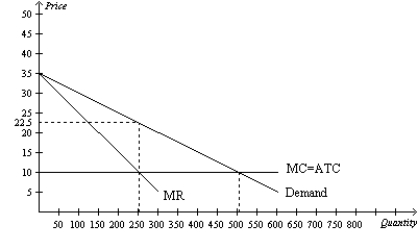 -Refer to Figure 15-19. If the monopoly firm is not allowed to price discriminate, then consumer surplus amounts to
 (Multiple Choice)
4.8/5 (79)
(79) For a monopoly firm, which of the following equalities is always true?
(Multiple Choice)
4.9/5 (71)
(71) When there are economies of scale over the relevant range of output for a monopoly, the monopoly
(Multiple Choice)
4.8/5 (97)
(97) Comparing firms in perfectly competitive markets to monopoly firms, which charges higher prices?
(Short Answer)
4.8/5 (73)
(73) If a monopolist's marginal costs increase by $1 for all levels of output, then the monopoly price will
(Multiple Choice)
4.9/5 (85)
(85) The best solution to the problem of welfare loss from monopoly is public ownership.
(True/False)
4.8/5 (94)
(94) Suppose a firm has a monopoly on the sale of widgets and faces a downward-sloping demand curve. When selling the 100th widget, the firm will always receive
(Multiple Choice)
4.9/5 (96)
(96) Policymakers are discussing various proposals regarding how to deal with natural monopolies. Senator Huff wants to regulate natural monopolies by equating price with average total cost. Huff contends that such a policy will ensure that monopolies make every effort to reduce costs. Senator Puff wants the government to own natural monopolies. Puff argues that government-owned monopolies usually do a better job of holding down costs than privately owned monopolies. Which senator's argument is correct?
(Multiple Choice)
4.9/5 (82)
(82) Describe how government is involved in creating a monopoly. Why might the government create one? Give an example.
(Essay)
5.0/5 (90)
(90) Consider a profit-maximizing monopoly pricing under the following conditions. The profit-maximizing price charged for goods produced is $12.The intersection of the marginal revenue and marginal cost curves occurs where output is 10 units and marginal cost is $6. The socially efficient level of production is 12 units. The demand curve and marginal cost curves are linear. What is the value of the deadweight loss created by the monopolist?
(Multiple Choice)
4.8/5 (77)
(77) For a long while, electricity producers were thought to be a classic example of a natural monopoly. People held this view because
(Multiple Choice)
4.8/5 (62)
(62) Like competitive firms, monopolies charge a price equal to marginal cost.
(True/False)
4.7/5 (77)
(77) Figure 15-1 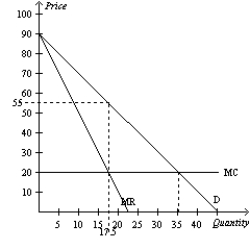 -Refer to Figure 15-1. Which is more efficient, single price profit maximization or perfect price discrimination?
 (Essay)
4.8/5 (87)
(87) What is the shape of the monopolist's marginal revenue curve?
(Multiple Choice)
4.8/5 (67)
(67) 
Filters
- Essay(0)
- Multiple Choice(0)
- Short Answer(0)
- True False(0)
- Matching(0)