



 Chat with AI
Exam 25: Production and Growth

Exam 1: Ten Principles of Economics455 Questions
Exam 2: Thinking Like an Economist643 Questions
Exam 3: Interdependence and the Gains From Trade547 Questions
Exam 4: The Market Forces of Supply and Demand693 Questions
Exam 5: Elasticity and Its Application626 Questions
Exam 6: Supply, Demand, and Government Policies668 Questions
Exam 7: Consumers, Producers, and the Efficiency of Markets547 Questions
Exam 8: Applications: the Costs of Taxation509 Questions
Exam 9: Application: International Trade521 Questions
Exam 10: Externalities543 Questions
Exam 11: Public Goods and Common Resources452 Questions
Exam 12: The Design of the Tax System664 Questions
Exam 13: The Costs of Production649 Questions
Exam 14: Firms in Competitive Markets604 Questions
Exam 15: Monopoly662 Questions
Exam 16: Monopolistic Competition649 Questions
Exam 17: Oligopoly522 Questions
Exam 18: The Markets for the Factors of Production592 Questions
Exam 19: Earnings and Discrimination511 Questions
Exam 20: Income Inequality and Poverty478 Questions
Exam 21: The Theory of Consumer Choice570 Questions
Exam 22: Frontiers in Microeconomics461 Questions
Exam 23: Measuring a Nation S Income547 Questions
Exam 24: Measuring the Cost of Living565 Questions
Exam 25: Production and Growth527 Questions
Exam 26: Saving, Investment, and the Financial System637 Questions
Exam 27: Tools of Finance534 Questions
Exam 28: Unemployment and Its Natural Rate701 Questions
Exam 29: The Monetary System540 Questions
Exam 30: Money Growth and Inflation504 Questions
Exam 31: Open-Economy Macroeconomics: Basic Concepts540 Questions
Exam 32: A Macroeconomic Theory of the Open Economy511 Questions
Exam 33: Aggregate Demand and Aggregate Supply572 Questions
Exam 34: The Influence of Monetary and Fiscal Policy on Aggregate Demand523 Questions
Exam 35: The Short-Run Tradeoff Between Inflation and Unemployment536 Questions
Exam 36: Six Debates Over Macroeconomic Policy354 Questions
Select questions type


Which well-known economist from the past asserted that "the power of population is infinitely greater than the power in the earth to produce subsistence for man?"

Free
(Short Answer)
4.9/5  (78)
(78) Correct Answer: Verified
The economist was Thomas Robert Malthus.
Without controlling for differences in natural resources and technological knowledge, diminishing returns can explain the entire difference in economic growth rates for China and the United States.
Free
(True/False)
4.8/5 (78)
(78) Correct Answer:Verified
VerifiedFalse
Which of the following is higher in Mali than in the United Kingdom?
Free
(Multiple Choice)
4.8/5 (76)
(76) Correct Answer:Verified
VerifiedC
If a good has become more scarce, then we know for sure that
(Multiple Choice)
4.9/5 (85)
(85) Country A has real GDP per person of 250,000 while Country B has real GDP per person of 500,000. All else constant, Country A will eventually have a higher standard of living than Country B if
(Multiple Choice)
4.9/5 (86)
(86) Suppose Japanese-based Toshiba Corporation builds and operates a new computer factory in the United States. Future production from such an investment will
(Multiple Choice)
4.8/5 (75)
(75) Which of the following countries had the lowest level of real GDP per person in 2014?
(Multiple Choice)
4.8/5 (68)
(68) If an American-based firm opens and operates a factory in China, then it is engaging in
(Multiple Choice)
4.7/5 (83)
(83) In a particular production process, if the quantities of all inputs used double, then the quantity of output doubles as well. This means that
(Multiple Choice)
4.8/5 (71)
(71) Which of the following nations experienced average rates of economic growth of less than 2 percent over the last 100 years or so?
(Multiple Choice)
4.9/5 (80)
(80) International data on the history of real GDP growth rates shows that over the last 120 years or so, rich countries got richer and poor countries got poorer.
(True/False)
4.7/5 (82)
(82) Over the period 1890-2014, Japan experienced a 2.59 percent average annual growth rate of real GDP per person.
(True/False)
4.9/5 (85)
(85) Dilbert's Incorporated produced 6,000,000 units of software in 2010. At the start of 2011 the pointy-haired boss raised employment from 10,000 total annual hours to 14,000 annual hours and production was 7,000,000 units. These number indicate that productivity
(Multiple Choice)
4.8/5 (84)
(84) Consider the nations of China, Japan, and the United States. Over the past century, which of these nations has progressed, in an economic sense, more rapidly than the other two nations?
(Essay)
5.0/5 (74)
(74) Figure 25-1 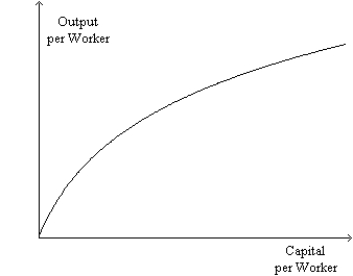 -Refer to Figure 21-1. Does the figure represent the idea that the amount of capital per worker influences the amount of output per worker, or does the figure represent the idea that the amount of output per worker influences the amount of capital per worker?
 (Essay)
4.8/5 (76)
(76) 
Filters
- Essay(0)
- Multiple Choice(0)
- Short Answer(0)
- True False(0)
- Matching(0)