



 Chat with AI
Exam 25: Production and Growth

Exam 1: Ten Principles of Economics455 Questions
Exam 2: Thinking Like an Economist643 Questions
Exam 3: Interdependence and the Gains From Trade547 Questions
Exam 4: The Market Forces of Supply and Demand693 Questions
Exam 5: Elasticity and Its Application626 Questions
Exam 6: Supply, Demand, and Government Policies668 Questions
Exam 7: Consumers, Producers, and the Efficiency of Markets547 Questions
Exam 8: Applications: the Costs of Taxation509 Questions
Exam 9: Application: International Trade521 Questions
Exam 10: Externalities543 Questions
Exam 11: Public Goods and Common Resources452 Questions
Exam 12: The Design of the Tax System664 Questions
Exam 13: The Costs of Production649 Questions
Exam 14: Firms in Competitive Markets604 Questions
Exam 15: Monopoly662 Questions
Exam 16: Monopolistic Competition649 Questions
Exam 17: Oligopoly522 Questions
Exam 18: The Markets for the Factors of Production592 Questions
Exam 19: Earnings and Discrimination511 Questions
Exam 20: Income Inequality and Poverty478 Questions
Exam 21: The Theory of Consumer Choice570 Questions
Exam 22: Frontiers in Microeconomics461 Questions
Exam 23: Measuring a Nation S Income547 Questions
Exam 24: Measuring the Cost of Living565 Questions
Exam 25: Production and Growth527 Questions
Exam 26: Saving, Investment, and the Financial System637 Questions
Exam 27: Tools of Finance534 Questions
Exam 28: Unemployment and Its Natural Rate701 Questions
Exam 29: The Monetary System540 Questions
Exam 30: Money Growth and Inflation504 Questions
Exam 31: Open-Economy Macroeconomics: Basic Concepts540 Questions
Exam 32: A Macroeconomic Theory of the Open Economy511 Questions
Exam 33: Aggregate Demand and Aggregate Supply572 Questions
Exam 34: The Influence of Monetary and Fiscal Policy on Aggregate Demand523 Questions
Exam 35: The Short-Run Tradeoff Between Inflation and Unemployment536 Questions
Exam 36: Six Debates Over Macroeconomic Policy354 Questions
Select questions type


All else equal, if there are diminishing returns, then what happens to productivity if both capital and labor increase?
(Multiple Choice)
4.8/5  (84)
(84) Economists differ in their views of the role of the government in promoting economic growth. A controversial idea is that government should
(Multiple Choice)
4.8/5 (70)
(70) Which of the following lists contains, in this order, natural resources, physical capital, and human capital?
(Multiple Choice)
4.9/5 (77)
(77) Countries that grew the fastest over the last 100 or so years had average growth rates of real income per person of about
(Multiple Choice)
4.8/5 (85)
(85) The inputs into production of goods and services that are provided by nature, such as land, rivers, and mineral deposits are called
(Multiple Choice)
5.0/5 (70)
(70) The Economic Development Minister of a country has a list of things she thinks may explain her country's low growth of real GDP per person relative to other countries. She asks you to pick the one you think most likely explains her country's low growth. Which of the following contributes to low growth?
(Multiple Choice)
4.9/5 (82)
(82) Suppose an economy experiences an increase in its saving rate. The higher saving rate leads to a higher growth rate of productivity
(Multiple Choice)
4.8/5 (77)
(77) According to Michael Kremer, at which population should technological progress be most rapid?
(Multiple Choice)
4.9/5 (70)
(70) Megan is a landscaper. Which of the following are included in her physical capital?
(Multiple Choice)
4.9/5 (86)
(86) If over a short time a large number of teenagers become old enough to find employment and a much smaller number of people retire, then productivity
(Multiple Choice)
4.7/5 (74)
(74) Some data that at first might seem puzzling: The share of GDP devoted to investment was similar for the United States and South Korea from 1960-1991. However, during these same years South Korea had a 6 percent growth rate of average annual income per person, while the United States had only a 2 percent growth rate. If the saving rates were the same, why were the growth rates so different?
(Essay)
4.9/5 (73)
(73) Which of the following is generally an opportunity cost of investment in human capital?
(Multiple Choice)
4.9/5 (75)
(75) Figure 25-1 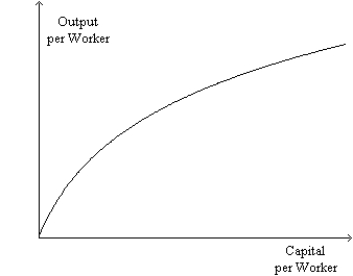 -Refer to Figure 21-1. In what way is the figure relevant to the catch-up effect?
 (Essay)
4.9/5 (94)
(94) Last year real GDP in the imaginary nation of Populia was 907.5 billion and the population was 3.3 million. The year before real GDP was 750 billion and the population was 3 million. What was the growth rate of real GDP per person during the year?
(Multiple Choice)
4.8/5 (78)
(78) Country A has real GDP per person of 100,000 while country B has real GDP per person of 200,000. All else constant, country A will eventually have a higher standard of living than country B if
(Multiple Choice)
4.8/5 (73)
(73) Although growth rates across countries vary some, rankings of countries by income remain pretty much the same over time.
(True/False)
5.0/5 (89)
(89) Figure 25-1. On the horizontal axis, K/L represents capital (K) per worker (L). On the vertical axis, Y/L represents output (Y) per worker (L). 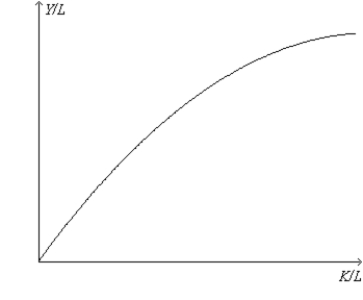 -Refer to Figure 25-1. Choose a point anywhere on the curve and call it point A. If the economy is at point A in 2011, then it will definitely remain at point A in 2012 if, between 2011 and 2012,
 (Multiple Choice)
4.8/5 (66)
(66) 
Filters
- Essay(0)
- Multiple Choice(0)
- Short Answer(0)
- True False(0)
- Matching(0)