



 Chat with AI
Exam 21: The Theory of Consumer Choice

Exam 1: Ten Principles of Economics455 Questions
Exam 2: Thinking Like an Economist643 Questions
Exam 3: Interdependence and the Gains From Trade547 Questions
Exam 4: The Market Forces of Supply and Demand693 Questions
Exam 5: Elasticity and Its Application626 Questions
Exam 6: Supply, Demand, and Government Policies668 Questions
Exam 7: Consumers, Producers, and the Efficiency of Markets547 Questions
Exam 8: Applications: the Costs of Taxation509 Questions
Exam 9: Application: International Trade521 Questions
Exam 10: Externalities543 Questions
Exam 11: Public Goods and Common Resources452 Questions
Exam 12: The Design of the Tax System664 Questions
Exam 13: The Costs of Production649 Questions
Exam 14: Firms in Competitive Markets604 Questions
Exam 15: Monopoly662 Questions
Exam 16: Monopolistic Competition649 Questions
Exam 17: Oligopoly522 Questions
Exam 18: The Markets for the Factors of Production592 Questions
Exam 19: Earnings and Discrimination511 Questions
Exam 20: Income Inequality and Poverty478 Questions
Exam 21: The Theory of Consumer Choice570 Questions
Exam 22: Frontiers in Microeconomics461 Questions
Exam 23: Measuring a Nation S Income547 Questions
Exam 24: Measuring the Cost of Living565 Questions
Exam 25: Production and Growth527 Questions
Exam 26: Saving, Investment, and the Financial System637 Questions
Exam 27: Tools of Finance534 Questions
Exam 28: Unemployment and Its Natural Rate701 Questions
Exam 29: The Monetary System540 Questions
Exam 30: Money Growth and Inflation504 Questions
Exam 31: Open-Economy Macroeconomics: Basic Concepts540 Questions
Exam 32: A Macroeconomic Theory of the Open Economy511 Questions
Exam 33: Aggregate Demand and Aggregate Supply572 Questions
Exam 34: The Influence of Monetary and Fiscal Policy on Aggregate Demand523 Questions
Exam 35: The Short-Run Tradeoff Between Inflation and Unemployment536 Questions
Exam 36: Six Debates Over Macroeconomic Policy354 Questions
Select questions type


If an increase in the interest rate raises savings, then

Free
(Multiple Choice)
4.9/5  (73)
(73) Correct Answer: Verified
A
A consumer chooses an optimal consumption point where the
Free
(Multiple Choice)
4.9/5 (84)
(84) Correct Answer:Verified
VerifiedD
The relationship between the marginal utility that Casey gets from eating ice cream sundaes and the number of ice cream cones he eats per week is as follows:  Casey receives 3 units of utility from the last dollar spent on each of the other goods he consumes. If ice cream sundaes cost $4 each, how many ice cream sundaes will he consume per month if he maximizes utility?
Free
(Multiple Choice)
4.7/5 (82)
(82) Correct Answer:Verified
VerifiedB
Figure 21-14 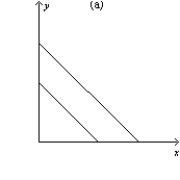
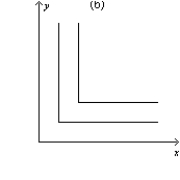
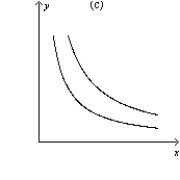 -Refer to Figure 21-14. Which of the graphs illustrates indifference curves for which the marginal rate of substitution varies?
 (Multiple Choice)
4.8/5 (83)
(83) Suppose that Sam likes pears twice as much as apples, meaning that he is always indifferent between consuming one pear or two apples. Sam's indifference curves for pears and apples are
(Multiple Choice)
4.8/5 (78)
(78) Figure 21-13 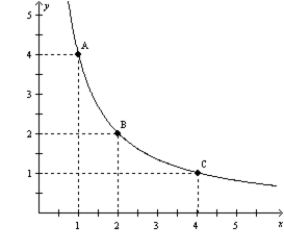 -Refer to Figure 21-13. As the consumer moves from A to B to C, the marginal rate of substitution
 (Multiple Choice)
4.9/5 (78)
(78) A rise in the interest rate will generally result in people consuming less when they are old if the substitution effect outweighs the income effect.
(True/False)
4.7/5 (80)
(80) Suppose a consumer spends her income on two goods: music CDs and DVDs. The consumer has $200 to allocate to these two goods, the price of a CD is $10, and the price of a DVD is $20. What is the maximum number of DVDs the consumer can purchase?
(Multiple Choice)
4.8/5 (81)
(81) When Adam's income increases, he purchases more tickets to Broadway musicals than he did before his income increased. For Adam, Broadway musicals are a(n)
(Multiple Choice)
4.8/5 (82)
(82) On a graph we draw indifference curves to illustrate Steven's preferences for steak and broccoli. If two of Steven's indifference curves cross, then it cannot be the case that Steven
(Multiple Choice)
4.7/5 (79)
(79) A good is an inferior good if the consumer buys more of it when
(Multiple Choice)
4.8/5 (82)
(82) Scenario 21-2
Lawrence has recently graduated from college with a degree in journalism and economics. He has decided to pursue a career as a freelance journalist writing for business newspapers and magazines. Lawrence is typically awake for 112 hours each week (he sleeps an average of 8 hours each day). For each hour Lawrence spends writing, he can earn $75. Lawrence is such a good writer that he can get paid for as many hours of writing as he chooses to work.
-Refer to Scenario 21-2. If Lawrence's wage increases to $90 per hour of writing, which of the following points would fall on his budget constraint?
(Multiple Choice)
4.9/5 (71)
(71) The income effect in the work-leisure model induces a person to work less in response to higher wages, which tends to make the labor-supply curve slope backward.
(True/False)
4.9/5 (69)
(69) Figure 21-32 The figure shows three indifference curves and a budget constraint for a consumer named Hannah. When young, Hannah works and earns income. When old, she is retired and earns no income. 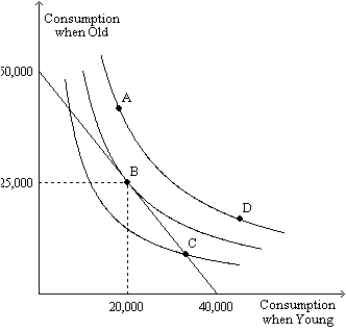 -Refer to Figure 21-32. If Hannah chose to spend $30,000 on consumption when young, then how much could she spend on consumption when old?
 (Essay)
4.8/5 (92)
(92) A rise in the interest rate will generally result in people consuming more when they are old if the substitution effect outweighs the income effect.
(True/False)
4.9/5 (65)
(65) Figure 21-2 The downward-sloping line on the figure represents a consumer's budget
constraint. 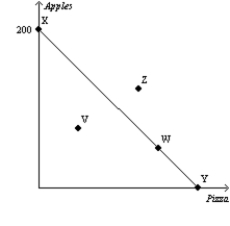 -Refer to Figure 21-2. Which points are affordable?
 (Multiple Choice)
4.8/5 (72)
(72) Figure 21-21 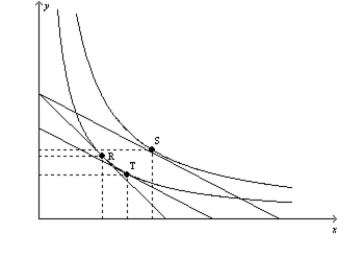 -Refer to Figure 21-21. Suppose that a consumer is originally at point R. Then the price of good X decreases. Which of the following represents the income effect of the price decrease?
 (Multiple Choice)
4.8/5 (78)
(78) 
Filters
- Essay(0)
- Multiple Choice(0)
- Short Answer(0)
- True False(0)
- Matching(0)