



 Chat with AI
Exam 21: The Theory of Consumer Choice

Exam 1: Ten Principles of Economics455 Questions
Exam 2: Thinking Like an Economist643 Questions
Exam 3: Interdependence and the Gains From Trade547 Questions
Exam 4: The Market Forces of Supply and Demand693 Questions
Exam 5: Elasticity and Its Application626 Questions
Exam 6: Supply, Demand, and Government Policies668 Questions
Exam 7: Consumers, Producers, and the Efficiency of Markets547 Questions
Exam 8: Applications: the Costs of Taxation509 Questions
Exam 9: Application: International Trade521 Questions
Exam 10: Externalities543 Questions
Exam 11: Public Goods and Common Resources452 Questions
Exam 12: The Design of the Tax System664 Questions
Exam 13: The Costs of Production649 Questions
Exam 14: Firms in Competitive Markets604 Questions
Exam 15: Monopoly662 Questions
Exam 16: Monopolistic Competition649 Questions
Exam 17: Oligopoly522 Questions
Exam 18: The Markets for the Factors of Production592 Questions
Exam 19: Earnings and Discrimination511 Questions
Exam 20: Income Inequality and Poverty478 Questions
Exam 21: The Theory of Consumer Choice570 Questions
Exam 22: Frontiers in Microeconomics461 Questions
Exam 23: Measuring a Nation S Income547 Questions
Exam 24: Measuring the Cost of Living565 Questions
Exam 25: Production and Growth527 Questions
Exam 26: Saving, Investment, and the Financial System637 Questions
Exam 27: Tools of Finance534 Questions
Exam 28: Unemployment and Its Natural Rate701 Questions
Exam 29: The Monetary System540 Questions
Exam 30: Money Growth and Inflation504 Questions
Exam 31: Open-Economy Macroeconomics: Basic Concepts540 Questions
Exam 32: A Macroeconomic Theory of the Open Economy511 Questions
Exam 33: Aggregate Demand and Aggregate Supply572 Questions
Exam 34: The Influence of Monetary and Fiscal Policy on Aggregate Demand523 Questions
Exam 35: The Short-Run Tradeoff Between Inflation and Unemployment536 Questions
Exam 36: Six Debates Over Macroeconomic Policy354 Questions
Select questions type


Refer to Scenario 21-1. If the consumer's income rises to $60, then the budget line for hot wings and beer would
(Multiple Choice)
4.8/5  (70)
(70) The indifference curves for left gloves and right gloves are straight lines.
(True/False)
4.7/5 (88)
(88) Figure 21-23 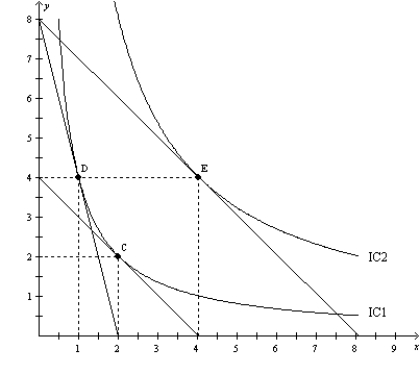 -Refer to Figure 21-23. When the price of X is $80, the price of Y is $20, and the consumer's income is $160, the consumer's optimal choice is D. Then the price of X decreases to $20. The demand curve can be illustrated as the movement from
 (Multiple Choice)
4.9/5 (91)
(91) Figure 21-26 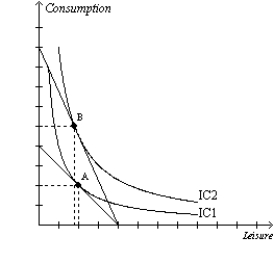 -Refer to Figure 21-26. Rhonda experiences an increase in her hourly wage. Her optimal choice point moves from A to B. For Rhonda,
 (Multiple Choice)
4.9/5 (79)
(79) The marginal rate of substitution is the slope of the indifference curve.
(True/False)
4.8/5 (65)
(65) Figure 21-29
The figure below illustrates the preferences of a representative consumer, Nathaniel. 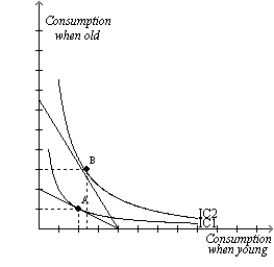 -Refer to Figure 21-29. Interest rates increase by 4 percent. Nathaniel's optimal choice point moves from A to B. Nathaniel consumes
 (Multiple Choice)
4.7/5 (85)
(85) Suppose an individual knows that the marginal utility he receives from the next apple is 5 and that the price of an apple is $2. He also knows that the marginal utility he receives from the next orange is 3 and the price of an orange is $1. If the individual is choosing optimally, the next good he will buy is
(Multiple Choice)
4.9/5 (84)
(84) When indifference curves are bowed inward, the marginal rate of substitution is
(Multiple Choice)
4.9/5 (83)
(83) Figure 21-6 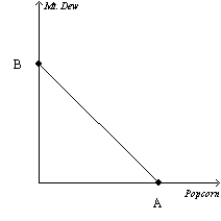 -Refer to Figure 21-6. Suppose a consumer has $100 in income, the price of popcorn is $2, and the value of B is 100. What is the price of Mt. Dew?
 (Multiple Choice)
4.8/5 (81)
(81) Figure 21-12 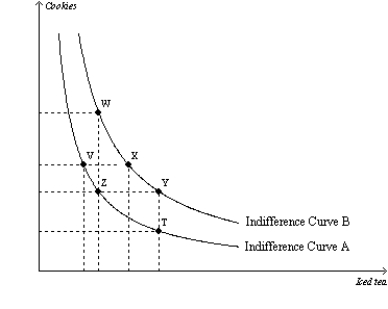 -Refer to Figure 21-12. Which of the following statements is correct?
 (Multiple Choice)
4.8/5 (100)
(100) Figure 21-24 The figure shows three indifference curves and a budget constraint for a certain consumer named Steve. 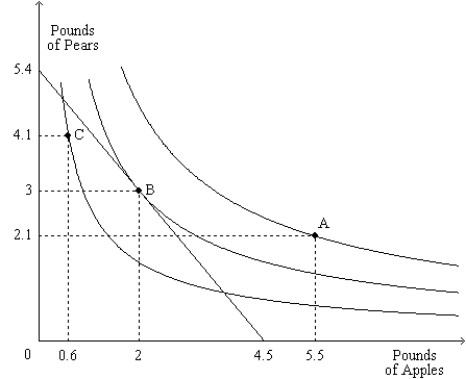 -Refer to Figure 21-24. Steve
 (Multiple Choice)
4.9/5 (77)
(77) The theory of consumer choice is representative of how consumers make decisions but is not intended to be a literal account of the process.
(True/False)
4.8/5 (74)
(74) Using indifference curves and budget constraints, graphically illustrate the substitution and income effect that would result from a change in the price of a normal good.
(Essay)
4.8/5 (65)
(65) Assume that goods X and Y are not Giffen goods. If the price of good X falls, a consumer will definitely
(Multiple Choice)
4.8/5 (88)
(88) Figure 21-12
-Refer to Figure 21-12. If the consumer moves from bundle W to bundle Z, the
-Refer to Figure 21-12. If the consumer moves from bundle W to bundle Z, the (Multiple Choice)
4.7/5 (82)
(82) A consumer has preferences over two goods, X and Y. Suppose we graph this consumer's preferences (which satisfy the usual properties of indifference curves) and budget constraint on a diagram with X on the horizontal axis and Y on the vertical axis. At the consumer's current consumption bundle, the consumer is spending all available income, and the marginal rate of substitution is greater than the slope of the budget constraint. We can conclude that the consumer
(Multiple Choice)
4.9/5 (69)
(69) Consider the indifference curve map and budget constraint for two goods, X and Y. Suppose the good on the horizontal axis, X, is normal. When the price of X increases, the substitution effect
(Multiple Choice)
4.9/5 (91)
(91) A decrease in the price of DVD players leads consumers to buy more DVD players. From this information we can conclude that DVD players
(Multiple Choice)
4.8/5 (83)
(83) 
Filters
- Essay(0)
- Multiple Choice(0)
- Short Answer(0)
- True False(0)
- Matching(0)