



 Chat with AI
Exam 21: The Theory of Consumer Choice

Exam 1: Ten Principles of Economics455 Questions
Exam 2: Thinking Like an Economist643 Questions
Exam 3: Interdependence and the Gains From Trade547 Questions
Exam 4: The Market Forces of Supply and Demand693 Questions
Exam 5: Elasticity and Its Application626 Questions
Exam 6: Supply, Demand, and Government Policies668 Questions
Exam 7: Consumers, Producers, and the Efficiency of Markets547 Questions
Exam 8: Applications: the Costs of Taxation509 Questions
Exam 9: Application: International Trade521 Questions
Exam 10: Externalities543 Questions
Exam 11: Public Goods and Common Resources452 Questions
Exam 12: The Design of the Tax System664 Questions
Exam 13: The Costs of Production649 Questions
Exam 14: Firms in Competitive Markets604 Questions
Exam 15: Monopoly662 Questions
Exam 16: Monopolistic Competition649 Questions
Exam 17: Oligopoly522 Questions
Exam 18: The Markets for the Factors of Production592 Questions
Exam 19: Earnings and Discrimination511 Questions
Exam 20: Income Inequality and Poverty478 Questions
Exam 21: The Theory of Consumer Choice570 Questions
Exam 22: Frontiers in Microeconomics461 Questions
Exam 23: Measuring a Nation S Income547 Questions
Exam 24: Measuring the Cost of Living565 Questions
Exam 25: Production and Growth527 Questions
Exam 26: Saving, Investment, and the Financial System637 Questions
Exam 27: Tools of Finance534 Questions
Exam 28: Unemployment and Its Natural Rate701 Questions
Exam 29: The Monetary System540 Questions
Exam 30: Money Growth and Inflation504 Questions
Exam 31: Open-Economy Macroeconomics: Basic Concepts540 Questions
Exam 32: A Macroeconomic Theory of the Open Economy511 Questions
Exam 33: Aggregate Demand and Aggregate Supply572 Questions
Exam 34: The Influence of Monetary and Fiscal Policy on Aggregate Demand523 Questions
Exam 35: The Short-Run Tradeoff Between Inflation and Unemployment536 Questions
Exam 36: Six Debates Over Macroeconomic Policy354 Questions
Select questions type


The following diagram shows two budget lines: A and B. 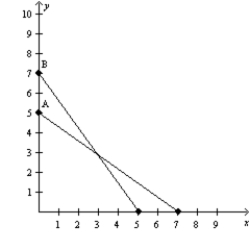 Which of the following could explain the change in the budget line from A to B?
 (Multiple Choice)
4.8/5  (90)
(90) When considering her budget, the highest indifference curve that a consumer can reach is the
(Multiple Choice)
4.8/5 (83)
(83) Scenario 21-4 Frank spends all of his income of $240 per month on shirts and hats. The price of a shirt is $40 and the price of a hat is $30.
-Refer to Scenario 21-4. If Frank uses all of his income to buy hats during a certain month, then how many hats does he buy?
(Short Answer)
4.8/5 (73)
(73) The change in consumption that results when a price change moves the consumer along a given indifference curve to a point illustrating the new marginal rate of substitution is called the
(Multiple Choice)
4.9/5 (77)
(77) Figure 21-8 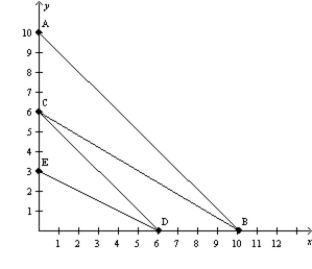 -Refer to Figure 21-8. If the price of good X is $3, and your budget constraint is BC, what is the price of good Y?
 (Multiple Choice)
4.8/5 (82)
(82) Figure 21-1 The downward-sloping line on the figure represents a consumer's budget
constraint. 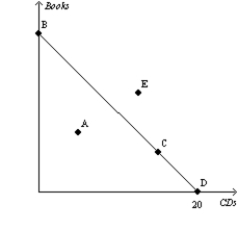 -Refer to Figure 21-1. If the price of a CD is $12, then the consumer's income amounts to
 (Multiple Choice)
4.8/5 (70)
(70) Pepsi and pizza are normal goods. When the price of pizza rises, the substitution effect causes Pepsi to be relatively
(Multiple Choice)
4.7/5 (85)
(85) If Priscilla regards cheese and crackers as perfect complements, then
(Multiple Choice)
4.8/5 (93)
(93) Figure 21-24 The figure shows three indifference curves and a budget constraint for a certain consumer named Steve. 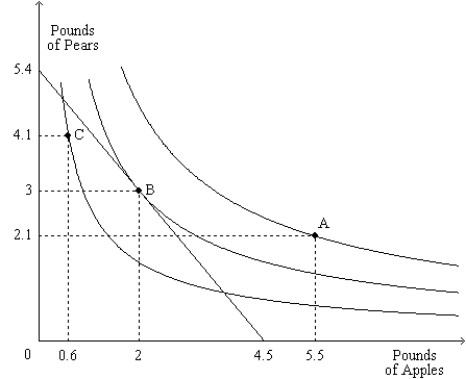 -Refer to Figure 21-24. Suppose the price of pears, the price of apples, and Steve's income remain constant, and Steve moves from point B to point C. In doing so, Steve
 (Multiple Choice)
5.0/5 (95)
(95) Scenario 21-2
Lawrence has recently graduated from college with a degree in journalism and economics. He has decided to pursue a career as a freelance journalist writing for business newspapers and magazines. Lawrence is typically awake for 112 hours each week (he sleeps an average of 8 hours each day). For each hour Lawrence spends writing, he can earn $75. Lawrence is such a good writer that he can get paid for as many hours of writing as he chooses to work.
-Refer to Scenario 21-2. If Lawrence decides to spend 80 hours a week playing volleyball on the beach and the rest of his time writing, how much income will he have available to spend on consumption goods?
(Multiple Choice)
4.9/5 (72)
(72) The indifference curves for perfect substitutes are straight lines.
(True/False)
4.8/5 (81)
(81) Using our model of consumer choice, is it possible for a consumer to buy less of a particular good when his income rises? Briefly explain.
(Essay)
4.8/5 (78)
(78) Thomas faces prices of $6 for a unit of good X and $30 for a unit of good Y. At his optimum, Thomas is willing to give up 1 unit of good Y for __________ units of good X.
(Short Answer)
4.8/5 (79)
(79) Figure 21-31 The figure shows two indifference curves and two budget constraints for a consumer named Kevin. 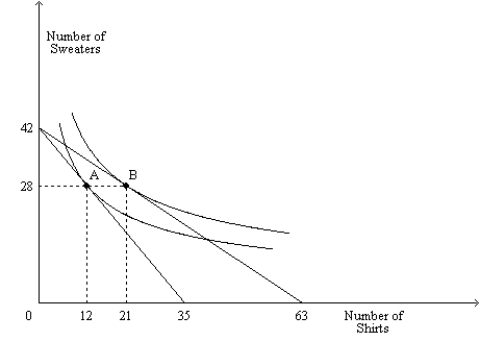 -Refer to Figure 21-31. Suppose Kevin is optimally purchasing 21 shirts and 28 sweaters, and he is spending $1,680 on sweaters. What is the price of a shirt?
 (Essay)
4.9/5 (87)
(87) If we observe that a consumer's budget constraint has shifted inward, we can assume that the consumer will buy
(Multiple Choice)
4.9/5 (89)
(89) When two goods are perfect substitutes, the marginal rate of substitution
(Multiple Choice)
4.9/5 (78)
(78) Jack and Diane each buy pizza and paperback novels. Pizza costs $3 per slice, and paperback novels cost $5 each. Jack has a budget of $30, and Diane has a budget of $15 to spend on pizza and paperback novels. Which consumer(s) can afford to purchase 3 slices of pizza and 4 paperback novels?
(Multiple Choice)
4.7/5 (80)
(80) When Jamar has an income of $2,000, he consumes 30 units of good A and 50 units of good B. After Jamar's income decreases to $1,500, he consumes 33 units of good A and 45 units of good B. Which of the following statements is correct?
(Multiple Choice)
4.9/5 (81)
(81) 
Filters
- Essay(0)
- Multiple Choice(0)
- Short Answer(0)
- True False(0)
- Matching(0)