



 Chat with AI
Exam 21: The Theory of Consumer Choice

Exam 1: Ten Principles of Economics455 Questions
Exam 2: Thinking Like an Economist643 Questions
Exam 3: Interdependence and the Gains From Trade547 Questions
Exam 4: The Market Forces of Supply and Demand693 Questions
Exam 5: Elasticity and Its Application626 Questions
Exam 6: Supply, Demand, and Government Policies668 Questions
Exam 7: Consumers, Producers, and the Efficiency of Markets547 Questions
Exam 8: Applications: the Costs of Taxation509 Questions
Exam 9: Application: International Trade521 Questions
Exam 10: Externalities543 Questions
Exam 11: Public Goods and Common Resources452 Questions
Exam 12: The Design of the Tax System664 Questions
Exam 13: The Costs of Production649 Questions
Exam 14: Firms in Competitive Markets604 Questions
Exam 15: Monopoly662 Questions
Exam 16: Monopolistic Competition649 Questions
Exam 17: Oligopoly522 Questions
Exam 18: The Markets for the Factors of Production592 Questions
Exam 19: Earnings and Discrimination511 Questions
Exam 20: Income Inequality and Poverty478 Questions
Exam 21: The Theory of Consumer Choice570 Questions
Exam 22: Frontiers in Microeconomics461 Questions
Exam 23: Measuring a Nation S Income547 Questions
Exam 24: Measuring the Cost of Living565 Questions
Exam 25: Production and Growth527 Questions
Exam 26: Saving, Investment, and the Financial System637 Questions
Exam 27: Tools of Finance534 Questions
Exam 28: Unemployment and Its Natural Rate701 Questions
Exam 29: The Monetary System540 Questions
Exam 30: Money Growth and Inflation504 Questions
Exam 31: Open-Economy Macroeconomics: Basic Concepts540 Questions
Exam 32: A Macroeconomic Theory of the Open Economy511 Questions
Exam 33: Aggregate Demand and Aggregate Supply572 Questions
Exam 34: The Influence of Monetary and Fiscal Policy on Aggregate Demand523 Questions
Exam 35: The Short-Run Tradeoff Between Inflation and Unemployment536 Questions
Exam 36: Six Debates Over Macroeconomic Policy354 Questions
Select questions type


The bowed shape of the indifference curve reflects the consumer's
(Multiple Choice)
4.7/5  (83)
(83) In the work-leisure model, suppose consumption and leisure are both normal goods. The income effect of a wage increase results in the worker choosing to
(Multiple Choice)
4.9/5 (74)
(74) Suppose that Milton likes to consume one glass of milk with every three chocolate chip cookies. For Milton, an additional cookie has no value unless he can consume it with the appropriate proportion of milk. Milton's indifference curves for milk and cookies are
(Multiple Choice)
5.0/5 (71)
(71) A consumer is currently spending all of her available income on two goods: music CDs and DVDs. At her current consumption bundle, she is spending twice as much on CDs as she is on DVDs. If the consumer has $120 of income and is consuming 10 CDs and 2 DVDs, what is the price of a CD?
(Multiple Choice)
4.8/5 (85)
(85) When a consumer is purchasing the best combination of two goods, X and Y, subject to a budget constraint, we say that the consumer is at an optimal choice point. A graph of an optimal choice point shows that it occurs
(Multiple Choice)
4.9/5 (77)
(77) When economists describe preferences, they often use the concept of
(Multiple Choice)
4.9/5 (86)
(86) Assume that a college student spends her income on mac-n-cheese and CDs. The price of one box of mac-n-cheese is $1, and the price of one CD is $12. If she has $200 of income, she could choose to consume
(Multiple Choice)
4.7/5 (85)
(85) In the upward-sloping portion of the individual labor-supply curve, the substitution effect is
(Multiple Choice)
4.9/5 (82)
(82) Figure 21-20
The following graph illustrates a representative consumer's preferences for marshmallows and chocolate chip cookies: 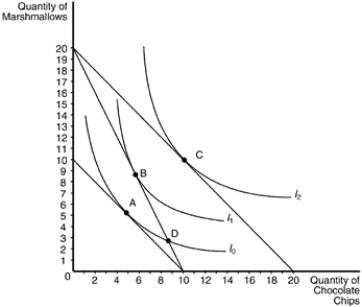 -Refer to Figure 21-20. Assume that the consumer has an income of $40. Based on the information available in the graph, which of the following price-quantity combinations would be on her demand curve for marshmallows if the price of chocolate chips were $4?
 (Multiple Choice)
4.9/5 (88)
(88) When indifference curves are bowed inward, the marginal rate of substitution varies at each point on the indifference curve.
(True/False)
4.8/5 (79)
(79) Which of the following equations corresponds to an optimal choice point?
(i)MRS = PX/PY
(ii)MUX/MUY = PX/PY
(iii)MUX/PX = MUY/PY
(iv)MUX/PY = MUY/PX
(Multiple Choice)
4.8/5 (75)
(75) Scenario 21-3
Scott knows that he will ultimately face retirement. Assume that Scott will experience two periods in his life, one in which he works and earns income, and one in which he is retired and earns no income. Scott can earn $250,000 during his working period and nothing in his retirement period. He must both save and consume in his work period with an interest rate of 10 percent on savings.
-Refer to Scenario 21-3. Assume that Scott decides to consume $100,000 in the work period. How much money will he have available for consumption in his retirement period?
(Multiple Choice)
4.9/5 (76)
(76) A consumer likes two goods: hamburgers and watermelons. The five bundles shown in the table below lie on the same indifference curve for the consumer.
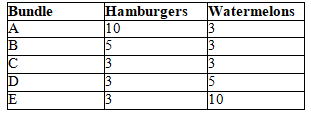 Which of the following statements regarding these bundles is correct?
 (Multiple Choice)
4.7/5 (62)
(62) If Suzette responds to an increase in the interest rate by decreasing her saving, then, for Suzette,
(Multiple Choice)
4.9/5 (74)
(74) Figure 21-25 The figure pertains to a particular consumer. On the axes, X represents the quantity of good X and Y represents the quantity of good Y. 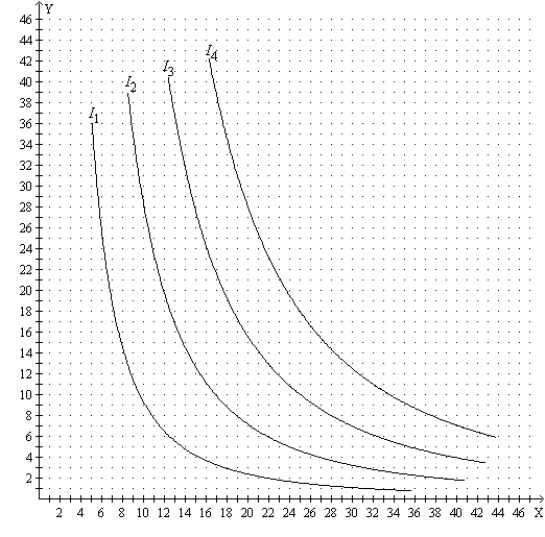 -Refer to Figure 21-25. Suppose the price of good X is $15, the price of good Y is $10, and the consumer's income is $450. Then the consumer's optimal choice is represented by a point on which curve?
 (Multiple Choice)
4.7/5 (69)
(69) 
Filters
- Essay(0)
- Multiple Choice(0)
- Short Answer(0)
- True False(0)
- Matching(0)