



 Chat with AI
Exam 21: The Theory of Consumer Choice

Exam 1: Ten Principles of Economics455 Questions
Exam 2: Thinking Like an Economist643 Questions
Exam 3: Interdependence and the Gains From Trade547 Questions
Exam 4: The Market Forces of Supply and Demand693 Questions
Exam 5: Elasticity and Its Application626 Questions
Exam 6: Supply, Demand, and Government Policies668 Questions
Exam 7: Consumers, Producers, and the Efficiency of Markets547 Questions
Exam 8: Applications: the Costs of Taxation509 Questions
Exam 9: Application: International Trade521 Questions
Exam 10: Externalities543 Questions
Exam 11: Public Goods and Common Resources452 Questions
Exam 12: The Design of the Tax System664 Questions
Exam 13: The Costs of Production649 Questions
Exam 14: Firms in Competitive Markets604 Questions
Exam 15: Monopoly662 Questions
Exam 16: Monopolistic Competition649 Questions
Exam 17: Oligopoly522 Questions
Exam 18: The Markets for the Factors of Production592 Questions
Exam 19: Earnings and Discrimination511 Questions
Exam 20: Income Inequality and Poverty478 Questions
Exam 21: The Theory of Consumer Choice570 Questions
Exam 22: Frontiers in Microeconomics461 Questions
Exam 23: Measuring a Nation S Income547 Questions
Exam 24: Measuring the Cost of Living565 Questions
Exam 25: Production and Growth527 Questions
Exam 26: Saving, Investment, and the Financial System637 Questions
Exam 27: Tools of Finance534 Questions
Exam 28: Unemployment and Its Natural Rate701 Questions
Exam 29: The Monetary System540 Questions
Exam 30: Money Growth and Inflation504 Questions
Exam 31: Open-Economy Macroeconomics: Basic Concepts540 Questions
Exam 32: A Macroeconomic Theory of the Open Economy511 Questions
Exam 33: Aggregate Demand and Aggregate Supply572 Questions
Exam 34: The Influence of Monetary and Fiscal Policy on Aggregate Demand523 Questions
Exam 35: The Short-Run Tradeoff Between Inflation and Unemployment536 Questions
Exam 36: Six Debates Over Macroeconomic Policy354 Questions
Select questions type


Figure 21-17 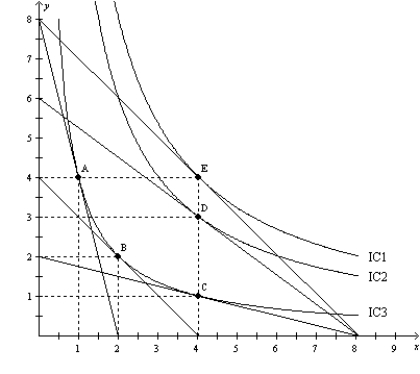 -Refer to Figure 21-17. When the price of X is $6, the price of Y is $24, and income is $48, Paul's optimal choice is point C. Then the price of Y decreases to $6. Paul's new optimal choice is point
 (Multiple Choice)
4.9/5  (90)
(90) Figure 21-10 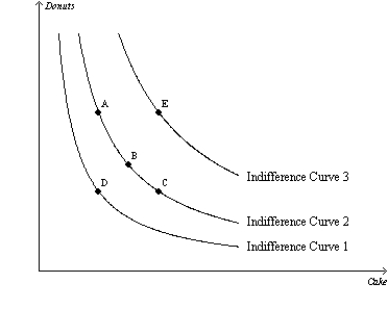 -Refer to Figure 21-10. Which of the following statements is correct?
 (Multiple Choice)
4.8/5 (87)
(87) "Left" gloves and "right" gloves provide a good example of
(Multiple Choice)
4.9/5 (88)
(88) Andi uses all of her income to purchase books and games. At any two points A and B on Andi's budget constraint,
(Multiple Choice)
4.8/5 (76)
(76) If the consumer's income and all prices simultaneously double, then the optimum consumption bundle will
(Multiple Choice)
4.9/5 (77)
(77) Figure 21-10
-Refer to Figure 21-10. When comparing bundle A to bundle E, the consumer
-Refer to Figure 21-10. When comparing bundle A to bundle E, the consumer (Multiple Choice)
4.9/5 (76)
(76) Suppose Alyssa likes oranges twice as much as apples, no matter how many apples or oranges she has. Her indifference curves for oranges and apples
(Multiple Choice)
5.0/5 (66)
(66) An optimizing consumer will select the consumption bundle in which the marginal rate of substitution
(Multiple Choice)
4.8/5 (89)
(89) Figure 21-16 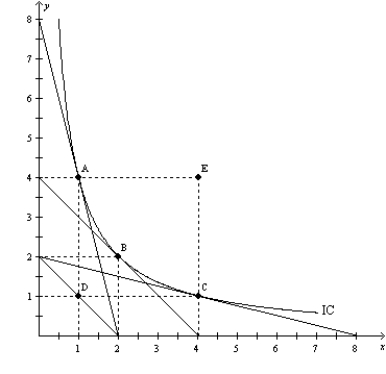 -Refer to Figure 21-16. The price of X is $20, the price of Y is $5, and the consumer's income is $40. Which point represents the consumer's optimal choice?
 (Multiple Choice)
4.8/5 (61)
(61) A set of indifference curves that are only slightly bowed inward represent goods that could best be described as
(Multiple Choice)
4.9/5 (81)
(81) When two goods are perfect complements, the indifference curves are
(Multiple Choice)
4.8/5 (79)
(79) Calvin is planning ahead for retirement and must decide how much to spend and how much to save while he's working in order to have money to spend when he retires. When the substitution effect dominates the income effect, an increase in the interest rate on savings will cause him to
(Multiple Choice)
4.9/5 (69)
(69) Hannah and Chris each like jewelry and music by the Rolling Stones. If we were to graph an indifference curve with jewelry on the horizontal axis and CDs by the Rolling Stones on the vertical axis, then
(Multiple Choice)
4.9/5 (80)
(80) Explain the difference between inferior and normal goods. As a developing economy experiences increases in income (measured by GDP), what would you predict to happen to demand for inferior goods?
(Essay)
4.8/5 (82)
(82) Figure 21-1 The downward-sloping line on the figure represents a consumer's budget
constraint. 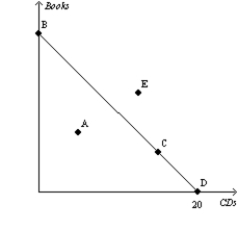 -Refer to Figure 21-1. All of the points identified on the figure represent affordable consumption options with the exception of
 (Multiple Choice)
4.7/5 (67)
(67) When two goods are perfect substitutes, the indifference curve is
(Multiple Choice)
4.9/5 (94)
(94) Which of the following statements is necessarily true regarding a point along a budget line?
(Multiple Choice)
5.0/5 (90)
(90) Figure 21-2 The downward-sloping line on the figure represents a consumer's budget
constraint. 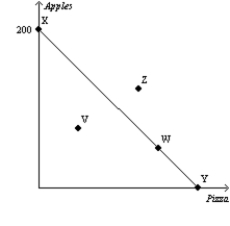 -Refer to Figure 21-2. Which of the following statements is correct?
 (Multiple Choice)
4.9/5 (82)
(82) If Hector's marginal rate of substitution between pens and pencils is constant, regardless of how many pens and pencils he has, then his indifference curves
(Multiple Choice)
4.9/5 (83)
(83) Economic studies of lottery winners and people who have inherited large amounts of money show that
(Multiple Choice)
4.9/5 (75)
(75) 
Filters
- Essay(0)
- Multiple Choice(0)
- Short Answer(0)
- True False(0)
- Matching(0)