



 Chat with AI
Exam 21: The Theory of Consumer Choice

Exam 1: Ten Principles of Economics455 Questions
Exam 2: Thinking Like an Economist643 Questions
Exam 3: Interdependence and the Gains From Trade547 Questions
Exam 4: The Market Forces of Supply and Demand693 Questions
Exam 5: Elasticity and Its Application626 Questions
Exam 6: Supply, Demand, and Government Policies668 Questions
Exam 7: Consumers, Producers, and the Efficiency of Markets547 Questions
Exam 8: Applications: the Costs of Taxation509 Questions
Exam 9: Application: International Trade521 Questions
Exam 10: Externalities543 Questions
Exam 11: Public Goods and Common Resources452 Questions
Exam 12: The Design of the Tax System664 Questions
Exam 13: The Costs of Production649 Questions
Exam 14: Firms in Competitive Markets604 Questions
Exam 15: Monopoly662 Questions
Exam 16: Monopolistic Competition649 Questions
Exam 17: Oligopoly522 Questions
Exam 18: The Markets for the Factors of Production592 Questions
Exam 19: Earnings and Discrimination511 Questions
Exam 20: Income Inequality and Poverty478 Questions
Exam 21: The Theory of Consumer Choice570 Questions
Exam 22: Frontiers in Microeconomics461 Questions
Exam 23: Measuring a Nation S Income547 Questions
Exam 24: Measuring the Cost of Living565 Questions
Exam 25: Production and Growth527 Questions
Exam 26: Saving, Investment, and the Financial System637 Questions
Exam 27: Tools of Finance534 Questions
Exam 28: Unemployment and Its Natural Rate701 Questions
Exam 29: The Monetary System540 Questions
Exam 30: Money Growth and Inflation504 Questions
Exam 31: Open-Economy Macroeconomics: Basic Concepts540 Questions
Exam 32: A Macroeconomic Theory of the Open Economy511 Questions
Exam 33: Aggregate Demand and Aggregate Supply572 Questions
Exam 34: The Influence of Monetary and Fiscal Policy on Aggregate Demand523 Questions
Exam 35: The Short-Run Tradeoff Between Inflation and Unemployment536 Questions
Exam 36: Six Debates Over Macroeconomic Policy354 Questions
Select questions type


Figure 21-16 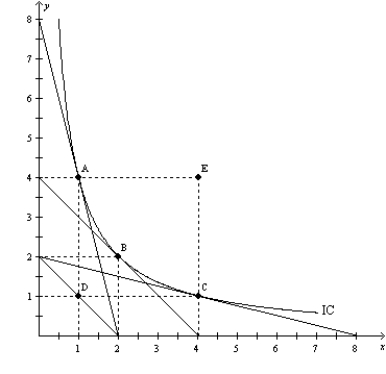 -Refer to Figure 21-16. The price of X is $5, the price of Y is $20, and the consumer's income is $40. Which point represents the consumer's optimal choice?
 (Multiple Choice)
4.7/5  (93)
(93) The slope at any point on an indifference curve equals the absolute price at which a consumer is willing to substitute one good for the other.
(True/False)
4.9/5 (91)
(91) The following diagram shows two budget lines: A and B. 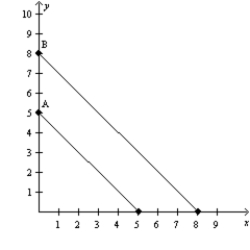 Which of the following could explain the change in the budget line from A to B?
 (Multiple Choice)
4.7/5 (83)
(83) Figure 21-8 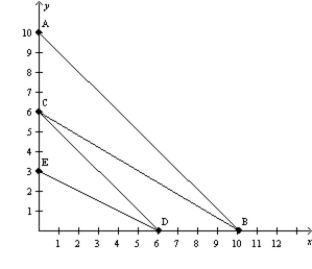 -Refer to Figure 21-8. You have $300 to spend on good X and good Y. If good X costs $30 and good Y costs $50, your budget constraint is
 (Multiple Choice)
4.8/5 (77)
(77) Figure 21-24 The figure shows three indifference curves and a budget constraint for a certain consumer named Steve. 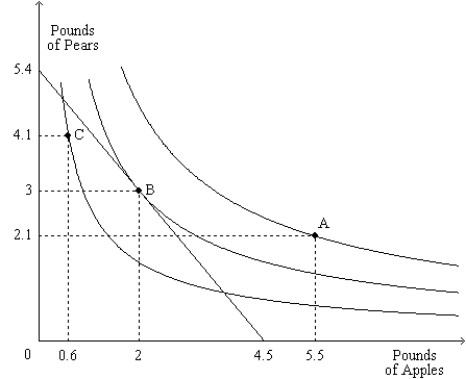 -Refer to Figure 21-24. Which of the following pairs of prices matches the appearance of the budget constraint?
 (Multiple Choice)
4.8/5 (88)
(88) Gerald spends his weekly income on gin and cocktail olives. The price of gin has risen from $7 to $9 per bottle, the price of cocktail olives has fallen from $6 to $5 per jar, and Gerald's income has stayed fixed at $46 per week. Since the price changes, Gerald has been buying 4 bottles of gin and 2 jars of cocktail olives per week. At the original prices, 4 bottles of gin and 2 jars of cocktail olives would have
(Multiple Choice)
4.8/5 (82)
(82) Preston goes to the movies every Sunday afternoon. The movie theater offers 4 combinations of popcorn and beverages: the "mini-combo" costs $5 and includes a small popcorn and a small drink, the "medium-combo" costs $7 and includes a medium popcorn and a medium drink, the "value-combo" also costs $7 and includes a small popcorn and a large drink, and the "large-combo" costs $9 and includes a large popcorn and a large drink. Preston always purchases the "value-combo." We can conclude that
(Multiple Choice)
4.7/5 (80)
(80) Clark enjoys fishing and hunting. He divides his leisure hours between the two outdoor activities. Suppose we were to draw Clark's indifference curves for the two activities, placing fishing on the horizontal axis and hunting on the vertical axis. If Clark's indifference curves are bowed inward, then
(Multiple Choice)
4.9/5 (80)
(80) When a consumer experiences a price decrease for an inferior good, if the income effect is
(Multiple Choice)
4.8/5 (77)
(77) Assume that a college student purchases only Ramen noodles and textbooks. If Ramen noodles are an inferior good and textbooks are a normal good, then the income effect associated with a decrease in the price of a textbook will result in
(Multiple Choice)
4.8/5 (78)
(78) Indifference curves tend to be bowed inward because of diminishing
(Multiple Choice)
4.9/5 (71)
(71) Goods x and y are available to Jeff. At Jeff's optimum, the marginal utility per dollar spent on good x equals __________________.
(Essay)
4.8/5 (90)
(90) When indifference curves are downward sloping, the marginal rate of substitution is usually constant.
(True/False)
4.8/5 (90)
(90) Suppose good X is on the horizontal axis, good Y is on the vertical axis, and the slope of an individual's budget line is -2. Which of the following is true?
(Multiple Choice)
4.7/5 (88)
(88) The indifference curves for perfect substitutes are right angles.
(True/False)
4.8/5 (73)
(73) An optimizing consumer will select the consumption bundle in which the
(Multiple Choice)
4.8/5 (70)
(70) 
Filters
- Essay(0)
- Multiple Choice(0)
- Short Answer(0)
- True False(0)
- Matching(0)