



 Chat with AI
Exam 16: Monopolistic Competition

Exam 1: Ten Principles of Economics455 Questions
Exam 2: Thinking Like an Economist643 Questions
Exam 3: Interdependence and the Gains From Trade547 Questions
Exam 4: The Market Forces of Supply and Demand693 Questions
Exam 5: Elasticity and Its Application626 Questions
Exam 6: Supply, Demand, and Government Policies668 Questions
Exam 7: Consumers, Producers, and the Efficiency of Markets547 Questions
Exam 8: Applications: the Costs of Taxation509 Questions
Exam 9: Application: International Trade521 Questions
Exam 10: Externalities543 Questions
Exam 11: Public Goods and Common Resources452 Questions
Exam 12: The Design of the Tax System664 Questions
Exam 13: The Costs of Production649 Questions
Exam 14: Firms in Competitive Markets604 Questions
Exam 15: Monopoly662 Questions
Exam 16: Monopolistic Competition649 Questions
Exam 17: Oligopoly522 Questions
Exam 18: The Markets for the Factors of Production592 Questions
Exam 19: Earnings and Discrimination511 Questions
Exam 20: Income Inequality and Poverty478 Questions
Exam 21: The Theory of Consumer Choice570 Questions
Exam 22: Frontiers in Microeconomics461 Questions
Exam 23: Measuring a Nation S Income547 Questions
Exam 24: Measuring the Cost of Living565 Questions
Exam 25: Production and Growth527 Questions
Exam 26: Saving, Investment, and the Financial System637 Questions
Exam 27: Tools of Finance534 Questions
Exam 28: Unemployment and Its Natural Rate701 Questions
Exam 29: The Monetary System540 Questions
Exam 30: Money Growth and Inflation504 Questions
Exam 31: Open-Economy Macroeconomics: Basic Concepts540 Questions
Exam 32: A Macroeconomic Theory of the Open Economy511 Questions
Exam 33: Aggregate Demand and Aggregate Supply572 Questions
Exam 34: The Influence of Monetary and Fiscal Policy on Aggregate Demand523 Questions
Exam 35: The Short-Run Tradeoff Between Inflation and Unemployment536 Questions
Exam 36: Six Debates Over Macroeconomic Policy354 Questions
Select questions type


Figure 16-14 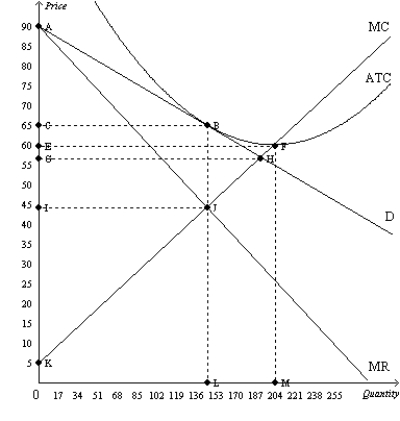 -Refer to Figure 16-14. Which letter identifies the efficient level of output for this firm?
Free
(Short Answer)
4.8/5  (83)
(83) Correct Answer: Verified
M
When a new firm considers entering a market, it takes into account only the profit it would make. What are the two external effects that occur in the market that the firm does not consider?
Free
(Essay)
4.9/5 (75)
(75) Correct Answer:Verified
Verifiedproduct-variety externality
business-stealing externality
Table 16-7
A monopolistically competitive firm faces the following demand schedule for its product. In addition, the firm has total fixed costs equal to 20.  -Refer to Table 16-7. If this firm profit maximizes and faces a constant marginal cost of $7, does it have excess capacity? How do you know?
Free
(Short Answer)
4.7/5 (80)
(80) Correct Answer:Verified
VerifiedYes, average total cost is not minimized.
Which of the following is not an example of Joel Waldfogel's "Tyranny of the Market"?
(Multiple Choice)
4.9/5 (77)
(77) The government of Italy will not allow any Hard Rock Cafe restaurants to open in Italy. Defenders of the efficiency of brand-name markets would argue that this has hindered restaurant market efficiency in Italy.
(True/False)
4.9/5 (79)
(79) Figure 16-3
This figure depicts a situation in a monopolistically competitive market. 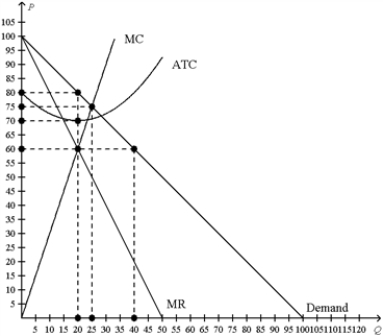 -Refer to Figure 16-3. How much output will the monopolistically competitive firm produce in this situation?
 (Multiple Choice)
4.8/5 (82)
(82) The product-variety externality arises in monopolistically competitive markets because
(Multiple Choice)
4.9/5 (84)
(84) The debate over the efficiency of markets in which products with brand names are sold
(Multiple Choice)
4.8/5 (86)
(86) Scenario 16-5
McDonald's restaurants has recently announced intentions to open a new restaurant in Smalltown, Indiana. Assume that the fast-food restaurant market in Smalltown is characterized by monopolistic competition.
-Refer to Scenario 16-5. As a result of the new McDonald's, residents of Smalltown are likely to benefit from
(Multiple Choice)
4.8/5 (71)
(71) Figure 16-9
The figure is drawn for a monopolistically-competitive firm. 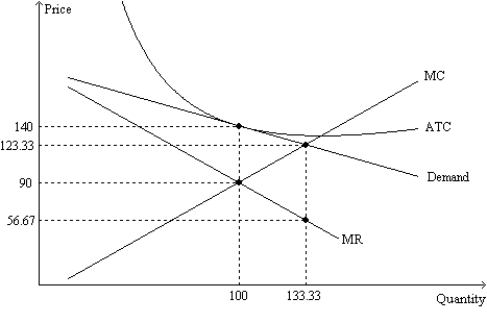 -Refer to Figure 16-9. The firm's maximum profit is
 (Multiple Choice)
4.9/5 (87)
(87) Figure 16-6 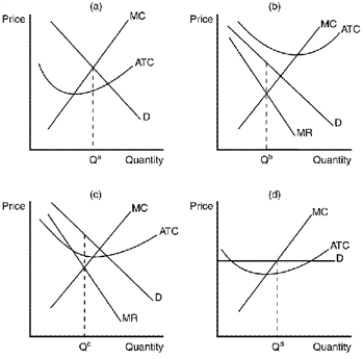 -Refer to Figure 16-6. Which of the graphs shown would be consistent with a profit maximizing firm in a monopolistically competitive market that is earning a positive profit?
 (Multiple Choice)
4.8/5 (82)
(82) A firm in a monopolistically competitive market is similar to a monopoly in the sense that
(i)they both face downward-sloping demand curves.
(ii)they both charge a price that exceeds marginal cost.
(iii)free entry and exit determines the long-run equilibrium.
(Multiple Choice)
4.8/5 (76)
(76) Consider two industries in which firms hold the following market shares:
Industry A: 25%, 20%, 18%, 15%, 8%, 7%, 4%, 2%, 1%
Industry B: 30%, 10%, 9%, 8%, 8%, 8%, 8%, 6%, 6%, 5%, 2%
What are the concentration ratios for each industry? Which is more competitive?
(Short Answer)
4.8/5 (77)
(77) Defenders of advertising argue that firms use advertising as a signal of quality, even if the advertising delivers little helpful information about the product.
(True/False)
4.9/5 (82)
(82) Firms that sell highly differentiated consumer goods, such as over-the-counter drugs, soft drinks, breakfast cereals, and dog food, typically spend between 10 and 20 percent of revenue for
(Short Answer)
4.9/5 (80)
(80) Which of the following best describes the idea of excess capacity in monopolistic competition?
(Multiple Choice)
4.7/5 (84)
(84) Which type of market structure has the fewest number of firms?
(Short Answer)
4.8/5 (89)
(89) Scenario 16-2
Suppose market demand for a product is given by the equation P = 20 - Q. For this market demand curve, marginal revenue is MR = 20 - 2Q.
-Refer to Scenario 16-2. If the marginal cost of producing this good is 0, what quantity would a profit-maximizing monopolist produce?
(Multiple Choice)
4.8/5 (84)
(84) Table 16-4
This table shows the demand schedule, marginal cost, and average total cost for a monopolistically competitive firm. 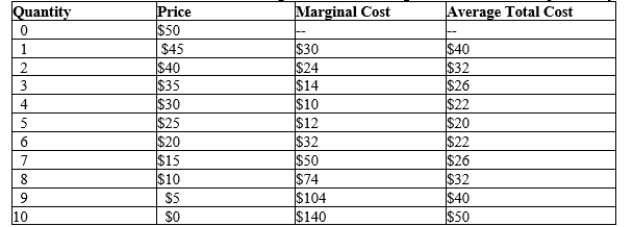 -Refer to Table 16-4. If the government forces this firm to produce at its efficient output level, how much output will this firm produce?
 (Multiple Choice)
4.8/5 (79)
(79) In the long run, a firm in a perfectly competitive market operates
(Multiple Choice)
4.7/5 (86)
(86) 
Filters
- Essay(0)
- Multiple Choice(0)
- Short Answer(0)
- True False(0)
- Matching(0)