



 Chat with AI
Exam 16: Monopolistic Competition

Exam 1: Ten Principles of Economics455 Questions
Exam 2: Thinking Like an Economist643 Questions
Exam 3: Interdependence and the Gains From Trade547 Questions
Exam 4: The Market Forces of Supply and Demand693 Questions
Exam 5: Elasticity and Its Application626 Questions
Exam 6: Supply, Demand, and Government Policies668 Questions
Exam 7: Consumers, Producers, and the Efficiency of Markets547 Questions
Exam 8: Applications: the Costs of Taxation509 Questions
Exam 9: Application: International Trade521 Questions
Exam 10: Externalities543 Questions
Exam 11: Public Goods and Common Resources452 Questions
Exam 12: The Design of the Tax System664 Questions
Exam 13: The Costs of Production649 Questions
Exam 14: Firms in Competitive Markets604 Questions
Exam 15: Monopoly662 Questions
Exam 16: Monopolistic Competition649 Questions
Exam 17: Oligopoly522 Questions
Exam 18: The Markets for the Factors of Production592 Questions
Exam 19: Earnings and Discrimination511 Questions
Exam 20: Income Inequality and Poverty478 Questions
Exam 21: The Theory of Consumer Choice570 Questions
Exam 22: Frontiers in Microeconomics461 Questions
Exam 23: Measuring a Nation S Income547 Questions
Exam 24: Measuring the Cost of Living565 Questions
Exam 25: Production and Growth527 Questions
Exam 26: Saving, Investment, and the Financial System637 Questions
Exam 27: Tools of Finance534 Questions
Exam 28: Unemployment and Its Natural Rate701 Questions
Exam 29: The Monetary System540 Questions
Exam 30: Money Growth and Inflation504 Questions
Exam 31: Open-Economy Macroeconomics: Basic Concepts540 Questions
Exam 32: A Macroeconomic Theory of the Open Economy511 Questions
Exam 33: Aggregate Demand and Aggregate Supply572 Questions
Exam 34: The Influence of Monetary and Fiscal Policy on Aggregate Demand523 Questions
Exam 35: The Short-Run Tradeoff Between Inflation and Unemployment536 Questions
Exam 36: Six Debates Over Macroeconomic Policy354 Questions
Select questions type


Figure 16-2. The figure is drawn for a monopolistically competitive firm. 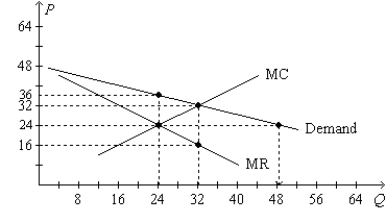 -Refer to Figure 16-2. Suppose that average total cost is $36 when Q=24. What is the profit-maximizing price and resulting profit?
 (Multiple Choice)
4.7/5  (75)
(75) Figure 16-11 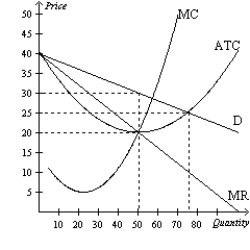 -Refer to Figure 16-11. If this firm profit-maximizes, how much profit or loss will it earn?
 (Short Answer)
4.8/5 (80)
(80) When a new firm considers entering a market, it takes into account only the profit it would make. What are the two external effects that occur in the market that the firm does not consider?
(Essay)
4.9/5 (79)
(79) A profit-maximizing firm in a monopolistically competitive market is characterized by which of the following?
(Multiple Choice)
4.8/5 (86)
(86) The debate over whether advertising serves a valuable purpose in society is definitively answered by economists who study the tastes and preferences of individuals.
(True/False)
4.8/5 (85)
(85) Figure 16-14 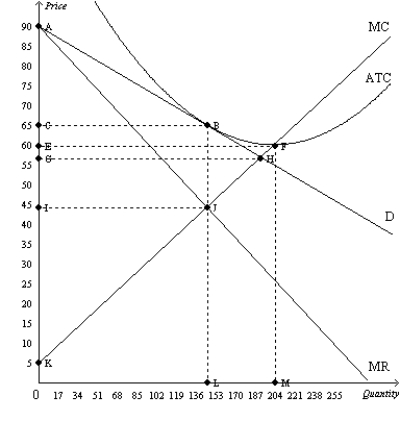 -Refer to Figure 16-14. Which of the following best describes the profit-maximizing outcome for the firm depicted here?
 (Multiple Choice)
4.9/5 (69)
(69) Which of the following conditions is characteristic of a monopolistically competitive firm in long-run equilibrium?
(Multiple Choice)
4.8/5 (79)
(79) Which of the following is a commonly-cited benefit of advertising?
(Multiple Choice)
4.8/5 (83)
(83) Figure 16-10
The figure is drawn for a monopolistically-competitive firm. 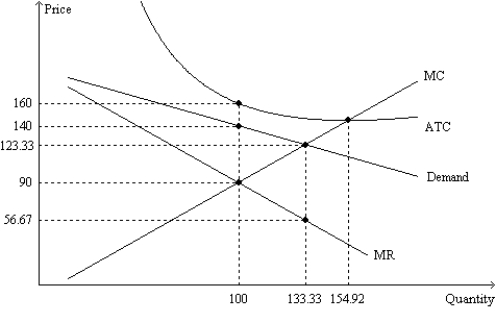 -Refer to Figure 16-10. In order to maximize its profit, the firm will choose to produce
 (Multiple Choice)
4.8/5 (86)
(86) The market structure in which each firm has a monopoly over the product it makes, but many other firms make similar products that compete for the same customers is called
(Short Answer)
4.9/5 (84)
(84) When firms in a monopolistically competitive market engage in price-related advertising, defenders of advertising argue that
(Multiple Choice)
4.9/5 (86)
(86) Adibok knows that it produces and sells high quality athletic shoes. Wurkout knows that it produces and sells low quality athletic shoes. According to the signaling theory of advertising,
(Multiple Choice)
4.9/5 (86)
(86) Which of the following pairs illustrates the two extreme examples of market structures?
(Multiple Choice)
4.8/5 (81)
(81) Which of the following goods is most likely to be associated with monopolistic competition?
(Multiple Choice)
4.9/5 (69)
(69) Scenario 16-3
Peter operates an ice cream shop in the center of Fairfield. He sells several unusual flavors of organic, homemade ice cream so he has a monopoly over his own ice cream, though he competes with many other firms selling ice cream in Fairfield for the same customers. Peter's demand and cost values for sales per day are given in the table below. (Everyone who purchases Peter's ice cream buys a double scoop cone because it's so delicious.) 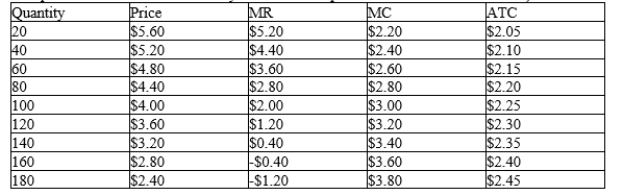 -Refer to Scenario 16-3. How many ice cream cones should Peter sell in one day to maximize his profits?
 (Short Answer)
4.9/5 (77)
(77) A profit-maximizing firm in a monopolistically competitive market differs from a firm in a perfectly competitive market because the firm in the monopolistically competitive market
(Multiple Choice)
4.7/5 (62)
(62) Figure 16-11 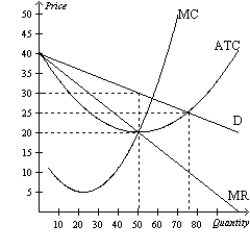 -Refer to Figure 16-11. If this firm profit-maximizes, how much revenue will it earn?
 (Short Answer)
4.8/5 (74)
(74) Figure 16-9
The figure is drawn for a monopolistically-competitive firm. 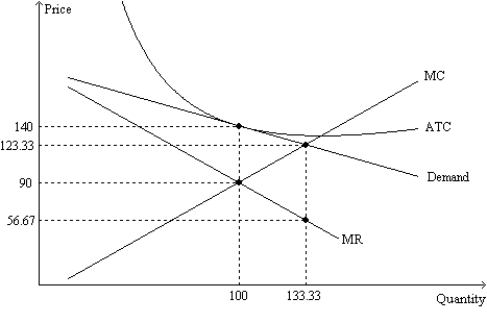 -Refer to Figure 16-9. Efficient scale is reached
 (Multiple Choice)
4.8/5 (70)
(70) Figure 16-11 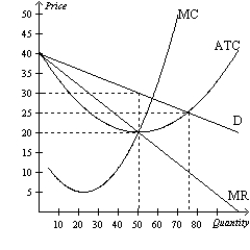 -Refer to Figure 16-11. The profit for this firm is
 (Multiple Choice)
4.8/5 (76)
(76) 
Filters
- Essay(0)
- Multiple Choice(0)
- Short Answer(0)
- True False(0)
- Matching(0)