



 Chat with AI
Exam 16: Monopolistic Competition

Exam 1: Ten Principles of Economics455 Questions
Exam 2: Thinking Like an Economist643 Questions
Exam 3: Interdependence and the Gains From Trade547 Questions
Exam 4: The Market Forces of Supply and Demand693 Questions
Exam 5: Elasticity and Its Application626 Questions
Exam 6: Supply, Demand, and Government Policies668 Questions
Exam 7: Consumers, Producers, and the Efficiency of Markets547 Questions
Exam 8: Applications: the Costs of Taxation509 Questions
Exam 9: Application: International Trade521 Questions
Exam 10: Externalities543 Questions
Exam 11: Public Goods and Common Resources452 Questions
Exam 12: The Design of the Tax System664 Questions
Exam 13: The Costs of Production649 Questions
Exam 14: Firms in Competitive Markets604 Questions
Exam 15: Monopoly662 Questions
Exam 16: Monopolistic Competition649 Questions
Exam 17: Oligopoly522 Questions
Exam 18: The Markets for the Factors of Production592 Questions
Exam 19: Earnings and Discrimination511 Questions
Exam 20: Income Inequality and Poverty478 Questions
Exam 21: The Theory of Consumer Choice570 Questions
Exam 22: Frontiers in Microeconomics461 Questions
Exam 23: Measuring a Nation S Income547 Questions
Exam 24: Measuring the Cost of Living565 Questions
Exam 25: Production and Growth527 Questions
Exam 26: Saving, Investment, and the Financial System637 Questions
Exam 27: Tools of Finance534 Questions
Exam 28: Unemployment and Its Natural Rate701 Questions
Exam 29: The Monetary System540 Questions
Exam 30: Money Growth and Inflation504 Questions
Exam 31: Open-Economy Macroeconomics: Basic Concepts540 Questions
Exam 32: A Macroeconomic Theory of the Open Economy511 Questions
Exam 33: Aggregate Demand and Aggregate Supply572 Questions
Exam 34: The Influence of Monetary and Fiscal Policy on Aggregate Demand523 Questions
Exam 35: The Short-Run Tradeoff Between Inflation and Unemployment536 Questions
Exam 36: Six Debates Over Macroeconomic Policy354 Questions
Select questions type


Firms that spend the greatest percentage of their revenue on advertising tend to be firms that sell
(Multiple Choice)
4.8/5  (75)
(75) Among the following situations, which one is least likely to apply to a monopolistically competitive firm?
(Multiple Choice)
4.8/5 (89)
(89) Figure 16-10
The figure is drawn for a monopolistically-competitive firm. 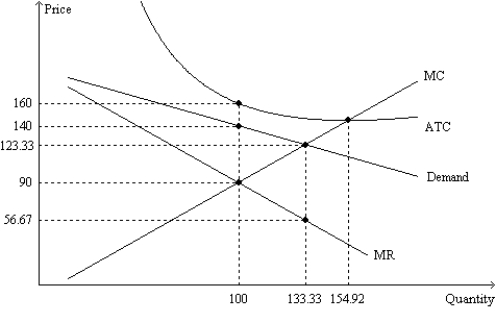 -Refer to Figure 16-10. In order to maximize its profit, the firm will choose to produce
 (Multiple Choice)
4.7/5 (81)
(81) In monopolistically competitive markets, positive economic profits
(Multiple Choice)
4.9/5 (84)
(84) Advertisements that appear to convey no information at all
(Multiple Choice)
4.9/5 (83)
(83) If regulators required firms in monopolistically competitive markets to set price equal to marginal cost,
(Multiple Choice)
4.9/5 (93)
(93) Your company has recently requested that you travel to Dhaka, Bangladesh, to work on negotiations for a new factory to be located in one of the port cities. Your travel agent provides a list of several hundred local hotels and a Sheraton. In this case, the Sheraton brand-name is likely to be used as a signal of
(Multiple Choice)
4.9/5 (91)
(91) Table 16-2
The following table shows the total output produced by the top six firms as well as the total industry output for each industry. 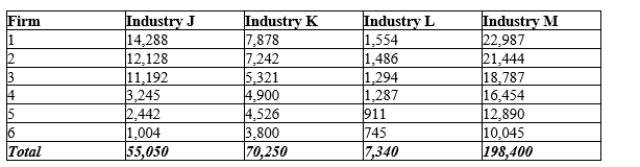 -Refer to Table 16-2. What is the concentration ratio for Industry J?
 (Multiple Choice)
4.8/5 (82)
(82) Considering perfect competition, monopolistic competition, and monopoly, which of the market structures can have positive profits in the short run?
(Essay)
4.7/5 (68)
(68) The Mikati Philippines Hard Rock Cafe has the exact same menu as the Hard Rock Cafe in New York. This is an example of a brand name enhancing market efficiency for U.S. tourists visiting the Philippines.
(True/False)
4.7/5 (78)
(78) Firms that sell highly differentiated consumer goods, such as over-the-counter drugs, soft drinks, breakfast cereals, and dog food, typically spend between 10 and 20 percent of revenue for
(Short Answer)
4.8/5 (91)
(91) A monopolistically competitive firm is currently earning a positive economic profit. If other firms enter the market, we would expect that the added competition will cause this firm to adjust its output such that it
(Multiple Choice)
4.9/5 (70)
(70) Figure 16-4 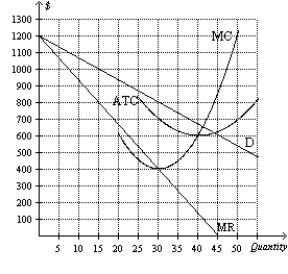 -Refer to Figure 16-4. What price will the monopolistically competitive firm charge in this market?
 (Multiple Choice)
4.9/5 (75)
(75) The business-stealing externality states that entry of a new firms imposes a cost on existing firms because they lose customers.
(True/False)
4.8/5 (85)
(85) The breakfast cereal industry, with its concentration ratio of 80%, would best be described as a(n)
(Multiple Choice)
5.0/5 (80)
(80) Scenario 16-3
Peter operates an ice cream shop in the center of Fairfield. He sells several unusual flavors of organic, homemade ice cream so he has a monopoly over his own ice cream, though he competes with many other firms selling ice cream in Fairfield for the same customers. Peter's demand and cost values for sales per day are given in the table below. (Everyone who purchases Peter's ice cream buys a double scoop cone because it's so delicious.) 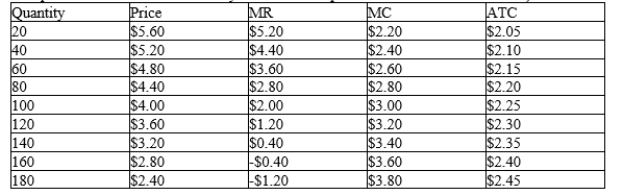 -Refer to Scenario 16-3. What is the maximum amount of profit that Peter can earn per day?
 (Short Answer)
4.8/5 (80)
(80) In monopolistically competitive markets, free entry and exit suggests that
(Multiple Choice)
4.8/5 (91)
(91) Scenario 16-3
Peter operates an ice cream shop in the center of Fairfield. He sells several unusual flavors of organic, homemade ice cream so he has a monopoly over his own ice cream, though he competes with many other firms selling ice cream in Fairfield for the same customers. Peter's demand and cost values for sales per day are given in the table below. (Everyone who purchases Peter's ice cream buys a double scoop cone because it's so delicious.) 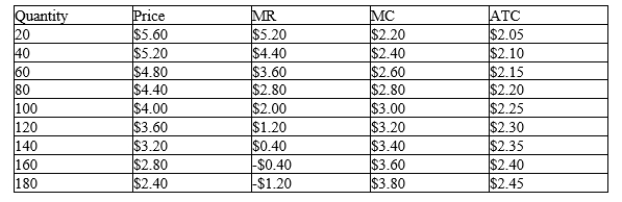 -Refer to Scenario 16-3. How many double scoop ice cream cones should Peter sell per day to maximize his profit?
 (Multiple Choice)
5.0/5 (70)
(70) Scenario 16-4
Delish, a moderately priced restaurant, has recently announced intentions to open a restaurant in Boston, MA. Assume that the restaurant market in Boston is characterized by monopolistic competition.
-Refer to Scenario 16-4. As a result of the new restaurant, existing restauranteurs in Boston are likely to experience a
(Multiple Choice)
4.9/5 (89)
(89) A new Mexican restaurant opens in the city of Manchester. The other restaurant owners are not happy about this new restaurant because they are experiencing what externality?
(Short Answer)
4.9/5 (58)
(58) 
Filters
- Essay(0)
- Multiple Choice(0)
- Short Answer(0)
- True False(0)
- Matching(0)